
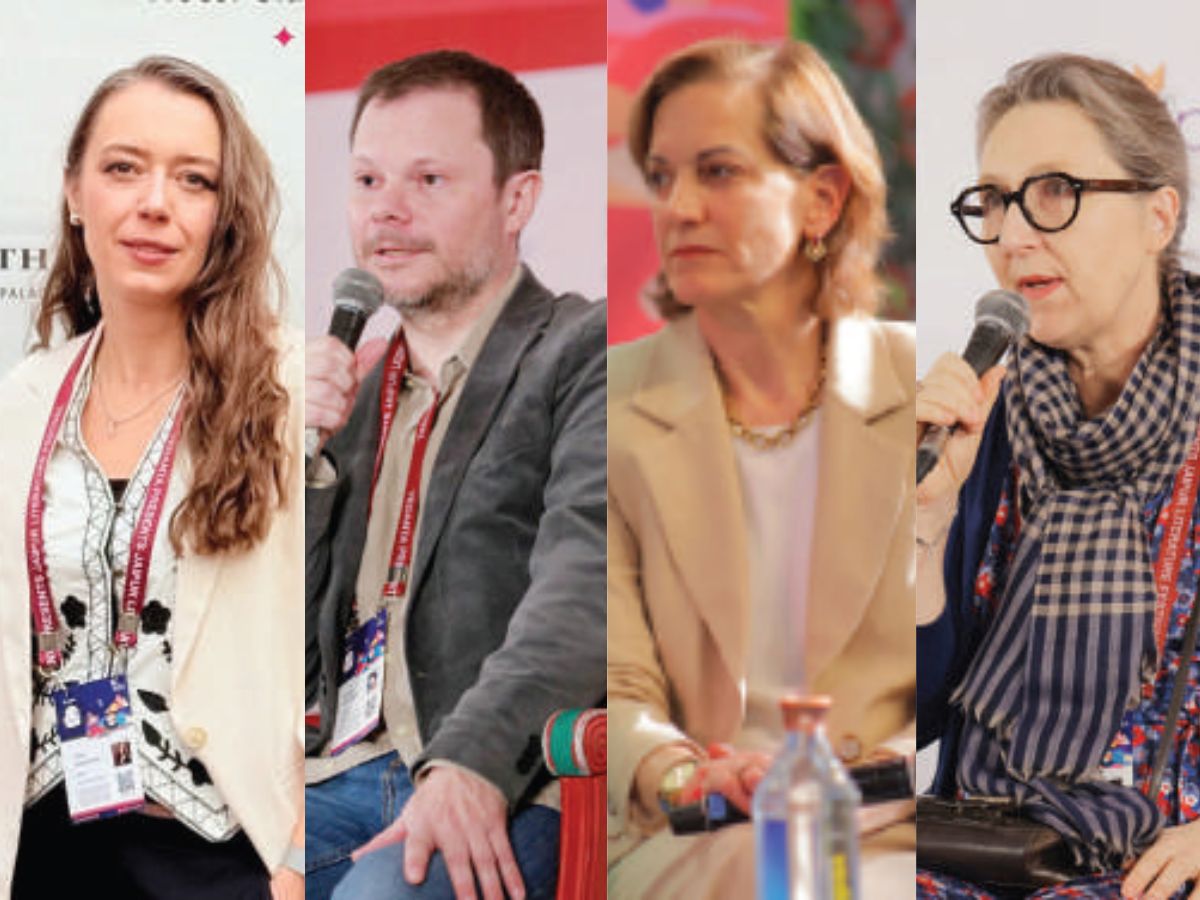
This year again, at the Jaipur Literature Festival, several European authors of note made their presence felt, showcasing the rich diversity of European literature and its unique culture. The ongoing war in Ukraine drew bulk of the attention with the Austrian author Andreas Unterweger and the Ukranian author Yuliya Musakovska engaging in three memorable sessions over three evenings at the Jaipur Litfest 2026. Literature emerged as a shared space where borders softened and languages leaned toward one another.
The Austrian–Ukrainian literary programme unfolded as a reflective meditation on belonging, displacement, and resilience, positioning writing not as escape, but as a vital record of lived history and moral attention in unsettled times. Rather than treating literature as ornament, the sessions insisted on its urgency—as a form that bears witness, resists erasure, and quietly imagines futures beyond the violence of the present. Questions of geography, memory, and language threaded through the programme, revealing how writers continue to negotiate identity in fractured worlds.
The opening conversation examined belonging not as inheritance, but as a condition shaped by movement, loss, and longing. Reflecting on the experience of being in India, Andreas noted the simultaneity of time and contradiction that defines both place and writing. “When you travel to India, you travel into the past and the future at the same time,” he said. “Thousands of years old traditions stand side by side with science fiction… forming an unlikely whole.” He spoke of how European histories—marked by war, silence, and the resurgence of extremist politics—continue to inform contemporary literary concerns, even when the landscape shifts. “Anti-fascism, humanity and an indestructible sense of humour are the invisible threads that connect us across all differences,” he observed.
The second evening turned to poetry as an emotional and ethical register, capable of holding grief and defiance within the same breath. Yulia’s readings, shaped by the realities of war, resonated through restraint rather than spectacle. She spoke of the dissonance of travelling from a frozen, bombarded homeland to India’s warmth, calling it “almost surreal,” yet profoundly necessary. “It felt profoundly important that the Ukrainian literary voice finally be present on such a major international platform,” she said, at a moment when war continues to define everyday life.
Presented by the Austrian Cultural Forum New Delhi and the Ukrainian Embassy New Delhi under the framework of Austrian–Ukrainian Cultural Cooperation, the programme concluded with a conversation on poetry and translation, exploring how words travel across languages without losing their moral weight. Translation emerged not as equivalence, but as trust—an act of carrying meaning with care. Yulia reflected on poetry’s enduring role: it becomes “a space for truth-telling and for celebrating human unity, resistance, and resilience in the face of aggression.”
Pulitzer Prize-winning American-Polish historian and author Anne Applebaum’s JLF 2026 sessions offered a bracing, unsentimental look at the arc of modern geopolitics, cutting through the anxiety that democracy is on an irreversible decline. Speaking exclusively to The Sunday Guardian, Applebaum stressed that political trajectories are never fixed. “There’s no such thing as an iron rule that says we go in one direction or another,” she said, arguing that neither the fall nor the rise of democracy is automatic. “Everything that happens tomorrow depends on what people do today.” She noted that her recent book now needs rethinking in light of political shifts in the United States. “How do the changes in the U.S. affect the autocratic world? How do they affect the democratic world?” she asked, framing a future where global responses, not inevitabilities, will shape what comes next.
Award-winning French writer Marie Darrieussecq’s conversations at JLF 2026 revealed a writer deeply engaged with questions of visibility, the body, and women’s lived realities. Speaking about her sessions, she reflected on her novel about the painter Paula Modersohn-Becker, calling her “like my sister — this unknown, formerly unknown German painter… who died giving childbirth at 31 but with a very big, amazing work.” Darrieussecq noted that she had not initially realised she was part of a larger feminist movement, adding, “I wrote it without being aware myself that I was part of a movement of de-invisibilizing women painters.”
Revisiting her debut novel ‘Pig Tales,’ she was candid about its origins. “I wrote this book out of rage,” she said, recalling experiences of street harassment. “I was suddenly seen as a piece of meat… and I wrote a fable of metamorphosis — you see me as a pig, I will show you what kind of pig I am.” She observed that the book’s themes remain disturbingly relevant: “Alas, the book has not gotten old.”
On writing advice, Darrieussecq urged young writers to trust their own lives. “There’s no place that is really boring. It depends how you see it and what you make of it,” she said, emphasising that literature begins with belief in one’s own experience.
Austrian author Valerie Fritsch, who has been awarded the Prix du Livre Autrichien FRANCE 2025 for her novel ‘Lemon,’ also visited the Jaipur Litfest 2026, taking a break from her sessions at the New Delhi World Book Fair. Fritsch explored the city, adding with delight, “I loved discovering Jaipur with all its contrasts — and its lovely monkeys,” including a visit to the iconic Monkey Temple.




