
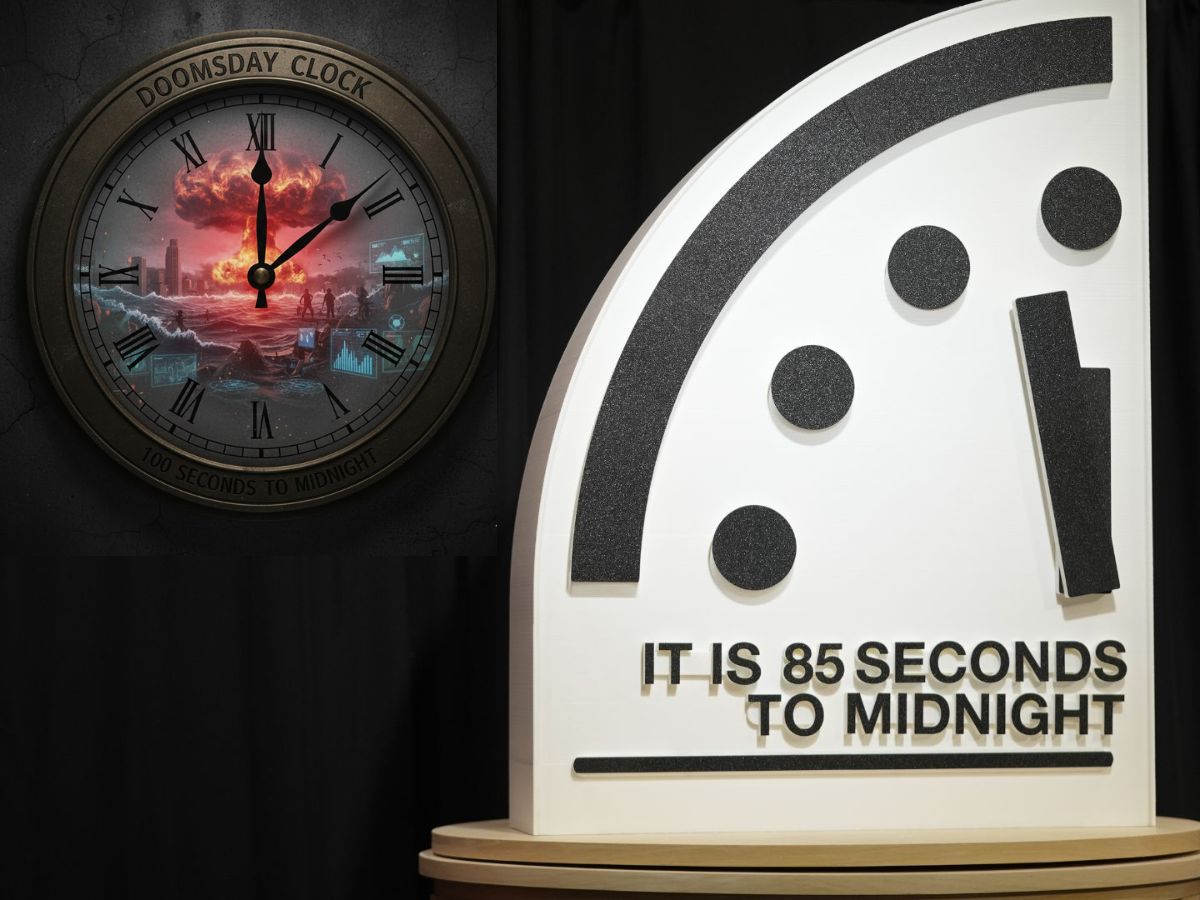
In a quiet announcement that echoes like an alarm, a panel of the world’s leading scientists today delivered a sobering verdict on the state of our planet: humanity is now a mere 85 symbolic seconds from global catastrophe. The Doomsday Clock, a haunting metaphor born from the ashes of World War II, was moved four seconds closer to midnight—the closest it has ever been—painting a portrait of a world where old dangers have mutated and new ones have emerged, all accelerated by a retreat into nationalism and distrust.
What Is the Doomsday Clock?
Beyond being a symbol, the Doomsday Clock serves as a global indicator of human-made existential danger. Introduced in 1947 by scientists linked to the first atomic bomb, it shows how near humanity is to destroying itself through technology, with “midnight” symbolizing worldwide catastrophe.
Purpose & Governance: This is not a forecast, but a blunt warning and urgent call to act. The time is fixed annually by the Bulletin of the Atomic Scientists’ Science and Security Board, in talks with experts, including Nobel laureates globally today.
Evolving Threats: Though it began with nuclear fears, the Clock now measures a range of modern threats, including renewed nuclear conflict, the growing climate change crisis, and the unchecked dangers posed by disruptive technologies such as AI and bioengineering.
A Timeline of Tension: The Clock’s hands have swung widely, reflecting the state of global cooperation. Their safest point was 17 minutes to midnight in 1991 after the Cold War’s end. The recent, alarming shift into “seconds to midnight” underscores a rapid decline in global stability.
What Just Pushed the Clock Forward?
This year’s annual adjustment, developed with input from Nobel laureates and global security experts, signals a convergence of contemporary crises. The collapse of nuclear arms agreements between the U.S. and Russia raises the prospect of a new arms race. Conflicts involving nuclear-armed states and rising geopolitical tensions intensify the risk. Danger is increased by the world’s slow and disjointed reaction to climate change. In particular, the Bulletin pointed out that political reversals on climate and clean energy agreements are making the world more vulnerable.
The Four Seconds That Changed Everything: Broader “Doom” in 2026
From its Cold War origins, the clock’s meaning has expanded. Today, it measures threats from new technologies as well. Experts point to biotechnology misuse and AI systems without proper international safeguards. These pose a complicated threat to global stability when combined with climate catastrophes like heatwaves and droughts. The obvious conclusion is that compared to the atomic weapon, humanity has a much greater capacity for self-destruction.
The clock’s significant forward tick this year results from multiple failures. The Bulletin highlights diplomacy between major powers collapsing, becoming aggressive, adversarial, and nationalistic. Key arms control treaties are destroyed, raising the specter of a new nuclear arms race. Political will on renewable energy and climate action has also retreated. Meanwhile, unregulated use of AI and biological weapons creates additional avenues for disaster, compounding the risks humanity faces today globally.
Shadow Over a Presidency and a “Winner-Takes-All” World
The statement casts a critical eye on the first year of a renewed Trump administration, citing the shattering of diplomatic norms, unilateral actions, and policies favoring fossil fuels. However, the warning is broader: the very idea of international cooperation is crumbling. “Hard-won global understandings are collapsing,” the Bulletin states, accelerating a dangerous “winner-takes-all” competition that makes every global problem—from pandemics to warming—harder to solve.
Is There a Way to Turn Back Time?
The Doomsday Clock, its creators stress, is not a prophecy but a call to action. The hands can move backward. They contend that responsible leadership from the world’s most powerful countries, revitalized diplomacy, and more international collaboration on common threats are the answers. It is a plea to reject a zero-sum worldview. As Daniel Holz, chair of the Bulletin’s Science and Security Board, warned: “If the world splinters into an us-versus-them approach, it increases the likelihood that we all lose.”
FAQ: The Doomsday Clock Explained
Q: What does “85 seconds to midnight” actually mean?
A: It’s a symbolic measure, not a precise prediction. Midnight represents a global catastrophe of humanity’s own making. Being 85 seconds away is the experts’ assessment that we are alarmingly, historically close to that point due to current geopolitical, technological, and environmental trends.
Q: Who decides to move the clock?
A: The decision is taken by the Bulletin of the Atomic Scientists’ Science and Security Board, after consulting its Board of Sponsors, which includes several Nobel Prize winners. It reflects expert judgment and analysis, rather than opinion through public poll alone.
Q: Has it ever been this close before?
A: No. The previous closest setting was 89 seconds to midnight in 2025. At the end of the Cold War in 1991, it was at its “safest” point: 17 minutes to midnight.
Q: Is the clock only about nuclear war?
A: No longer. While created in 1947 due to nuclear fears, it now also measures major threats from climate change, disruptive technologies like AI and biotechnology, and state-based information warfare.




