
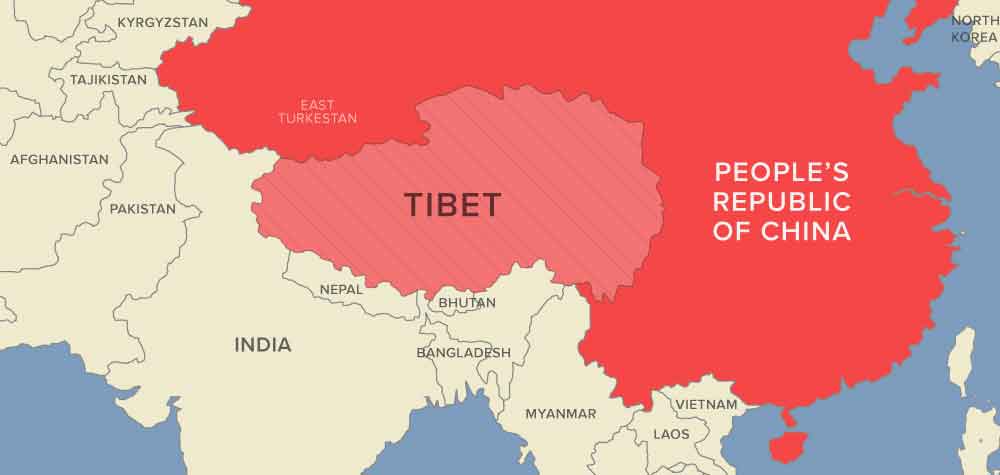
Much before they were turned into instruments of control, Tibet’s mountains were once places of refuge and faith. The year 2026 marks the 150th birth anniversary of the 13th Dalai Lama, Thubten Gyatso. His legacy goes on to display that Tibet’s spiritual and political traditions long predate the Chinese rule.
His 1913 declaration of independence remains a defining moment in Tibetan history. It reinforces a deeply held sense of identity and autonomy.
Since 1949, Beijing’s grip over Tibet has gone far beyond administration. It has sought to reshape the very beliefs, culture and landscape of the plateau.
Turning Monasteries into Museums
China’s approach to Tibetan monasteries has changed over time. The era of outright destruction has largely been replaced by a quieter strategy: controlled reconstruction and rebranding.
These are not restorations meant to revive religious life. They are carefully managed spaces where monks and nuns are required to attend regular political study sessions as well as demonstrate loyalty to the Communist Party. Faith is allowed only within limits set by the state.
Sacred sites like the Potala Palace now function largely as tourist attractions. In 2024, official figures reported around 63 million tourist visits to Tibet which is a staggering number when compared to the region’s small resident population. Planning targets for 2025 were placed in the 61–64 million range, underlining how aggressively tourism is being pushed. Sacred spaces are increasingly treated as “tourism resources,” not living centres of worship.
The policy of “Sinicisation” has also hit major religious institutions hard. The Larung Gar Buddhist Academy, once one of the world’s largest centres of Buddhist learning, has been repeatedly targeted. In early 2025, reports confirmed that more than 1,000 monks and nuns were expelled as part of state efforts to reduce its influence.
In Lhasa, the historic Jebum-gang Lha-khang Temple has reportedly been converted into a modern art centre. Such transformations seek to recast them as cultural or commercial spaces. They strip them of their original purpose and disconnecting them from Tibetan religious life.
Controlling the Future: The Battle Over the 15th Dalai Lama
The 14th Dalai Lama turns 91 in July 2026. The question of his succession has become one of the most sensitive issues facing Tibetans today.
In mid-2025, the Dalai Lama made his position clear. The authority to recognise his successor lies solely with the Gaden Phodrang Trust. And no legitimacy should be given to any reincarnation chosen for political reasons.
Beijing, however, continues to insist on its own role. It has repeatedly cited a 2007 regulation that requires state approval for all recognised reincarnations, including so-called “Living Buddhas.” Chinese officials have also stated that any future Dalai Lama must be identified within China’s borders and approved by the state.
This points toward a likely dual-succession crisis, echoing the fate of the Panchen Lama, who disappeared in 1995 after being recognised by the Dalai Lama and has never been seen since. He is widely described as the world’s youngest political prisoner, replaced by a state-appointed figure loyal to Beijing.
Ecological Damage on the “Roof of the World”
The Tibetan Plateau is often called the “Water Tower of Asia.” Its glaciers feed major rivers such as the Brahmaputra, Mekong, and Yangtze, supporting nearly two billion people downstream.
Yet analysts warn that the plateau is under growing ecological strain. Large-scale infrastructure, mining, and militarisation have pushed the region toward what researchers describe as extreme ecological stress.
China’s planned mega dam on the Yarlung Tsangpo (Brahmaputra) is central to this concern. Public reporting has placed the project’s cost at around $170 billion, with an installed capacity expected to be roughly three times that of the Three Gorges Dam. While promoted as a clean-energy project, its environmental and downstream impacts remain deeply contested.
At the same time, Tibet’s copper and lithium reserves—critical for China’s electric vehicle and renewable energy industries—are being aggressively developed. Mining operations have scarred fragile ecosystems, even as the plateau warms at roughly twice the global average, making it especially vulnerable to climate change.
Sacred Land Turned Military Zone
Recent satellite imagery from January 2026 shows new permanent military structures near Pangong Lake. It highlighted how deeply Tibet has been folded into China’s border strategy.
Across the plateau, railways, airfields, highways, and so-called “model villages” serve a dual purpose. Marketed as development projects, they also function as forward infrastructure for the People’s Liberation Army. Hundreds of “moderately prosperous” border villages have been constructed along disputed frontiers, reinforcing China’s military presence under a civilian cover.
High-speed rail now links Lhasa directly to China’s interior, further tightening Beijing’s control.
Resilience in the Shadows
Despite the heavy pressure, Tibetan identity has not disappeared. In quiet corners of Lhasa and in remote villages across Kham and Amdo, faith and language still continue to survive.
In 2025, reports emerged of underground Tibetan-language classes operating in secret. Parents and teachers risk punishment to ensure children learn their mother tongue at a time, defying state-run boarding schools where Mandarin dominates instruction and Tibetan culture is increasingly marginalised. UN experts estimate that around one million Tibetan children are affected by these policies.
A Moment That Demands Attention
The 150th anniversary of Thubten Gyatso is more than a historical milestone. It is a reminder that Tibet’s struggle is not only about territory, but it goes much beyond that. It is about truth, culture and continuity.
Protecting Tibet’s sacred land and identity cannot be separated from recognising its history. The world may debate geopolitics. For Tibetans, however, the issue remains painfully simple–the survival of a people, their faith and their way of life.




