
New Delhi: Iran is the epicentre of Central Asia, South Asia, and the Middle East. It is one of the oldest civilisations in the world and shares borders with seven countries with a rather interesting history. It is the gateway to central Asia and dominates the crucial Straits of Hormuz with many ports along the Makran coast. The Persian empire extended from the Mediterranean Sea to what is now Pakistan but was conquered by the Greeks in 330 BC. Around 260 BC, Parni nomads ousted the Greeks and ruled for five centuries. The Sassanids came into power in 224 AD and in 642 AD, Persia became part of the Islamic Empire. In 1501, Safavid Empire began their reign and by the late 18th century, Russia and Britain took control of parts of Persia.
In 1921, a Persian army officer named Reza Khan took control and sought to end outside influence. In 1935, he renamed the country Iran. His son, Mohammad Reza Pahlavi, became “Shah” in 1941. In 1951, the British-owned oil industry was nationalised, much referred to as the “Abadan Crisis”. Despite British pressure, including an economic blockade, the nationalisation continued.
The Shah was sent into a brief exile in August 1953 after a failed military coup by Col Nassiri. In 1979, many Iranians felt Pahlavi was corrupt and forced him to flee, ending the reign of the Shahs in Iran, popularly known as the Islamic Revolution of 1979 with Ayatollah Khomeini at the helm in December 1979. His reign of ten years was marked by a long war with Iraq and tensions with the many other nations. Khomeini died in 1989, but many of those tensions still exist today.
A political merry go round has since been the norm from 1997 to 2024, with Mohammad Khatami, Mahmoud Ahmadinejad, Hassan Rouhani, Ebrahim Raisi and Masoud Pezeshkian, with Iran’s supreme leader, Ayatollah Ali Khamenei, being a constant power centre.
The seeds of discord stem from the Iranian Nuclear Programme, which began in the 1950s under the Pahlavi dynasty, with United States support. It expanded in the 1970s with plans for power reactors, paused after the 1979 Iranian Revolution and resumed secretly during the Iraq War of 1980.
Iran’s nuclear program has been a focal point of international scrutiny for decades. In 2003, Iran suspended its formal atomic weapons program and claimed its program was for peaceful purposes. An important waypoint in this imbroglio was the Joint Comprehensive Plan of Action (JCPOA), also known as the Iran Nuclear deal. This was an agreement between Iran and the P 5+1 (the five permanent members of the United Nations Security Council & the European Union). Iran and the P5+1 countries engaged in negotiations for 20 months and, in April 2015, agreed on an Iran nuclear deal framework, which later led to JCPOA, along with a Roadmap Agreement between Iran and the International Atomic Energy Agency (IAEA).
Under the JCPOA, Iran agreed to constrain its nuclear program by limiting fuel cycle activities that could lead to the production of weapons-grade uranium or plutonium. The JCPOA restricted the number and type of centrifuges in operation, the level of uranium enrichment, and the size of Iran’s enriched uranium stockpile. Key facilities at Fordow, Natanz and Arak were repurposed for civilian uses. The agreement took effect on 20 January 2016 and was deeply criticised and opposed by Israel, Saudi Arabia and the Iranian Conservatives.
The United States with drew from the pact on 8 May 2018, imposing sanctions under its maximum pressure campaign. The sanctions applied to all countries and companies doing business with Iran and cut it off from the international financial system. Many reports indicated that Iran was apparently producing enriched uranium at 60% purity in May 2024 and the international community-imposed sanctions that severely impacted its economy, restricting its oil exports and limiting access to global financial systems.
IAEA found Iran noncompliant with its nuclear obligations for the first time in 20 years in June 2025. A day later, Israel went on an offensive with coordinated strikes across Iran, targeting nuclear facilities of Isfahan, Natanz and Fordow. On 22 June 2025, the US launched “Operation Midnight Hammer”, targeting Fordow, Natanz Nuclear Facility and Isfahan. This was the first US attack post assassination of Qasem Soleimani in 2020 and on Iran’s territory since the naval offensive “Operation Praying Mantis” in 1988. As aftermath of the June 2025 Iran-Israel war, Iran officially announced the termination of the agreement after 10 years in October 2025.
It is also of significance that Iran was the fifthlargest crude oil producer in OPEC in 2021 and the third-largest natural gas producer in the world in 2020. It holds some of the world’s largest deposits of proven oil and natural gas reserves, ranking as the world’s third-largest oil and second-largest natural gas reserve holder in 2021.The country exported US$7.7 billion worth of crude and petroleum oils, with UAE and China being the largest buyers.
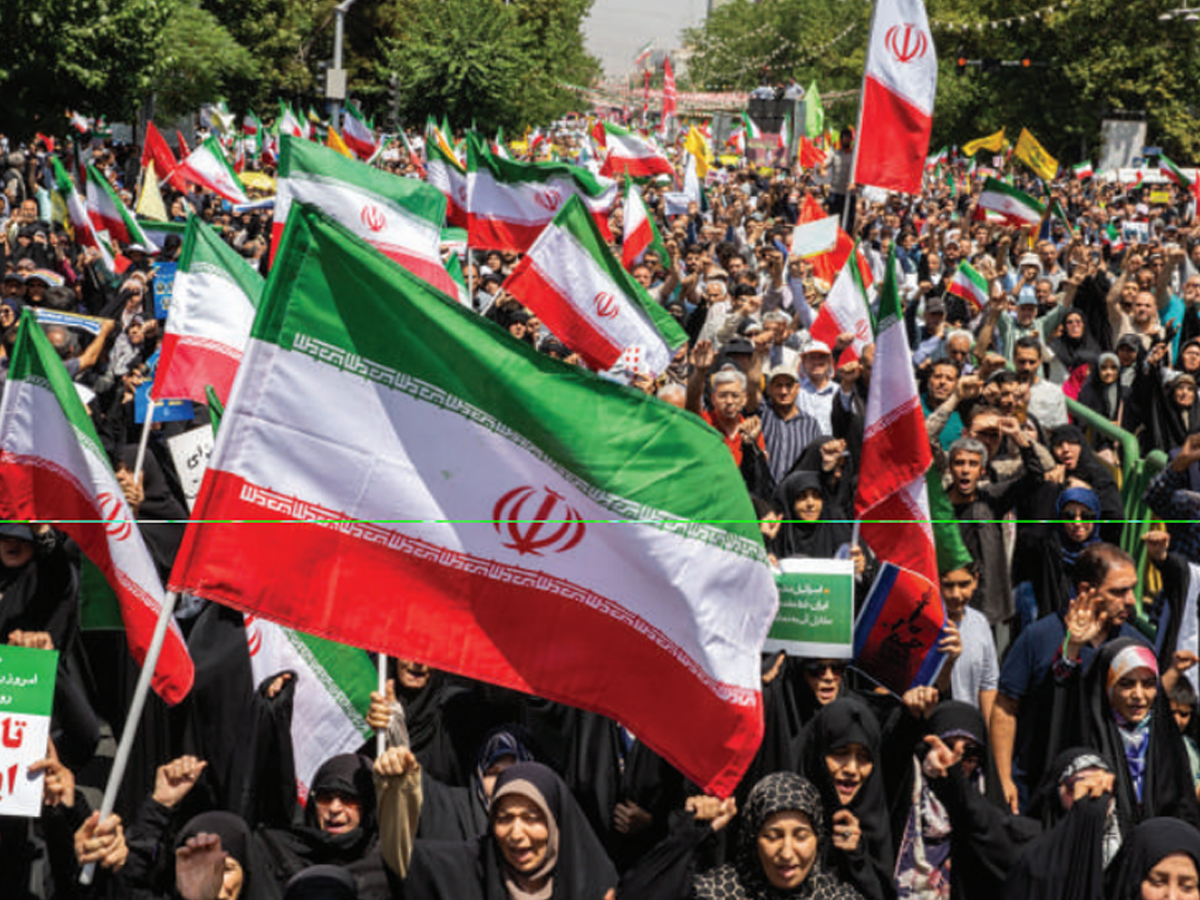
The present imbroglio is centric to choking energy markets for China and some others with pressure tactics for resumption of talks. This has followed a pattern with a trajectory of controlled offensive in June 2025 by the United States and economic sanctions of an additional 25% tariffs for countries who trade with Iran. This has slowed down trade metrics and devaluation of the Iranian “Rial”. This was followed by mass protests on the streets against the Islamic regime in December 2025 and the stage has now been set with the US Armada sailing in with other assets encircling Iran.
An armed offensive will entail Iran unleashing its missile and drone arsenal as well as mobilising its proxies to open new fronts, besides suffering a massive collateral damage. While the overall US aim may be to destabilise the theocratic regime in Iran, the window for an offensive is shrinking rapidly. It cannot be glossed over that Iran has prepared for half a century, against all odds, for a war with the United States. The US options could also be limited to weakening the current system, while negotiating an asymmetric truce.
The question is will the US carry out an immediate strike, or will it be a forced postponement? Is it “Carrier Coercion” or simply “Strike Packaging” for a muddy brawl in the Persian Gulf and Arabian Sea? The course of the “shamal” (wind) is difficult to predict as of now.
*Anurag Awasthi is a veteran, and CEO of Escape Velocity Mediaworks. He is a known policy expert and a columnist who writes extensively on critical technologies, security and geopolitics. Views are personal.




