
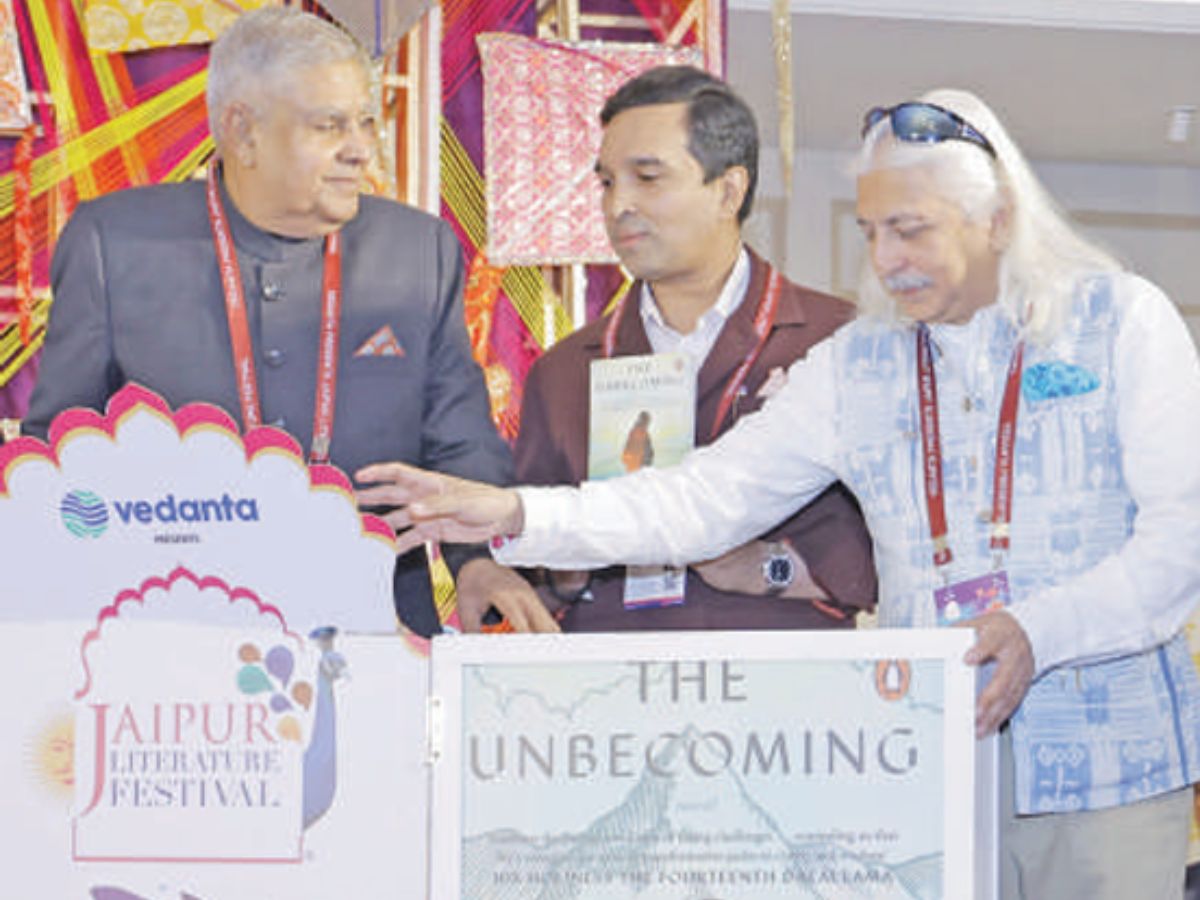
When Kartikeya Vajpai speaks about his debut novel, The Unbecoming, it is not with the urgency of a first-time author seeking validation, but with the calm of someone who seems to have already made peace with not needing it. That quiet assurance was palpable at the 2026 Jaipur Literature Festival, where the book was formally launched by former Vice President of India Jagdeep Dhankhar and Sanjoy K. Roy, Managing Director, Teamwork Arts—an unlikely but fitting moment for a work that sits at the intersection of public life and deeply private inquiry.
Though rooted in Kartikeya’s own spiritual experiences, The Unbecoming is firmly positioned as a work of fiction. Its philosophical core, however, is unmistakably personal. The novel explores what Kartikeya describes as a return to an original state of being—one in which awareness leads action, and creativity flows not from effort or ambition, but from stillness.
“At the heart of the book,” Kartikeya explains, “is the philosophy of the unbecoming. Becoming is how you like to see yourself in the eyes of the world—projecting, imitating, pretending to fit into a persona you aspire to be. Unbecoming is connecting to that source which is already within you, which does not require any approval. It is already complete.”
That idea—of undoing rather than acquiring—runs counter to the worlds Kartikeya inhabits by profession. A distinguished advocate and the founder of a boutique law firm in New Delhi, he is also an MBA with extensive experience in corporate marketing. Strategy, precision, performance, and persuasion are second nature to him. Yet, as The Unbecoming reveals, these external markers of success were never enough to answer the deeper questions that began forming early in his life.
Those questions, interestingly, emerged not in solitude but on the cricket field. Kartikeya’s relationship with discipline and awareness began when he was barely eleven years old, representing his state at the under-14 nationals. kartikeya Vajpai
“I was very blessed that this happened to me very early in my childhood,” he recalls. “I started playing cricket professionally when I was only 11… and that is when my mother introduced me to Transcendental Meditation.”
The practice, taught by Maharshi Mahesh Yogi, opened a doorway that sport alone could not. Amidst the intensity of competitive cricket, Kartikeya began experiencing fleeting moments of heightened awareness—what athletes often call being ‘in the zone.’ “I could sense glimpses where my inner spontaneity and my awareness would take charge of my actions,” he says. “I would intuitively know what was coming next Cup. in sports. But this zone, I entered accidentally. And there was always a desire within me—how can I make it permanent?”
That question—how to sustain flow—became the quiet undercurrent of his life. Over the years, his inner exploration expanded beyond Transcendental Meditation to include yogic practices such as trataka, Mahamudra rooted in Mahayana Buddhist traditions, and eventually Mahavatar Babaji’s Kriya Yoga. Parallel to this inward journey, his outward life flourished: a successful legal career, corporate leadership, and continued engagement with cricket, where he now represents Team India Lawyers at the Lawyers’ Cricket World Cup.
What The Unbecoming does is bring these parallel lives into conversation. Rather than framing spirituality as an escape from the world, the novel suggests that authentic action within the world is only possible when one is no longer consumed by how they are perceived. “We are too busy projecting and trying to appear how the world would like to see us,” Kartikeya observes. “And hence, we are not connected to that source of creativity.”
In Kartikeya’s telling, creativity is not a talent reserved for artists or mystics. It is a natural human faculty, blocked not by lack of skill but by fear. “The seed of creativity is there in each one of us,” he says. “But for many of us, it goes unexplored because we never care to look within. Our authentic expressions get blocked.”
This idea forms the emotional engine of The Unbecoming. Its characters move through professional ambition, social roles, and internal conflict, gradually confronting the tension between who they are and who they believe they must become. The novel’s concept of flow—where action arises spontaneously from awareness—echoes Kartikeya’s own experiences in sport and meditation. “Creativity,” he insists, “is simply embracing your authenticity. It is as simple as it sounds, and as difficult as it is to practice.”
The Jaipur Literature Festival, Kartikeya believes, is an ideal space for such conversations. For him, litfests are not merely platforms for promotion but living ecosystems of shared reflection. “Everything is an exchange of energy,” he says. “When you have creative minds coming together, exchanging ideas and wisdom, it becomes a beautiful place for anyone who likes to reflect upon life.”
That sense of exchange—between reader and text, inner life and outer action—is what The Unbecoming ultimately offers. It does not preach renunciation, nor does it glorify achievement. Instead, it invites readers to examine the subtle ways in which they may have drifted from themselves, and the courage it takes to return.
In a cultural moment obsessed with reinvention and visibility, Kartikeya Vajpai’s debut arrives as a quiet counterpoint. It suggests that the most radical transformation may not lie in becoming something new, but in unbecoming everything that was never truly ours to begin with.




