
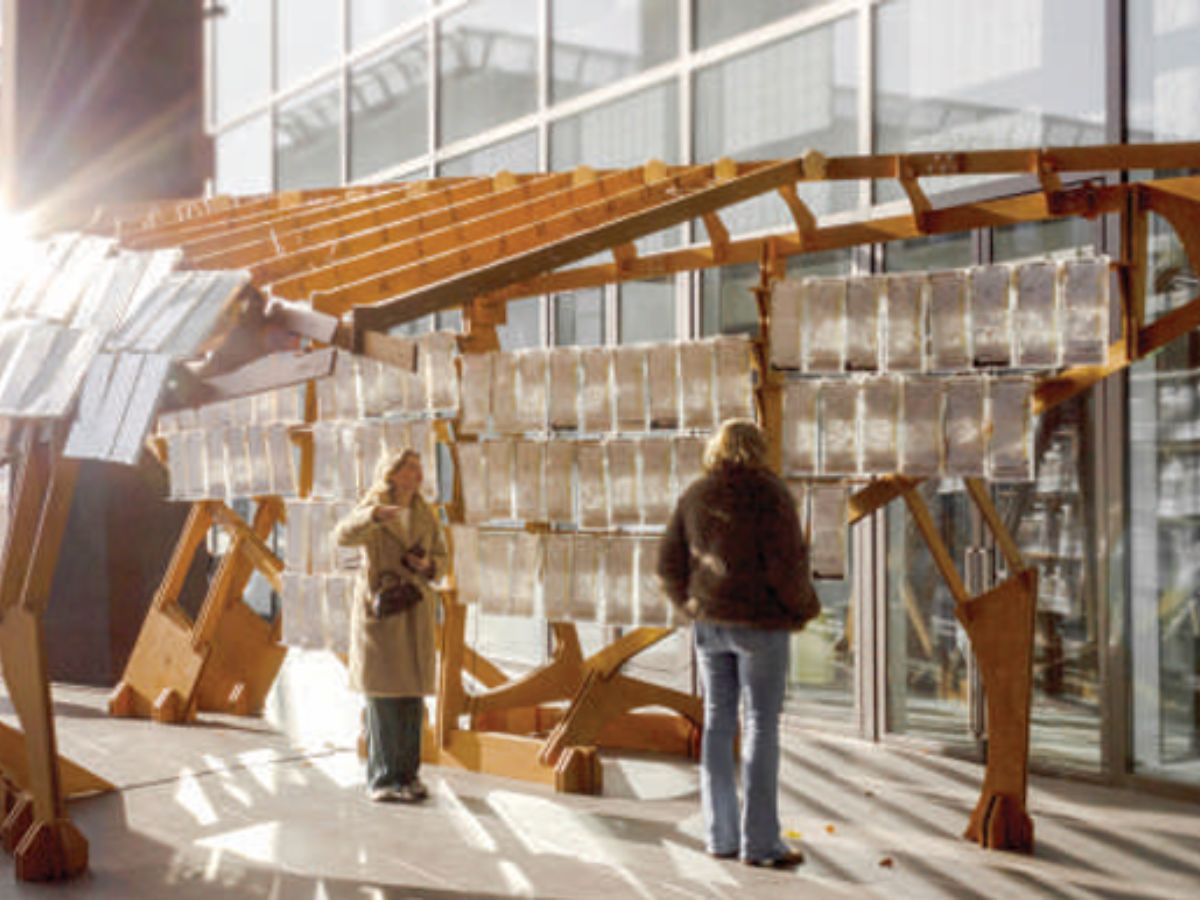
“Are worms the architects of the future?” is the intriguing question architect Aditya Mandlik asks through his latest exhibition Factory 5.0, which was displayed at the prestigious Dutch Design Week in Eindhoven in the Netherlands recently. This thought spoke directly to the fair’s theme of ‘Past. Present. Possible.’, and in doing so, became the only Indian architecture practice to earn a spot in Europe’s largest design festival.
“Our installation asks a radical question: What if buildings weren’t designed by humans alone?” muses Mandlik, explaining the idea behind his project. “The exhibit used worms as tools for building to demonstrate the evolving relationship between human innovation and biological processes.”
The innovation of the project aside, this was the first Indian architecture studio to showcase an architectural pavilion in the Netherlands. “We believe it’s a milestone that marked a significant moment for Indian design on the global stage. Factory 5.0’s inclusion in the prestigious Grand Projects program places us alongside some of the most ambitious and thought-provoking works from around the globe, offering a platform to engage international audiences in conversations about the future of design amid climate challenges and technological acceleration.”
Their participation in Dutch Design Week (DDW) 2025, a nine-day event focussing on designers shaping our future, seems fitting. The DDW outlines five missions or subjects that reflect the needs of our society. These include the need for a thriving planet, living environment, digital futures, health and wellbeing and an equal society.
As one of the world’s leading design events, DDW has showcased the work and ideas of over 2,500 designers and attracts more than 300,000 visitors from around the globe. It’s spread across 120 locations in Eindhoven, and features a diverse range of exhibitions, lectures, award ceremonies, events, debates and festive gatherings.
Mumbai-based Studio Aditya Mandlik / Space and Matter, or SAM, as it’s better known, works to realise the vision of a post-anthropocentric future shaped by metabolic design. Its practice challenges traditional, human-focused paradigms by reimagining architecture as a living, adaptive process engaging with its environment. The belief that buildings should coexist with nature as opposed to dominating it, is at the core of SAM’s philosophy, which is why it creates spaces which integrate with and respond to their ecosystems. To do so, they draw from architecture, biology, ecology and technology, through an interdisciplinary approach. It’s an exploration of the relationship between space and material in creating a bridge between built and natural worlds.
Speaking about the project on display at DDW’s recent edition, Mandlik shares, “As the name suggests, Factory 5.0 is a site for decomposition and marks a critical juncture as we transition into the Fifth Industrial Revolution, an era defined by the convergence of human and non-human intelligence. Drawing from the first industrial revolution and the advent and trajectory of plastic as a speculative model for a non-human-centred future, the installation is a fundamental rethinking of how we build. It calls for more symbiotic relationships between architecture, ecology and the urban environment.”
Mandlik’s practice moves beyond human-centred design, making space for a future where built form aligns with ecological processes that are not dependent on human intent alone. “The installation positions biological agents as co-creators, most notably through its engagement with plastic, the defining material of the first industrial revolution, and the speculative commentary on worms that can metabolise it. By collaborating with another form of intelligence, the project blurs the boundaries between nature and construction, proposing a shared model of architectural production. Its form intentionally breaks away from entrenched modes of thinking and making; although the tooling still echoes industrial-revolution assembly lines and capital-driven systems, the method of manufacturing is reimagined. Factory 5.0 subverts the logic of these systems from within, advocating a design ethos rooted in ecological balance, interspecies cooperation, and a radically expanded understanding of intelligence,” he says.
The project consists of a pavilion comprising 546 digitally fabricated composite timber components and 200 Styrofoam plates intentionally exposed to biological decomposition. 10,000 king worms, housed within transparent acrylic chambers, become active participants in gradually breaking down the Styrofoam and reshaping its spatial configuration over time. As Mandlik explains, “The structure juxtaposes the engineered precision of the composite timber framework with the organic, unpredictable transformation of the decaying material. Together, they form a sectional architectural landscape that reveals its layers, openings and structural rhythms as visitors move around and through it.”
He adds, “Light plays a central role, casting shifting shadows and angular patterns, amplifying the sense of continual movement and change. Throughout the exhibition, the installation remained in a state of flux, reinforcing its identity as a dynamic, metabolic entity. As the worms consume and transform the material, the pavilion evolves, not as a static object, but as a living architectural organism responsive to its environment. This gradual decomposition becomes a powerful metaphor for our architectural practice being rooted in ecological cycles, where growth, decay, and regeneration are interdependent and continuous. Factory 5.0 positions architecture as adaptive and collaborative, a glimpse into a future where human and non-human intelligence coauthor spaces.”
At the heart of the pavilion lies a design-for-disassembly approach, which Mandlik expands on: “We offer a framework for disassembly, regeneration and sustainable futures. Every element can be flatpacked, shipped and reconfigured, and the acrylic boxes have been modified to behave almost like silica gel, absorbing moisture and adapting to the needs of each user or environment. Built for a shorter lifespan but maximum adaptability, the pavilion challenges the traditional cycle of permanence versus demolition, proposing instead a model where components evolve across generations. After the exhibition, its parts will be repurposed, extending their material life cycle, while the decomposed Styrofoam plates – shaped by worms highly sensitive to light, sound and human presence – are preserved as ‘objects of memory’, tangible records of the pavilion’s time-based transformation. These remnants will later become moulds for casting metal lights, further embedding regeneration into the project’s logic. Factory 5.0 thus becomes a critical reflection on architecture’s role in the Fifth Industrial Revolution, where technological and biological intelligence converge. By fostering a dialogue between human design and natural systems, it illuminates the potential of regenerative architecture to reshape future cities as sustainable, interconnected ecosystems.”
Noor Anand Chawla pens lifestyle articles for various publications and her blog www.nooranandchawla.com.




