
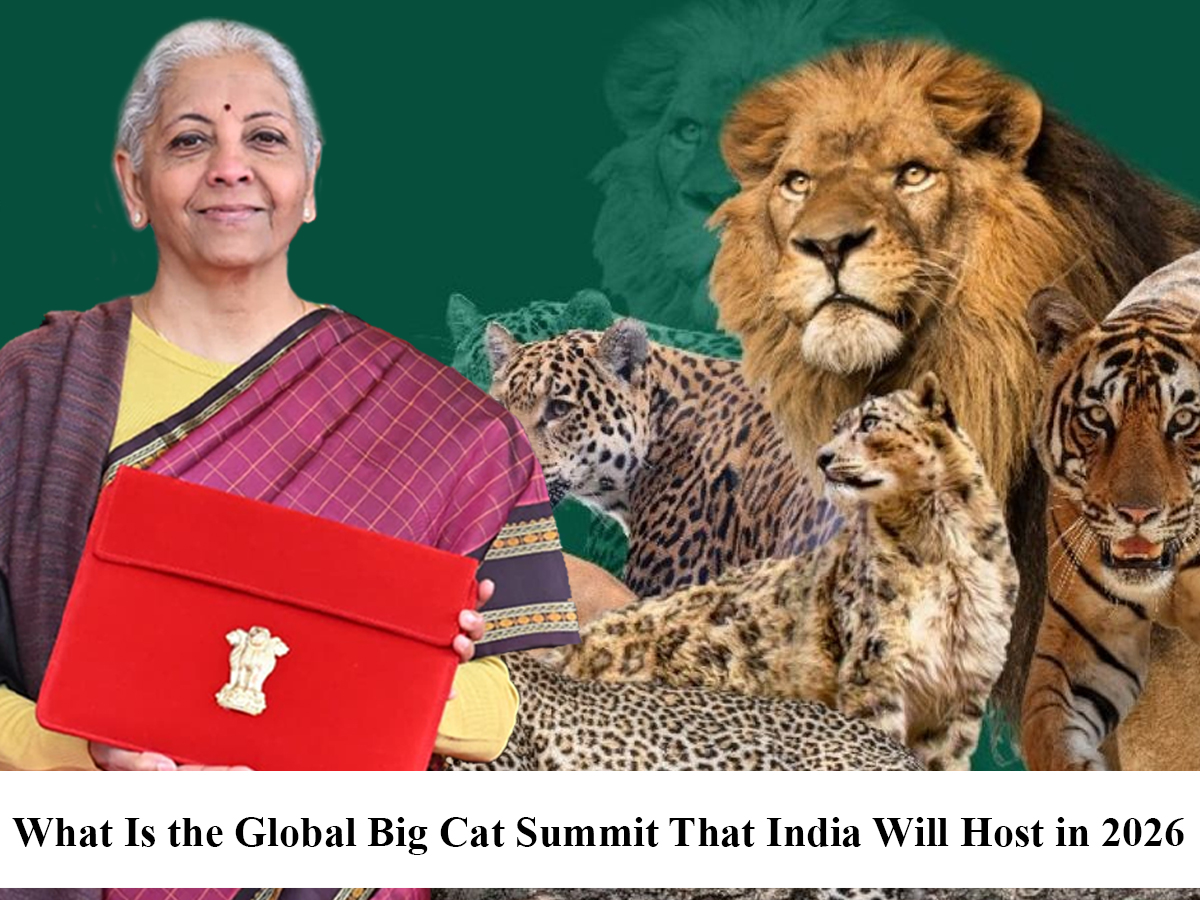
India is set to take centre stage in global wildlife conservation after Finance Minister Nirmala Sitharaman announced that the country will host the first-ever Global Big Cat Summit later this year. The announcement came during the presentation of the Union Budget 2026 in Parliament, underlining the government’s growing focus on environmental leadership alongside economic priorities.
The summit will be organised under the International Big Cat Alliance (IBCA) and will bring together world leaders, ministers, conservation experts, and civil society representatives from across the globe. The move positions India as a key driver of international cooperation to protect some of the world’s most threatened wildlife species.
India’s Big Conservation Announcement in Budget 2026
While outlining key initiatives in the Budget, Sitharaman highlighted India’s role in shaping global conservation efforts.
“We established the Big Cat Alliance in 2024. This year India is hosting the first-ever global Big Cat Summit where heads of governments and ministers from 95 range countries will deliberate on collective strategies for conservation,” Sitharaman said.
The announcement marks a major milestone for the alliance, which aims to bring countries together to protect big cats whose habitats stretch across continents.
What Is the Global Big Cat Summit?
The Global Big Cat Summit is a high-level international conference focused on protecting the world’s big cats, including tigers, lions, leopards, snow leopards, cheetahs, jaguars, and pumas. These species live across 95 “range countries”, from Asia and Africa to the Americas.
The summit will serve as a platform where governments, scientists, and conservation groups can share strategies on habitat protection, anti-poaching measures, scientific research, and community involvement. It also aims to improve cross-border cooperation, as many big cat habitats extend beyond national boundaries.
What Is the International Big Cat Alliance?
The International Big Cat Alliance was formally set up by India in March 2024 under the National Tiger Conservation Authority, which functions under the Ministry of Environment, Forest, and Climate Change. The alliance focuses on conserving seven big cat species and strengthening global efforts through shared knowledge and coordinated action.
As of September 2024, 25 countries had formally joined the alliance, with more expected to come on board through diplomatic agreements. The Union government has allocated Rs 150 crore to the initiative from 2023-24 to 2027-28, signalling long-term commitment.
Why India Is Leading the Big Cat Conversation
India’s leadership role draws strength from its own conservation success. The country revived its tiger population through Project Tiger, launched in 1973. After tiger numbers crashed to around 1,800 by 1970, sustained protection efforts helped increase the population to over 3,600 tigers today, nearly 70 per cent of the global wild tiger population.
India has also protected large populations of leopards and snow leopards and successfully reintroduced cheetahs after decades.
Why Big Cat Conservation Matters
Big cats play a critical role in maintaining ecological balance. As apex predators, they control prey populations and help preserve forests and grasslands. These ecosystems store carbon, reduce climate risks, and support biodiversity.
By hosting the Global Big Cat Summit, India strengthens its environmental diplomacy and sends a clear message that conservation and development can move forward together through global cooperation.




