
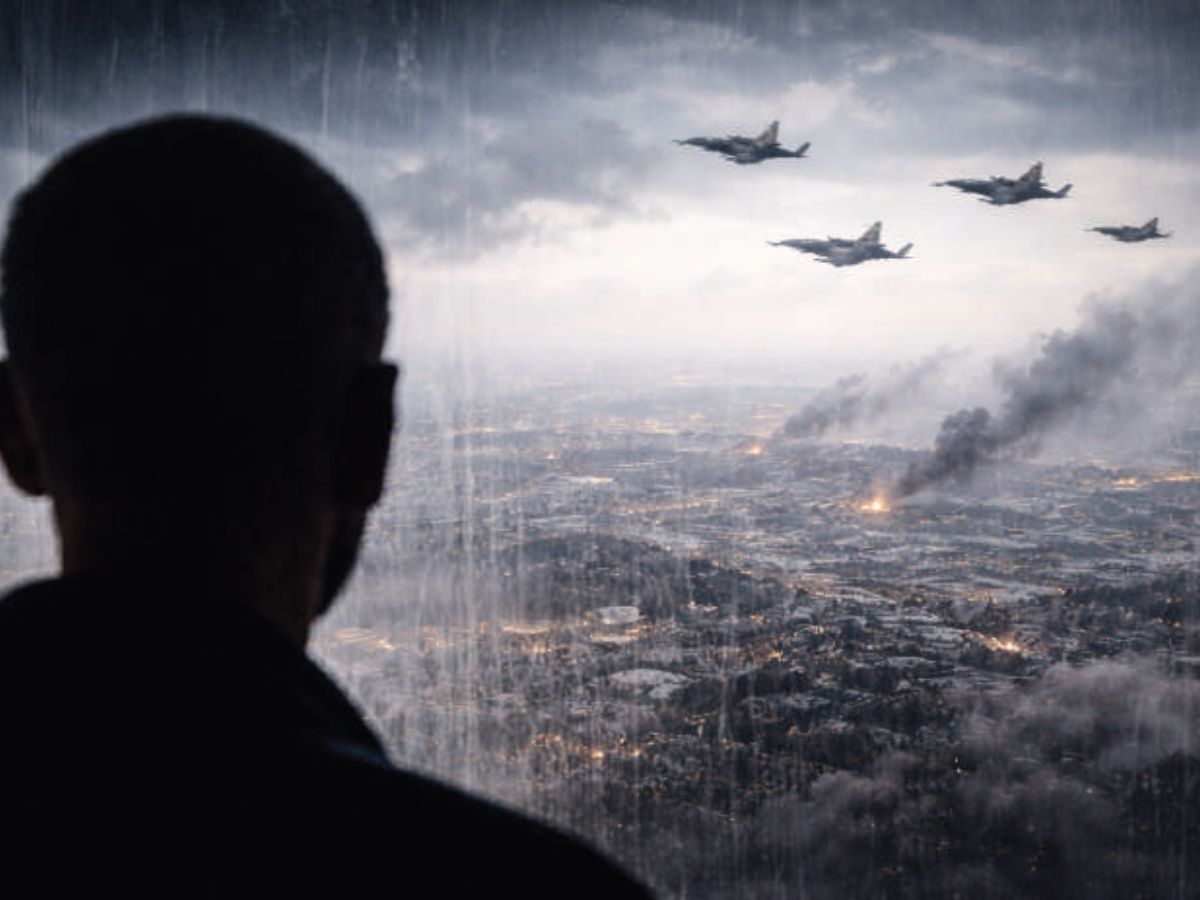
Nations often behave remarkably like insecure individuals. They nurse historical wounds for centuries. They demand recognition. They measure themselves against rivals and mistake expansion for strength. They speak the language of security while acting from fear. Strip away the flags and treaties, and what you find underneath is a collective ego doing exactly what every private ego does: seeking safety in the wrong places. This is not a metaphor. It is a diagnosis of the sharp geopolitical fractures and conflagrations of the last five years.
Consider several of the most talked-about moves of the moment. In early January 2026, U.S. forces carried out an operation in Venezuela that resulted in Nicolás Maduro being captured and taken to the United States, triggering debate about sovereignty, intervention, and the future of regional order. At almost the same time, the United States renewed political interest in Greenland, an autonomous territory within Denmark, in a way that has unsettled allies and raised questions about how far strategic desire can stretch without eroding alliance trust. And US–Iran tensions have sharpened again, with diplomacy running alongside visible military signalling and fears of escalation around the nuclear issue. These episodes may seem unrelated. Closer scrutiny shows them as part of a larger pattern in which nations act on fear, identity, and perceived threat in ways that worsen tension rather than resolve it.
The ego is not an abstract idea. It is the sense that “I am this,” attached first to the body and then to every social identity that grows from it. A nation’s first identification is with its population and territory. Its second is with its history and culture. Its third is with its projected ambitions. These layers shape how threat and dignity are perceived, often more powerfully than cold calculations of advantage. Territory becomes the body. The border becomes the skin.
This is why territorial disputes provoke reactions out of proportion to the land involved. It is never really about the physical land alone. It is about the ego’s boundary feeling threatened. When the boundary feels violated, nations behave the way any organism does. They tighten, mobilise, and strike. The reasoning follows later, assembled to justify what the body already decided.
Russia’s invasion of Ukraine can be explained in terms of buffers and alliances. Over and over, the language returns to identity: who belongs where, who is part of whom, which past must be restored. When a political project becomes a project of psychological repair, it behaves like a wounded self, not a cool strategist.
In the South China Sea, several nations claim overlapping sovereignty over reefs and shoals, some barely above water at high tide. These disputes are about more than trade routes. They are about the boundary of belonging, its insistence that even the ocean floor be marked as “mine.”
South Asia recently experienced one of its most serious military crises in decades. The deliberate targeting of unarmed civilians is indefensible, and a nation that responds decisively exercises a right that requires no apology. Once public emotion reaches a certain pitch, however, escalation becomes easier, restraint becomes suspect, and reason is forced to compete with momentum. Even justified action deserves the clarity that comes from self-awareness.
In Gaza, the devastation has been extensive. The violence that triggered the wider war was also framed in existential terms. Both sides use the language of survival.
In Sudan, former allies turned their weapons on each other and tore the country apart. The objection was never to domination itself. It was to not being the one in charge.
Saying that ego dynamics operate in every conflict is not the same as saying every side is equally responsible. The moral weight of deliberately attacking civilians is not the same as the moral weight of responding. Recognising that ego dynamics accompany every conflict is not moral equivalence. It is philosophical seriousness.
The ego’s trick is to use legitimate pain as fuel for its own expansion. Recognising that trick is not a betrayal of the pain. It is the only way to prevent the pain from being hijacked. The ego does not merely participate in geopolitics. It generates it.
The ego survives by division. It must say “I,” and therefore “not-I.” On the personal level, this creates inner conflict. On the collective level, it becomes nation against nation, alliance against alliance, civilisation against civilisation.
Great coalitions define themselves primarily by what they oppose. Remove the adversary and the bloc loses coherence. This is why the end of the Cold War did not produce lasting peace. It produced a frantic search for the next enemy, because without an enemy the collective ego loses its mirror.
The United States–China dynamic illustrates this. Neither power can articulate what it stands for without referencing the other. Two civilisational egos struggle to share the same room without one feeling diminished. The established power cannot tolerate displacement. The rising power cannot tolerate being held back.
The ego’s deepest terror is bodily annihilation. Nuclear deterrence is this terror scaled to nations, a promise that your entire territory, population, and civilisation will be destroyed if you act. Yet crises still escalate because, for the ego, humiliation can feel worse than destruction. The ego would rather gamble with catastrophe than accept diminishment. This is not strategic rationality, far more dangerous than any missile.
This helps explain why arms races never produce security. Every new weapon is the ego trying to insure itself against its own fragility. A nation that doubles its defence budget does not feel twice as safe. It discovers the need to triple it. The hunger is structural, not circumstantial.
The global order entrusted with security is heavily shaped by the same powers most capable of waging large-scale war and by industries that profit from equipping it. The ego’s supply chain made institutional.
Every aggressor in history speaks the vocabulary of defence. The ego cannot act without first clothing itself in righteousness. The more destructive the action, the more elaborate the moral justification.
This is why propaganda works even on intelligent people. It does not need to persuade. It needs only to provide the ego with a respectable outfit. Once the outfit is on, the ego does not look inward. It looks outward at the enemy and feels clean.
Power at the geopolitical level does not corrupt as much as it exposes. A nation insecure as a regional power becomes aggressive as a global one.
Remove a tyrant and a committee takes his place. Dissolve an empire and its fragments go to war with each other. The map changes. The hunger does not.
None of this means institutions do not matter. Diplomacy, treaties, international law, and multilateral bodies can reduce suffering when they work. But they will never be sufficient. No treaty holds if the parties remain inwardly at war. No ceasefire survives if the ego’s hunger for enemies persists.
A nation at war behaves like a crowd. Crowds simplify. Responsibility thins. The collective reacts rather than reflects. Dissent is treated as betrayal. The crowd does not tolerate the individual who refuses to merge.
There is no final resolution to this. The ego is not an error that can be fixed once and set aside. It is rooted in the body, and the body persists. As long as human beings are alive, the tendency to identify, to divide, to seek safety in tribe and territory will reassert itself.
The problem regenerates because it lives in us, not in the system. No realignment of alliances, no new world order, no technological breakthrough will resolve what is fundamentally a crisis of self-knowledge.
So what would real change look like? Not another summit. Not another treaty signed with ceremony and broken with excuses. The deeper shift begins with the individual. With the willingness to notice the surge of collective emotion and ask what it is feeding on. With the recognition that the enemy I despise may be reflecting something I have not faced in myself.
Do not ask first which nation to support. Ask why you are so easily mobilised, why the world arranges itself so neatly into allies and enemies in your mind, why criticism of your group feels like a personal attack.
The world will not become sane before its people do. Watch what excites you when you read the news. Watch whether you seek understanding or vindication. If a headline gives you instant certainty about who is right, pause. If it produces instant hatred toward other people, pause longer.
This is not a call for passivity. Engage with the world. Demand accountability from governments. Support institutions that restrain the worst impulses. But do so without being possessed by it. Can you criticise a nation’s actions without demonising its people? Can you hold accountable without turning accountability into tribal intoxication?
The test is not neutrality; the test is honesty. Only self-inquiry makes such honesty possible. Why does this flag feel like an extension of my body? What fear is being masked by the global surge in parochialism?
Borders will shift. Empires will rise and crumble. The external map will keep being redrawn. The inner map, built from fear, attachment, and the need for tribe and certainty, tends to last far longer.
The only territory worth defending is the one within. The only sovereignty that endures is sovereignty over one’s own reactions. The only disarmament that lasts is the disarmament of the ego’s certainties. Begin there.
Acharya Prashant is a teacher and author whose work centres on self-inquiry and its application to contemporary life.




