
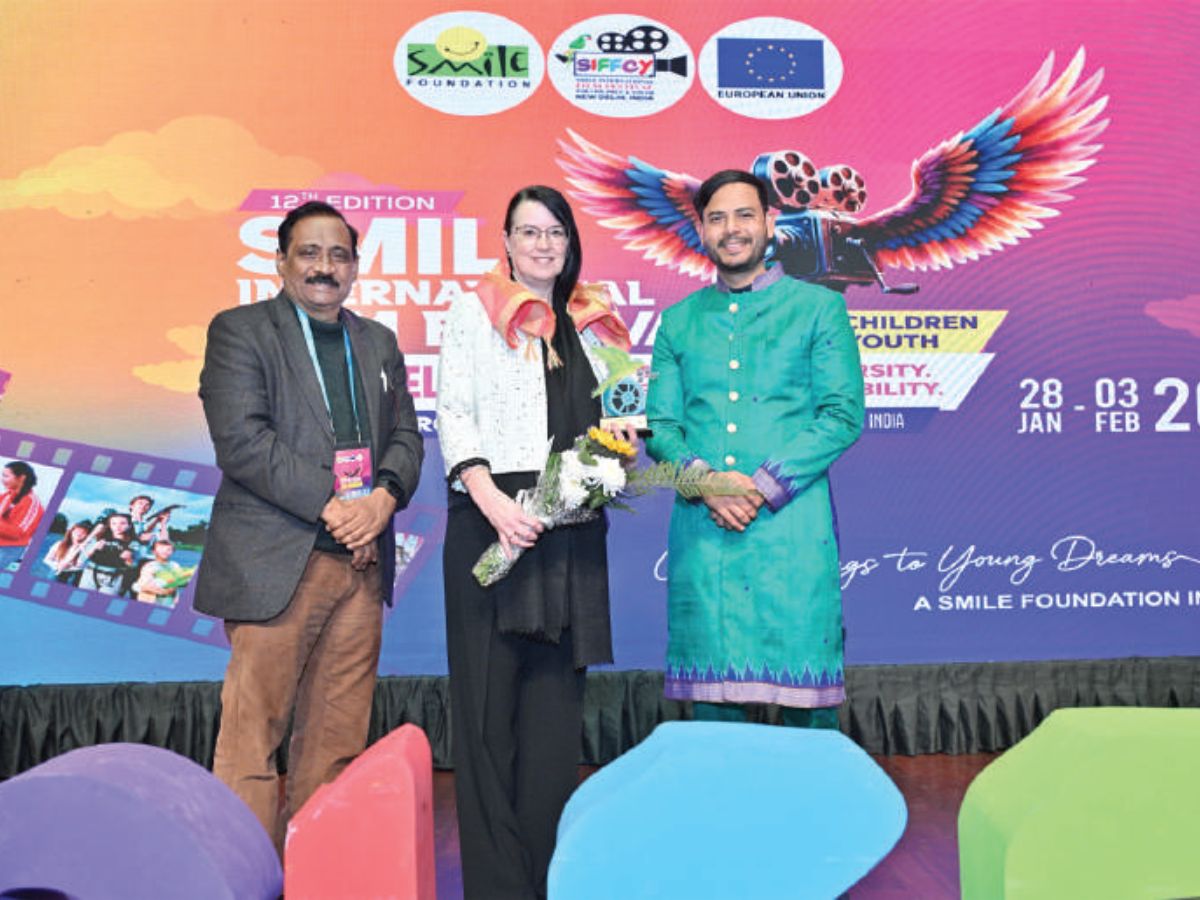
At a time when children across the world are growing up amid climate anxiety, social fragmentation, and an overload of digital stimuli, the Smile International Film Festival for Children & Youth (SIFFCY) has steadily positioned itself as more than a showcase of films. In its recently hosted 12th edition at PHD House, New Delhi, SIFFCY emerged as a space where cinema becomes a tool for empathy, dialogue, and selfrecognition for young audiences.
For Jitendra Mishra, Festival Director of SIFFCY and President of CIFEJ (2025–27), the central vision of SIFFCY lies in a fundamental shift in how children are perceived within cultural ecosystems. “At its heart, SIFFCY 2026 recognises children not just as audiences, but as powerful storytellers and thoughtful opinion-makers,” he says. The festival, he explains, is driven by the belief that young people are inherently curious and emotionally intelligent, capable of engaging deeply with the world through cinema.
What distinguishes this edition, Mishra notes, is the clarity with which the ideas of Inclusion, Diversity, Equity and Accessibility shape every layer of the festival—from film selection to audience engagement. “These ideas influence the films selected, the conversations around them, and how audiences experience the festival itself,” he says, adding that SIFFCY today feels less like a conventional film festival and more like a shared, participatory space.
That curatorial intent was reflected strongly in the jury’s verdicts. The International Competition – Feature Film award went to I Accidentally Wrote a Book, directed by Nòra Lakos, a Netherlands–Hungary coproduction that also earned Lakos the Best Director award. The film went on to receive the CIFEJ Award and the Film Critics Circle of India (FCCI) Award, making it the most decorated title of SIFFCY 2026. Other major honours included Best Actress for Jayashree in Bird of a Different Feather from India, Best Story for the Germany–Luxembourg production Stitch Head, and the ECFA Award for Grandpa, Let’s Go!, a Poland–Czech Republic co-production.
Santanu Mishra, Chairman of SIFFCY and Cofounder of Smile Foundation, believes the diversity of award-winning films underlines the festival’s philosophy. “Each award at SIFFCY represents a story that respects the intelligence and emotional depth of young audiences,” he says. “The diversity of films recognised this year, from across the globe, reaffirms our belief that meaningful cinema can shape values, empathy and imagination.”
For Jitendra Mishra, this respect for young viewers is especially crucial in today’s turbulent world. SIFFCY 2026 prioritised themes such as resilience, environmental responsibility, displacement, empathy and the impact of technology on daily life. “Children today are growing up surrounded by major disruptions and constant change,” he explains. “Cinema offers a way to process those emotions safely. Through thoughtful storytelling, films help children understand complex issues and develop emotional awareness without overwhelming them.”
The festival also consciously challenges the long-held assumption that children’s cinema must be simplistic or purely entertaining. “There is a common belief that films for young audiences need to avoid complexity,” Mishra says. “SIFFCY challenges this by presenting stories that engage with layered emotions and moral questions in age-appropriate ways. The films trust young audiences to think, feel, and reflect.”
This philosophy extends to SIFFCY’s strong emphasis on Global South voices and underrepresented narratives. Mishra points out that representation, when rooted in authenticity rather than tokenism, creates a sense of recognition among both filmmakers and audiences. The 2026 selection included stories deeply embedded in local cultures and languages, while still resonating universally through themes of belonging, identity and courage.
Equally central to SIFFCY’s mission is film literacy. Beyond screenings, the festival expanded its interactive initiatives this year through post-screening discussions, workshops and filmmaker interactions. “Film literacy is about encouraging children to actively engage with what they watch,” Mishra says. “These spaces allow young viewers to ask questions and understand how films are made, while inclusive formats ensure children with different abilities can participate comfortably.”
International collaborations added another important dimension to SIFFCY 2026. Poland’s role as Partner Country was highlighted through screenings and cultural exchanges. Małgorzata Wejsis-Gołębiak, Director of the Polish Institute New Delhi, described the partnership as a celebration of cinema’s connective power. “Through a shared commitment to inclusion, diversity, accessibility, and equity, we are proud to showcase the rich tapestry of Polish cinema for young audiences and foster meaningful dialogue between Indian and Polish storytellers,” she said, adding that film has the power not just to entertain, but to empower young people to imagine a more empathetic world.
The festival’s engagement with literature and storytelling was exemplified by a special Moomin storytelling session led by Finnish diplomat Iiris Määttä. Drawing from Tove Jansson’s The Invisible Child, Määttä read and discussed the story with young audiences, inviting them to reflect on invisibility, kindness and emotional healing. “The story is full of emotions,” she noted, explaining how children related Ninny’s experience to their own feelings and friendships. The session resonated deeply with SIFFCY’s larger emphasis on emotional literacy and inclusion.
With participation from over one lakh young viewers, schools from across the region, filmmakers and international delegates, SIFFCY 2026 reaffirmed its position as a significant cultural platform. For Jitendra Mishra, the ultimate measure of the festival’s success lies beyond awards or attendance numbers. “If children leave the festival more curious, more empathetic, and willing to ask questions about the world around them,” he says, “then SIFFCY has done what it set out to do.”
In nurturing that curiosity and empathy, SIFFCY continues to argue—quietly but convincingly—that children’s cinema is not a lesser form, but one of the most vital spaces where the future imagination of the world is being shaped.




