
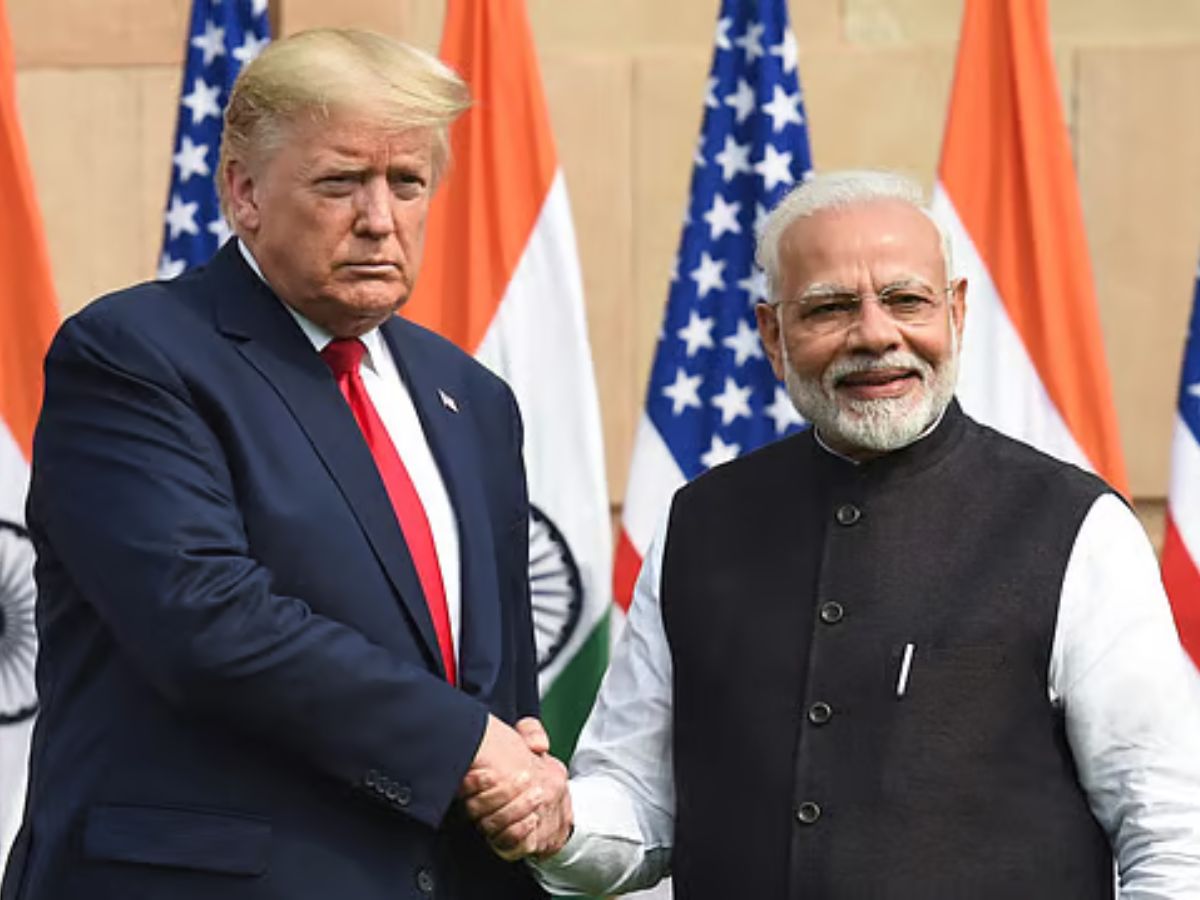
India and the United States have taken a major step toward deepening economic ties with a new interim trade framework that includes a landmark commitment. India plans to import $500 billion worth of American goods over the next five years.
This pledge answers a central question in the recently announced trade pact and reshapes expectations for bilateral commerce between the world’s largest democracies.
The announcement follows high-level negotiations that resulted in a joint statement outlining tariff reductions, market-opening measures, and reciprocal commitments designed to boost trade and investment between the two nations.
India-US Interim Trade Pact: What India Will Import?
India’s commitment to purchasing $500 billion in American goods is aimed at products that support its industrial, energy and technology needs. According to the joint statement, India will import energy products, aircraft and aircraft parts, precious metals, advanced technology goods like GPUs, and coking coal from the United States.
Most of these items are already part of India’s current import basket, but the scale and value are expected to rise sharply. Currently, India imports roughly $300 billion in such products annually, with trade in these categories growing about 8-10 per cent each year.
Analysts believe the demand for these goods could surge to nearly $2 trillion over time as industries expand and infrastructure projects accelerate, making the deal potentially beneficial for both countries.
Some of the key categories India plans to import include:
- Energy and Fossil Fuel Products: Including crude oil, natural gas and other energy derivatives.
- Aircraft and Aircraft Parts: Supporting aviation growth and airline fleet expansion.
- Technology Goods: Such as high-end graphics processing units (GPUs) for AI, data centres, and advanced computing infrastructure.
- Precious Metals: To support manufacturing and investment use domestically.
- Coking Coal: For steel production and heavy industry.
Officials have said India will “intend to purchase” these goods while the United States will exercise its “best endeavour to meet the obligation” — underlining flexibility rather than a legally binding contract.
India-US Interim Trade Pact: Why the Import Commitment Matters?
The $500 billion import plan plays a crucial role in balancing the deal after the US agreed to slash tariffs on Indian goods from 50 per cent to 18 per cent. This reduction gives India a clear edge over competitors such as China, Vietnam, Bangladesh, Indonesia and Pakistan, all of which face higher tariffs.
China’s exports face tariffs of 33 per cent, Vietnam and Bangladesh 20 per cent, and Indonesia and Pakistan 19 per cent. India is now the only major exporter with an 18 per cent tariff, significantly improving its competitiveness in the US market.
Goyal described the agreement as a “historic” framework and a “very fair, equitable and balanced agreement”.
India-US Interim Trade Pact: How India Will Benefit From It?
Lower tariffs bring immediate relief to India’s labour-intensive sectors, including textiles, apparel, leather, footwear, plastics and rubber. These industries employ millions and were struggling to cope with the earlier tariff burden. The sharp cut restores price competitiveness and helps Indian exporters regain market share in the US.
The deal also allows zero duties on Indian exports such as gems and diamonds, generic pharmaceuticals and aircraft parts, starting as early as March when the agreement is formally signed.
India will receive relief under Section 232 on aircraft parts, a preferential tariff quota for auto components, and negotiated outcomes for generic medicines. These steps are expected to deliver tangible export gains.
Indian agriculture also stands to benefit. The US will impose zero tariffs on a wide range of Indian agricultural products, including spices, tea, coffee, copra, areca, cashew, chestnuts, fruits and vegetables, avocadoes, bananas, guava, mango, papaya and pineapples.
Goyal said the framework “fully protected” Indian farmers through carefully designed exceptions, keeping sensitive agricultural and dairy products shielded.
India-US Interim Trade Pact: What is Mission 500?
The interim deal advances Mission 500, a joint goal announced by Prime Minister Narendra Modi and US President Donald Trump after Modi’s US visit on February 13, 2025.
Mission 500 aims to more than double bilateral trade to $500 billion annually by 2030. The import commitment, tariff cuts and market-opening measures form the backbone of this strategy.
“We have put in motion” the goal of achieving $500 billion in annual bilateral trade, Goyal said.
The framework also includes a safeguard clause. If either country changes agreed tariffs in the future, the other side can modify its commitments, protecting both economies from unilateral trade actions.
Why This Deal Changes the Global Trade Equation?
By securing lower tariffs and committing to large-scale imports, India has strengthened its position in the US market while maintaining control over sensitive sectors. The deal opens doors for MSMEs, farmers, fishermen, youth, women, and skilled workers, while reinforcing India’s role as a key economic partner of the United States.
As negotiations move toward a final agreement, the interim deal sets the tone for a deeper, more balanced trade relationship—and places India at the centre of the global supply chain shift.




