
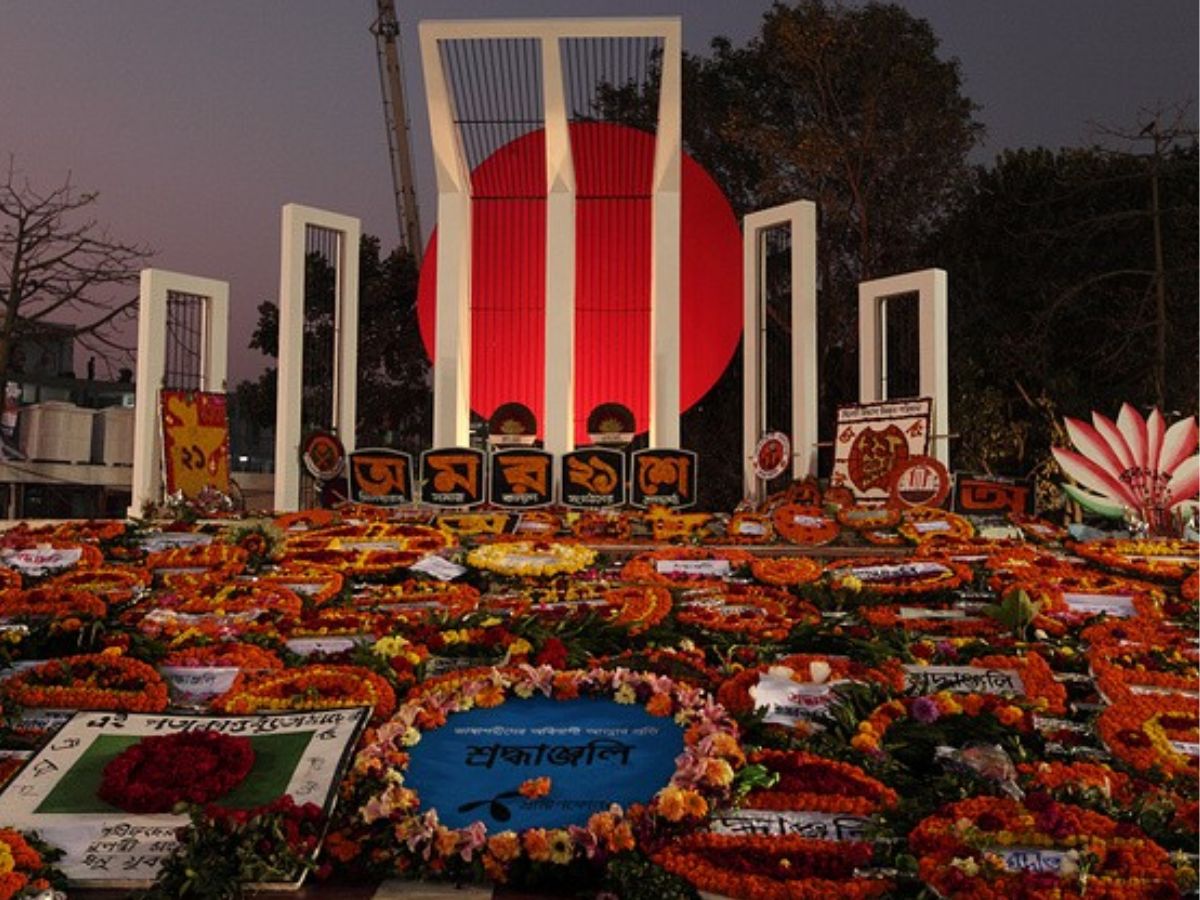
The Language Movement of 1952 is one of the most powerful chapters in the history of the Bengali culture. Ordinary students and citizens risked, and in many cases gave, their lives so that Bengali would be recognised as a state language instead of Urdu. Every year on 21 February, now observed worldwide as International Mother Language Day, Bangladesh honours these martyrs. Their sacrifice helped shape a national identity that eventually led to independence from Pakistan in 1971. Today, however, recent textbook changes under the post-Hasina interim administration have raised concerns. Several critics say that these revisions reduce the importance of the 1952 movement while highlighting other political narratives and many fear this could weaken the country’s connection to its own history.
The Beginning of the Struggle: The 1952 Language Movement
After the Partition of India in 1947, East Pakistan, which is now Bangladesh, was governed by West Pakistan. Despite Bengali speakers making up 56 percent of Pakistan’s population, the government at the time declared Urdu as the only national language. For many in East Pakistan, this was not just a language issue. It was, in fact, a sign of cultural and political domination.
Students of Dhaka University led protests demanding recognition of Bengali. On 21 February 1952, they defied Section 144, which banned public gatherings, and marched in protest. Police opened fire on unarmed demonstrators and killed several people. The deaths deeply moved the nation. Young activists such as Rafiq, Barkat and Salam became symbols of resistance. Their sacrifice turned a language movement into a wider nationalist struggle. By 1954, political change followed, and in 1956 Bengali was recognised as a state language alongside Urdu.
More than 10,000 students initially joined the protests and over 1,000 were arrested and it remains one of the rare moments in history where people gave their lives solely for the right to speak their mother tongue.
Global Recognition: International Mother Language Day
The courage shown in 1952 gained international recognition. In 1999, Bangladesh suggested to UNESCO that the day be marked internationally on 21 February. Since 2000, it has been known as International Mother Language Day, observed in 193 member states.
The Shaheed Minar in Dhaka stands as a national symbol of remembrance. Each year, millions visit barefoot to lay flowers in honour of the martyrs.
The day has inspired language preservation efforts around the world. UNESCO notes that more than 7,000 languages exist globally, many of them endangered. The observance of 21 February has helped bring attention to the importance of protecting linguistic heritage.
In Bangladesh, 21 February is also Martyrs’ Day (Shaheed Dibash) and a national holiday. Black badges, cultural programs and processions keep the memory alive.
From Language to Liberation
The 1952 movement was the beginning of a larger struggle. It inspired later political movements, including the 6-Point Movement of 1966 and ultimately the 1971 Liberation War.
During the 1970 elections, Sheikh Mujibur Rahman’s Awami League, which was rooted in the language movement, won 167 of 169 East Pakistan seats. It was when power was denied that tensions escalated into war. The conflict led to the deaths of nearly three million people.
The victory of the language movement strengthened Bengali nationalism. After independence, the Constitution declared Bengali as the sole national language.
The movement also shaped cultural life. Bengali literature developed, and writers, poets, and musicians enhanced the cultural identity of the nation. Folk culture, Baul songs, and local art forms flourished as a symbol of resistance against the suppression of culture.
Post-Hasina Revisions: Concerns Over History
However, after Sheikh Hasina resigned in August 2024 due to student protests, the caretaker government, led by Muhammad Yunus, started implementing changes in the school textbooks via the National Curriculum and Textbook Board (NCTB). For many parents and teachers, these were more than just normal updates. They had a connection to the history and identity of the nation.
Among the changes were the removal of the title “Bangabandhu” for Sheikh Mujibur Rahman, shorter excerpts from his historic 7 March 1971 speech and very little coverage of the 1952 Language Movement. For many people, these edits felt like changes to stories they had grown up with and held close. For many citizens, especially those who grew up learning these stories with pride, the changes felt personal–as if familiar pages of their own history were being rewritten. At the same time, more attention was given to Ziaur Rahman’s role in the declaration of independence in 1971.
Critics have described these steps as historical revisionism. The government has said the goal is to present a more “fact-based” and balanced account. However, protests followed, and some Mujib-linked sites were vandalised around 21 February 2025.
Reports suggest that newer textbooks have softened descriptions of police brutality in 1952 while reducing the focus on the martyrs. Many fear this could weaken the emotional and historical connection future generations have with the movement.
Present Challenges
In February 2026, political change continues. Tarique Rahman became Prime Minister on 17 February 2026. While the BNP has promised a balanced approach to history, critics remain cautious.
Surveys in 2025 found that almost 30 percent of young people under 25 did not clearly know the details of the 1952 Language Movement. Some reports also said that in 2025 there was a 20 percent drop in the number of people placing flowers at the Shaheed Minar, showing changes in public mood.
Even so, Bengali remains a strong and widely spoken language, used by about 265 million people around the world. The Ekushey Book Fair continues to draw nearly two million visitors every year. Civil society groups and members of the diaspora continue to defend the legacy of the language movement.
Tarique’s Leadership: A Turning Point
With Tarique Rahman’s recent victory, it is still unclear how school history will be taught in the coming years. Some people hope he will give more importance to the 1952 Language Movement. Others fear that political differences may lead to further changes in how history is presented.
Those who want to protect this legacy believe that key speeches, respected titles and the stories of martyrs like Barkat should continue to be taught clearly in schools. If these are reduced or removed, young people may slowly lose touch with the sacrifices that helped build the nation.
The meaning of 21 February is simple but powerful: people have the right to defend their mother tongue. Keeping that memory alive ensures that the sacrifices of 1952 are remembered and not altered over time.




