
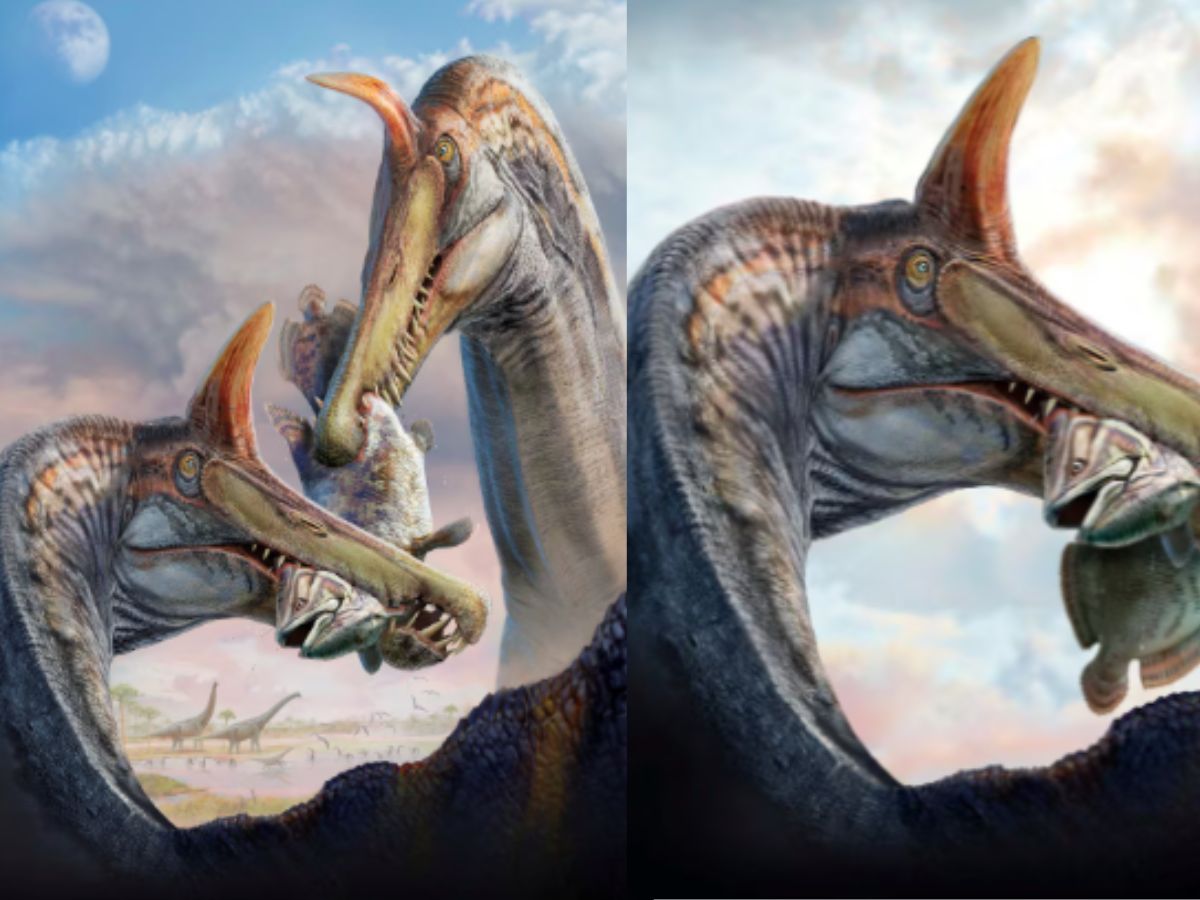
Researchers in a distant and barren region of the Sahara Desert in Niger have found fossils of a new type of Spinosaurus, one of the largest carnivorous dinosaurs that ever existed. The new species of Spinosaurus is distinctive because of its massive blade-like crest on the head and long jaws with interlocking teeth that were perfect for catching fish.
A Giant Predator Spinosaurus That Hunted Like a “Hell Heron”
Researchers say this dinosaur lived around 95 million years ago during the Cretaceous Period. It roamed a forested inland landscape and regularly entered rivers to hunt large fish, much like a modern wading bird. Because of its size about 40 feet long and weighing 5 to 7 tons, one scientist described it as a prehistoric “hell heron.”
Why It’s Called Spinosaurus mirabilis
The dinosaur has been named Spinosaurus mirabilis, with mirabilis meaning “astonishing.” The name refers to its prominent bony crest, which rose about 20 inches high from its skull and curved like a scimitar sword. Like other Spinosaurus species, it also had a large sail-like structure on its back and a long, crocodile-shaped snout.
This marks only the second known species of Spinosaurus ever identified. The first, Spinosaurus aegyptiacus, was discovered in Egypt in 1915 and later became famous through pop culture and films.
How This Species Differs From the Original Spinosaurus
Although both species shared a similar body design, scientists found key differences. Spinosaurus mirabilis had a larger head crest, a longer snout, more widely spaced teeth, and longer hind limbs. These features suggest it was even better adapted for catching fish than its cousin.
Crest Likely Used for Display, Not Combat
Experts believe the tall crest was not used as a weapon, as it appears too delicate despite being made of solid bone. Instead, it was probably covered in keratin similar to a bull’s horns and may have been brightly colored. Researchers think it played a role in attracting mates, showing dominance, or defending feeding territory.
As one scientist put it, “It’s about love and life attracting a mate, defending your hot feeding shallows.”
Perfectly Built for Catching Fish
The dinosaur’s nostrils were positioned farther back on its skull, allowing it to keep most of its snout underwater while still breathing. Its cone-shaped teeth fit tightly together, forming what scientists described as a natural “fish trap” that prevented prey from slipping away.
Researchers say these features make Spinosaurus mirabilis one of the most specialized fish-eating dinosaurs ever discovered.
Fossil Location Changes the Aquatic Debate
Unlike earlier Spinosaurus fossils found near ancient coastlines in Egypt and Morocco, these remains were discovered hundreds of miles inland. This strongly suggests the dinosaur lived in shallow rivers and wetlands, not open oceans. Scientists now say this discovery effectively ends the theory that Spinosaurus was a fully aquatic, deep-water swimmer.
A Challenging Expedition With Big Rewards
The fossils were uncovered at Jenguebi, a fossil-rich site surrounded by sand dunes. During a 2022 expedition, researchers traveled for nearly three days off-road through the desert, often getting stuck in deep sand. Their effort paid off with the discovery of three partial skulls and other bones, along with fossils of other ancient animals.
Spinosaurus Steps Into the Spotlight
Once overshadowed by dinosaurs like Tyrannosaurus rex, Spinosaurus is now gaining renewed attention. With this discovery, scientists say the giant fish-eater is finally having its moment. As one researcher summed it up: “It’s a dino-happening.”




