
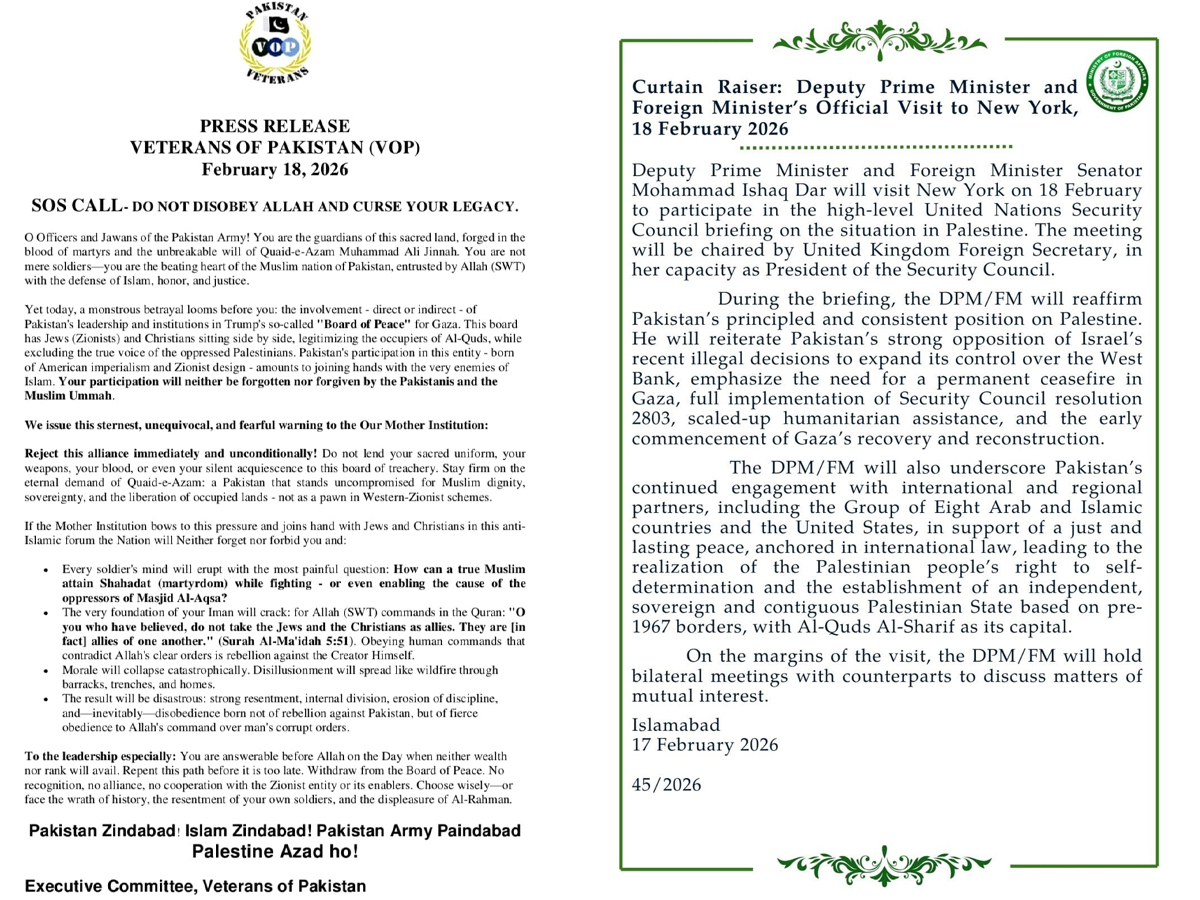
Pakistan’s political leadership faced a major internal conflict as the country’s military veterans issued a stern and impassioned warning against participating in the controversial “Board of Peace” for Gaza, in Washington, D.C. Apart from it having caused a stir internationally, the Board, spearheaded by U.S. President Donald Trump, also affected Pakistan’s own ranks, as prominent military figures voiced their concerns.
The Veterans of Pakistan (VOP), a group representing retired military officers and soldiers, issued an alarming call for the country’s leadership to refuse involvement in the U.S.-backed initiative. The “Board of Peace” was intended to address the ongoing conflict in Gaza and the broader Middle East, but the VOP claimed that its structure, which included both Jews (Zionists) and Christians as participants, undermined the Palestinian cause. Their statement portrayed the forum as a pawn in a larger American and Zionist agenda that they argued could be seen as a betrayal of Pakistan’s values and long-standing support for Palestine.
In their fiery statement, the VOP warned Pakistan’s leadership not to “disobey Allah and curse your legacy” by siding with the “enemies of Islam”—a phrase that highlighted the deep ideological divide the country’s leadership had to grapple with. The veterans made it clear that any kind of engagement with the Board of Peace would be considered an act of legitimizing the Israeli occupation of the Palestinian territories, especially Al-Quds (Jerusalem), which was in direct conflict with the long-standing position of Pakistan on this matter.
The issue became even more complicated as the Deputy Prime Minister and Foreign Minister of Pakistan, Senator Mohammad Ishaq Dar, attended the high-level briefing of the United Nations Security Council in New York on February 18, 2026, which took place against the backdrop of the current scenario in Palestine. The DPM/FM also emphasized Pakistan’s commitment to working with regional and global partners, including the Group of Eight Arab and Islamic countries, to achieve a just and lasting peace in the region, which Pakistan argued must respect Palestinian self-determination and the establishment of a sovereign Palestinian state based on pre-1967 borders, with Al-Quds as its capital.
However, the VOP’s statement made Dar’s task even more difficult. The military veterans, who are a major faction of the Pakistani population, were opposed to any diplomatic move that might lead to a closer relationship with Israel or the West, particularly if it came at the cost of the Palestinian cause. The mention of the Quranic verse that prohibits any alliance with Jews and Christians in this particular context indicated the emotional and religious significance of the issue in Pakistan. It was a direct challenge to the political leadership of Pakistan to adhere to what they believed were the holy tenets of Islam, particularly in the matter of Palestine.
Although the VOP’s statement appeared to cast doubts on the honesty of the present political leadership, the government remained adamant about its diplomatic program. On February 19, 2026, Prime Minister Muhammad Shehbaz Sharif took part in the inaugural meeting of the Board of Peace in Washington, together with his deputy, Ishaq Dar. Despite the VOP’s scathing rebuke, Sharif’s delegation not only attended the meeting but also engaged in bilateral talks with senior U.S. leadership to discuss global and mutual concerns.
The invitation to participate in the Board of Peace put Pakistan’s leadership in a precarious position. They were faced with the need to interact diplomatically with world powers such as the U.S., while also dealing with increasing public pressure from military veterans and nationalist groups who saw the Board of Peace as a compromise that was not welcome. The prime minister and foreign minister were faced with the dilemma of balancing international diplomacy with the national feelings, especially the deeply rooted religious and ideological beliefs that had been reignited by the VOP’s statement.
The situation was very delicate for the Pakistani government. On the one hand, they wanted to play an important role in shaping a peace process that might help bring an end to the suffering of the Palestinian people for decades. On the other hand, they were faced with the pressure to remain true to their moral and ideological commitments to the Palestinian cause, which had been an important part of their foreign policy.
This internal struggle also illustrated the difficulties the leadership faced in dealing with international diplomacy while placating a vocal and influential portion of the population. As Pakistan entered the international arena at the United Nations and met with U.S. officials, it became clear how the government balanced its foreign policy goals with domestic concerns about its position on Palestine. The VOP threat was only the start of a larger debate that would influence Pakistan’s position in the Middle East in the years to come.




