
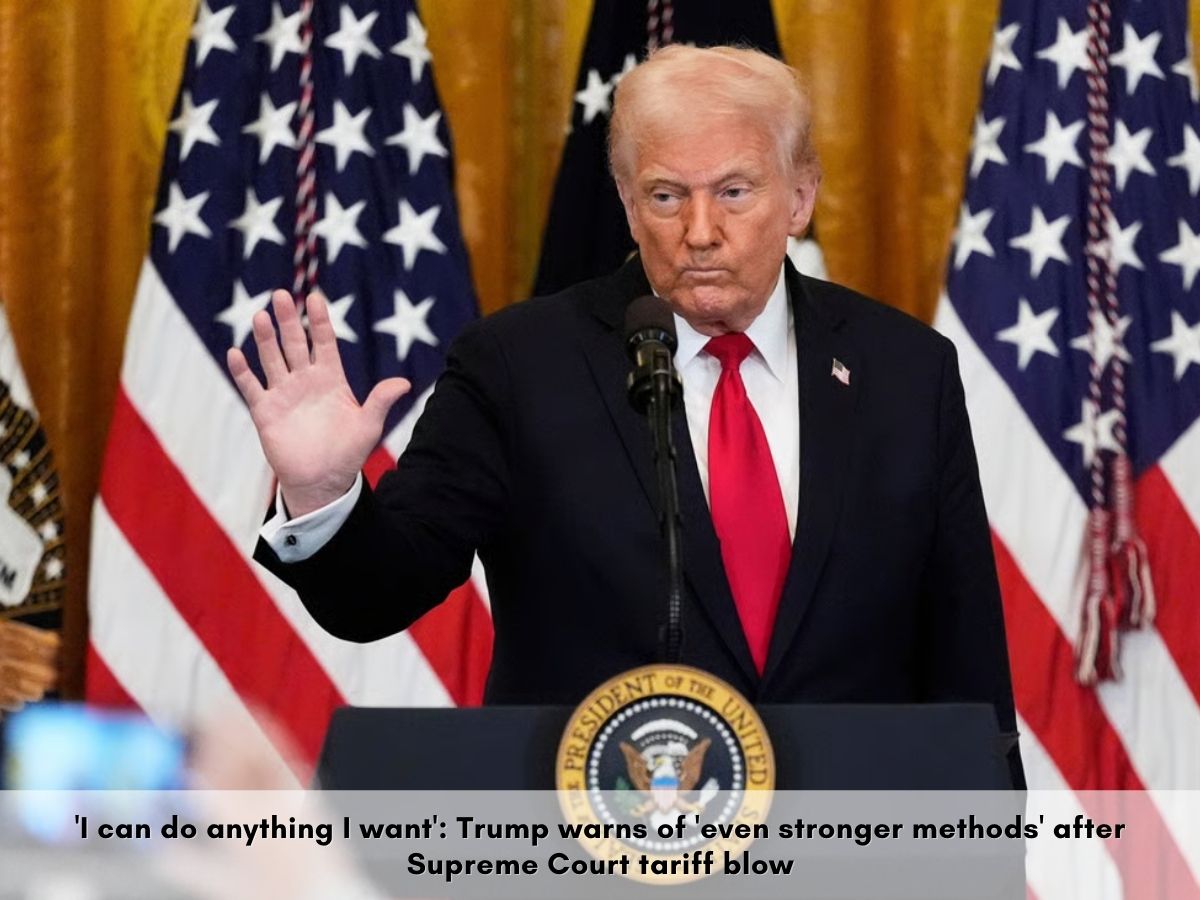
President Donald Trump vowed “even stronger methods” Friday after the Supreme Court’s 6-3 ruling struck down his sweeping tariffs under the 1977 International Emergency Economic Powers Act. In a White House address, he declared “I can do anything I want” and announced plans to sign a 10% global tariff order under Section 122 of the Trade Act, plus new Section 301 investigations.
Why Did Trump Call the Supreme Court Ruling a Disgrace?
Trump labeled the decision “deeply disappointing” and said he felt “absolutely ashamed” of justices lacking “courage” for America. Speaking at a governors’ breakfast, he called it a “disgrace” that dismantled his trade agenda.
Citing Congress’s constitutional taxation authority and the absence of any reference to tariffs, the court, presided over by Chief Justice John Roberts, declared that IEEPA lacked tariff jurisdiction. The majority was joined by Justices Gorsuch, Barrett, Sotomayor, Kagan, and Jackson.
Can Trump Actually Bypass or Override the Supreme Court Ruling?
The Constitution prohibits direct overruling; court interpretations bind branches. Trump cannot ignore it without risking scorn, crisis, or impeachment, despite having pardon power.
There are workarounds, such as switching to Section 301 (unfair practices), Section 232 (national security), or Section 338 (discrimination up to 50%). Long-term solutions can be found by pursuing new legislation or appointments, although such orders are subject to legal challenges.
Experts like Erin McLaughlin say tariffs “are here to stay” via alternatives; Basil Woodd-Walker predicts barriers replacing lost revenue.
What did the Supreme Court Actually Rule?
The court ruled in a 6-3 ruling written by Chief Justice John Roberts that Trump had overreached himself by imposing broad international tariffs under the 1977 International Emergency Economic Powers Act (IEEPA). According to Roberts, “to date, no President has read IEEPA to provide such power” and “IEEPA makes no reference to tariffs or duties.”
The ruling only struck down tariffs imposed via IEEPA. It did not address tariffs under other laws, including Section 232 of the Trade Expansion Act of 1962 (national security), Section 301 of the Trade Act of 1974 (unfair trade practices), or Section 122 of the same act (balance-of-payments).
What is Section 122, and can Trump Legally Use it?
Trump announced he would impose a 10 percent global tariff under Section 122 of the Trade Act of 1974, a law created in response to President Nixon’s 1971 import surcharge. The law allows temporary tariffs of up to 15 percent for up to 150 days when “fundamental international payments problems” exist.
However, legal experts question whether Trump can lawfully invoke Section 122. The provision has never been used by any president. Bryan Riley of the National Taxpayers Union argues the law “only authorizes tariffs in the presence of a fundamental international payments problem”—a condition that hasn’t existed since the U.S. adopted floating exchange rates in 1973.
What Other Tariff Powers does Trump still have?
Justice Brett Kavanaugh, in his dissenting opinion, listed five federal statutes that remain available:
- Section 232 of the Trade Expansion Act of 1962: National security tariffs on steel, aluminum, lumber and automobiles
- Section 301 of the Trade Act of 1974: Retaliation against unfair trade practices
- Section 201 of the Trade Act of 1974: Temporary duties for industries facing import competition
- Section 122 of the Trade Act of 1974: Temporary balance-of-payments tariffs
- Section 338 of the Tariff Act of 1930: Retaliatory duties up to 50% on countries discriminating against U.S. commerce
Kavanaugh noted that “neither the plaintiffs nor the Court has suggested that the numerous laws granting tariff power to the President violate the Constitution’s separation of powers.”
What About the Billions in Tariffs Already Collected?
Justice Kavanaugh warned that “the interim effects of the Court’s decision could be substantial,” noting the U.S. “may be required to refund billions of dollars to importers who paid the IEEPA tariffs, even though some importers may have already passed on costs to consumers or others.”
Economists estimate IEEPA-based tariffs collected since February 2025 total more than $175 billion. The Supreme Court did not address refund procedures, leaving that to the U.S. Court of International Trade.
How did Congress Respond?
Senate Minority Leader Chuck Schumer called the ruling a “victory for the wallets of every American consumer. Trump’s illegal tariff tax just collapsed—He tried to govern by decree and stuck families with the bill.”
Erin McLaughlin of The Conference Board told the BBC the ruling is a “blow” to Trump but “not a knockout one,” noting he has other tariff routes including Section 232.
FAQs
Q: What did Trump claim he would sign Friday?
A: 10% global tariff under Section 122, plus Section 301 probes.
Q: Which justices dissented?
A: Brett Kavanaugh, Clarence Thomas, Samuel Alito.
Q: What doctrine limited executive power?
A: Major questions doctrine for vast actions without clear Congress approval.
Q: Are refunds likely after the ruling?
A: Billions possible to importers; Kavanaugh called process a “mess.”
Q: Does Section 122 allow permanent tariffs?
A: Temporary up to 15% for 150 days on deficits.
Disclaimer: This information is based on inputs from news agency reports. TSG does not independently confirm the information provided by the relevant sources.




