
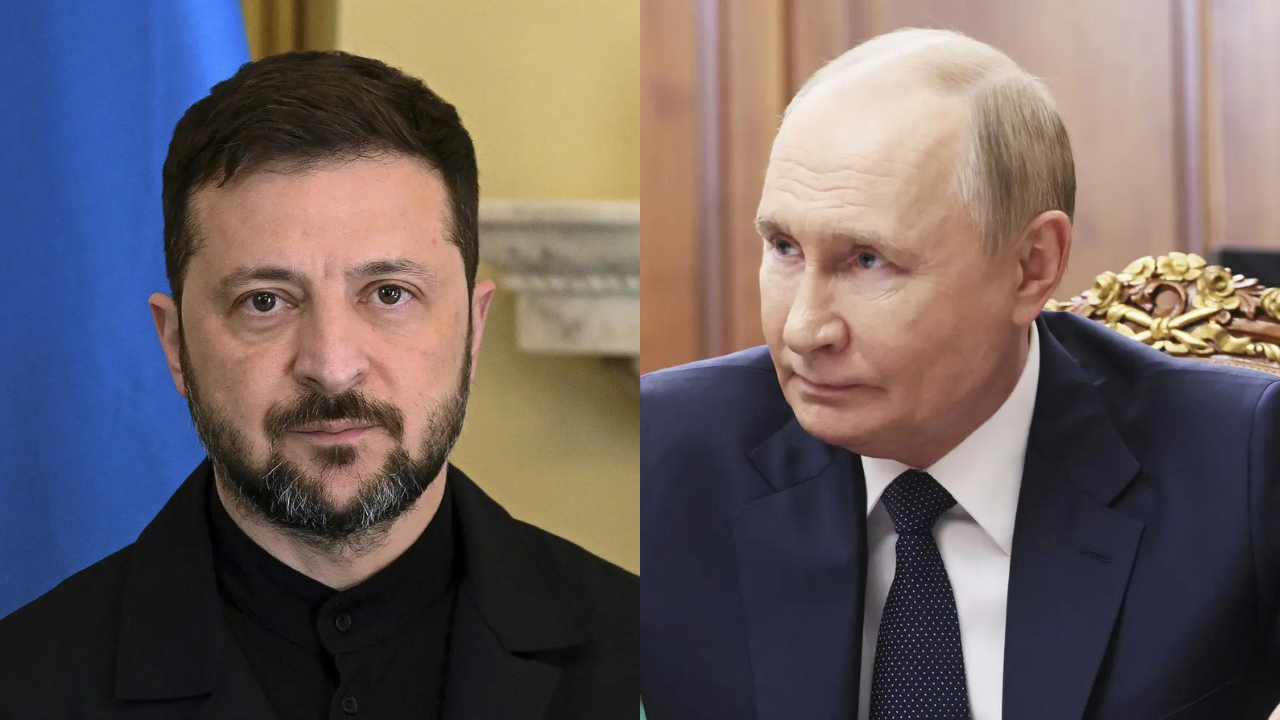
London: Tuesday marks the fourth anniversary of Vladimir Putin’s full-scale invasion of Ukraine, a “special military operation” planned to last just a few weeks. Prior to crossing into Ukraine on 24 February 2022, soldiers were ordered to pack their ceremonial uniforms, as within days they would be marching down the streets of Kyiv, showered with flowers by a welcoming population grateful to them for having been freed from their “Nazi” overlords. Instead, some 250,000 of them are buried in cemeteries around Russia, with another million or so wounded, many seriously, all the result of Putin’s catastrophic miscalculation.
Analysts will be writing about the war in Ukraine for years to come, but the simple fact remains that the invasion was planned and orchestrated by an unbalanced autocratic president who sees himself as a modern “Peter the Great,” determined that Russia should once again be viewed as a great power on the world stage.
But not even Putin himself can now believe that Ukraine, which he claims is a “fake country,” can be brought back into the Russian imperium as a province with no national sovereignty, the original aim of the war. For months, all eyes have been on the endless negotiations aimed at achieving some form of ceasefire acceptable to both sides, the latest of which ended on Wednesday in Geneva without success.
Nevertheless, more than a year after returning to the White House promising to end the Russia-Ukraine War within 24 hours, US President Donald Trump, who sees himself as “Donald the Great,” remains publicly confident that peace is just around the corner. “Very, very good talks today,” he regularly declares after each round of negotiations. “Something could be happening”.
In Kyiv, such optimism is in short supply. Ukrainian officials have learned to tread carefully around Trump’s bold claims. Few wish to risk alienating a US president who has demonstrated a readiness to personalize foreign policy disputes, yet beneath the diplomatic restraint, skepticism runs deep. A late January poll conducted by the Kyiv International Institute of Sociology found that only 20 percent of Ukrainians believe the war will end by July, while 43 percent expect fighting to drag on until 2027 or beyond.
Their doubts are rooted in experience. Ukraine agreed to an unconditional ceasefire in March 2025, but Putin refused to reciprocate. Instead, over the past year, Moscow has engaged in a familiar pattern of delay: stalling negotiations, shifting demands, and introducing fresh preconditions whenever talks appear to gain traction. The result, in the eyes of many Ukrainians and foreign observers alike, is a peace process in name only.
As negotiations have lumbered forward, the war itself has intensified. Russian forces have dramatically expanded their attacks on Ukrainian population centres, contributing to a reported 2,526 civilian deaths in 2025, a 31 percent surge year on year, with about 12,140 injured. This winter brought a particularly grim escalation, with systematic strikes on heating and power infrastructure during Arctic conditions, in what Ukrainian officials described as an attempt to freeze millions in their homes. For some legal scholars and human rights advocates, the deliberate targeting of essential utilities edges toward genocidal intent; at the very least, it underscores the chasm between the language of compromise and the logic of the battlefield.
This disconnect may reflect a fundamental misreading, as for Trump, the conflict appears to resemble a high stakes real estate negotiation: hard bargaining, maximalist opening bids, and eventual compromise along a mutually acceptable line. But Putin’s motivations extend far beyond territorial adjustments or sanctions relief. The Kremlin leader has long framed his war against Ukraine as a civilizational struggle.
To understand the limits of Trump’s delusional deal-making approach, one must revisit the ideological roots of Russia’s invasion. Putin’s hostility toward Ukrainian sovereignty predates the full-scale assault of 2022 by many years. The 2004 Orange Revolution in Kyiv, which overturned a fraudulent election and set Ukraine on a more democratic course, marked a turning point in Moscow’s worldview. From that moment on, Ukraine became the central arena in a broader confrontation between the Kremlin and the democratic West.
The seizure of Crimea in 2014 and the subsequent destabilization of eastern Ukraine were stepping stones toward the much larger invasion launched in February 2022. Throughout this period, Putin has shown himself willing to subordinate Russia’s economic well-being and international standing to what he sees as a historic mission: reversing the consequences of the Soviet collapse and restoring imperial prestige.
Ukraine occupies a singular place in this vision. As the largest non-Russian former Soviet republic and a country deeply intertwined with Russia’s historical narrative, it represents both a symbolic prize and a strategic necessity. Putin has repeatedly insisted that Russians and Ukrainians are “one people,” dismissing Ukraine as an artificial construct manipulated by hostile Western powers. State-controlled media has amplified this message relentlessly, portraying Ukraine as an “anti-Russia” run by extremists and “Nazis”.
This propaganda campaign has had a profound effect inside Russia and, despite mounting casualties and economic strain, visible anti-war sentiment remains muted. The dehumanization of Ukrainians has helped insulate the Kremlin from domestic backlash while preparing the ideological ground for a war that increasingly resembles a struggle for national erasure.
From this vantage point, Trump’s reportedly generous peace proposals, allowing Russia to retain captured territories with limited consequences, are less attractive than they might appear. A settlement based on current front lines would still leave roughly 80 percent of Ukraine outside Kremlin control and free to pursue integration with Europe. For Putin, that outcome would represent strategic failure. His objective is not simply to expand Russia’s borders but to prevent the consolidation of a stable, democratic Ukrainian state on Russia’s doorstep.
The stakes are also personal, as Putin has cast himself as a historical figure destined to restore Russian greatness. Comparisons to imperial rulers are common in Kremlin rhetoric, and a compromise peace that cements Ukraine’s independence would shatter that narrative. Rather than entering history as a conqueror, Putin risks being remembered as the leader who failed to conquer what Moscow long considered its most vital neighbour.
On the battlefield, the gap between ambition and reality has grown increasingly stark. When Russia launched its full-scale invasion, Putin vowed to “demilitarize” Ukraine. Four years later, Ukraine fields the largest army in Europe and has emerged as a world pioneer in drone warfare and battlefield innovation. Its forces have blunted multiple Russian offensives and turned the conflict into a grinding war of attrition. Russian troops suffered hundreds of thousands of casualties in 2025 while capturing less than one percent of Ukrainian territory. At this pace, military analysts calculate it would take decades to conquer the country outright.
Even so, Putin continues to project confidence, insisting that Russia’s objectives will be achieved in full. That narrative has begun to fray. In late 2025, the Kremlin repeatedly claimed to have seized Kupyansk, a key city in the Kharkiv Oblast; Ukrainian President Volodymyr Zelenskyy responded by visiting the city and filming a selfie video from its streets, puncturing Moscow’s assertions. The episode highlighted a widening credibility gap between official Russian pronouncements and battlefield realities.
Putin’s second declared war aim, “denazification,” has fared no better. Intended as shorthand for dismantling Ukraine’s independent identity and installing a pliant regime, it has instead catalysed a powerful surge in Ukrainian patriotism. Russian language and cultural symbols have been pushed aside in many parts of the country, while support for European integration has solidified. The prospect of a pro-Kremlin government in Kyiv now appears viable only under indefinite military occupation, a prospect that would drain Russian resources for years.
Internationally, the war has redrawn perceptions. For centuries, Ukraine was often viewed as inseparable from Russia, but now that perception has shifted dramatically. Today, Ukraine is widely regarded as a frontline European democracy whose fate carries profound implications for continental security. European governments, alarmed by Washington’s fluctuating commitments, have doubled down on their own support. Even as US military aid declined over the past year, assistance continues to flow through alternative mechanisms such as the Prioritised Ukraine Requirements List (PURL) initiative. Meanwhile, Kyiv’s revitalized defence industry now reportedly meets around half of the country’s military needs domestically, reducing dependence on external suppliers.
This evolving strategic environment leaves Putin in a bind. It is becoming increasingly impossible to achieve the sweeping victory he once promised, yet accepting a compromise peace would amount to acknowledging that his grand project has failed. As the invasion approaches its fifth year, the Kremlin leader faces a stark dilemma: escalate further in the hope of breaking Ukrainian resilience, or seek an exit that risks undermining his authority at home. Put simply, this is Vladimir Putin’s self-inflicted dilemma four years on.
* John Dobson is a former British diplomat, who also worked in UK Prime Minister John Major’s office between 1995 and 1998. He is currently a visiting fellow at the University of Plymouth




