
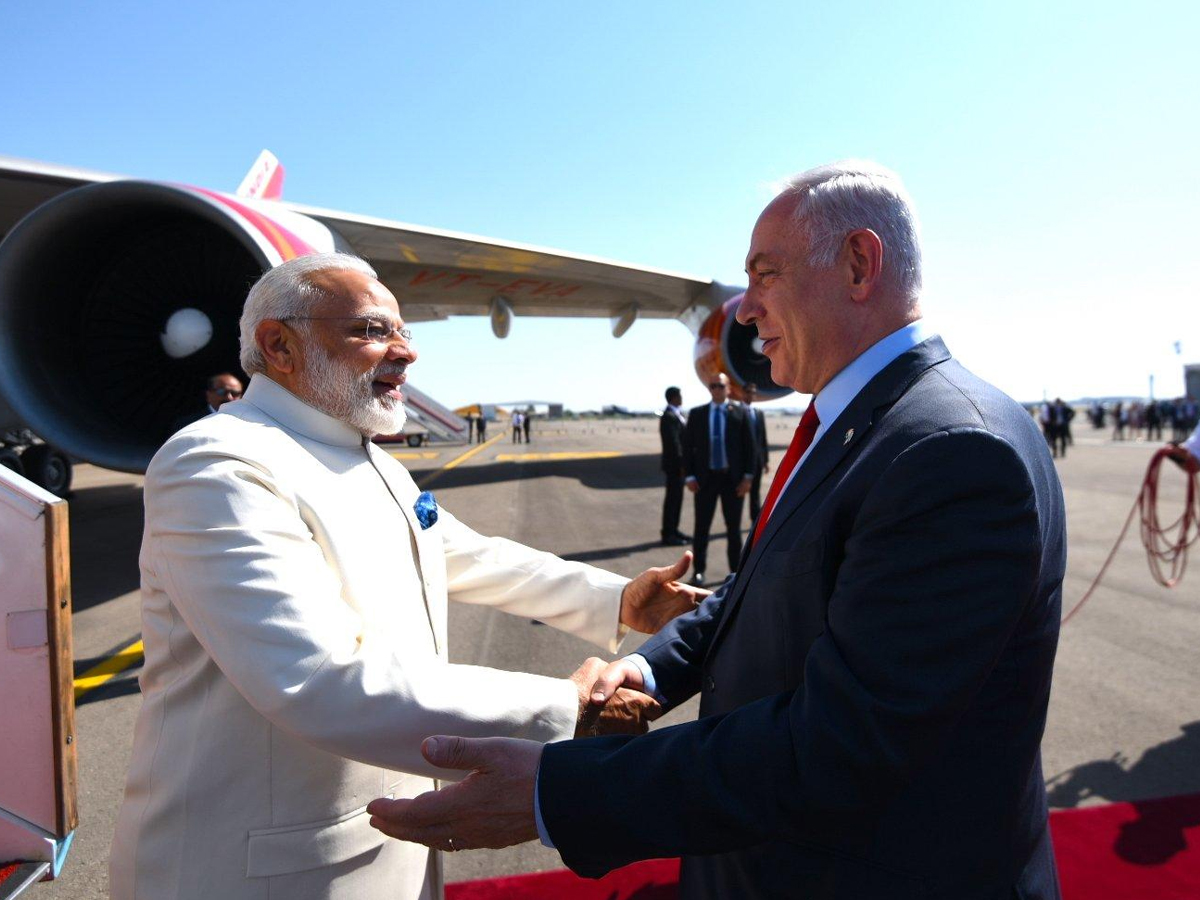
New Delhi: India and Israel on Wednesday decided to upgrade their bilateral relationship to a Special Strategic Partnership, with Prime Minister Narendra Modi and Israeli Prime Minister Benjamin Netanyahu announcing a broad expansion of cooperation across defence, technology, trade and agriculture.
In a joint press interaction after talks in Jerusalem, Modi said the decision reflected the deep trust, shared democratic values and long standing people to people ties between the two countries. He described the move as a historic step aligned with the aspirations of the people of both nations.
The announcement came during Modi’s visit to Israel, where he also addressed the Knesset and was conferred the Speaker’s medal.
Recalling his earlier visit nine years ago as the first Indian Prime Minister to travel to Israel, Modi said returning to the country was a moment of pride and emotion.
Both sides agreed to accelerate negotiations on a mutually beneficial Free Trade Agreement. They referred to the Bilateral Investment Agreement concluded last year and said economic engagement was emerging as a key driver of growth, innovation and shared prosperity.
Technology featured prominently in the discussions. The two leaders announced the launch of a Critical and Emerging Technologies Partnership covering areas such as artificial intelligence, quantum technologies and critical minerals.
They also welcomed an agreement enabling the use of India’s Unified Payments Interface in Israel and committed to cooperation in digital health.
Officials said that defence cooperation, described as decades old and reliable, is set to expand through joint development, joint production and transfer of technology.
The two sides also signalled intent to deepen engagement in civil nuclear energy and space.
Agriculture remains a central pillar of the partnership, as the joint statement suggests. Modi said Centres of Excellence established in India with Israeli collaboration would be scaled up to 100. The two countries will also work on creating Villages of Excellence aimed at taking Israeli agricultural technologies to rural India, with an emphasis on improving farmer incomes and productivity. An India Israel Innovation Centre for Agriculture is to be set up to support future ready farming solutions.
On mobility and workforce cooperation, the leaders referred to the 2023 manpower mobility agreement under which Indian workers have contributed to Israel’s construction and caregiving sectors.
The scope of cooperation is now being expanded to commerce and services, alongside the creation of an India Israel Academic Forum to link youth, researchers and innovators.
Regional and global issues also figured in the talks.
Modi said India would work with Israel and partners to advance the India Middle East Europe Economic Corridor and the I2U2 grouping involving India, Israel, the United States and the United Arab Emirates.
On security, both leaders reiterated that there is no place for terrorism in any form. Modi said India and Israel would continue to stand shoulder to shoulder against terrorism and its supporters.
Referring to the situation in West Asia, he underlined India’s support for dialogue and peaceful resolution, stating that humanitarian concerns must not become victims of conflict and that India backed ongoing efforts, including proposals aimed at peace in Gaza.
The visit signals a consolidation of strategic convergence between New Delhi and Jerusalem at a time of shifting regional dynamics, with both sides positioning technology, security and connectivity as the core pillars of their upgraded partnership.




