
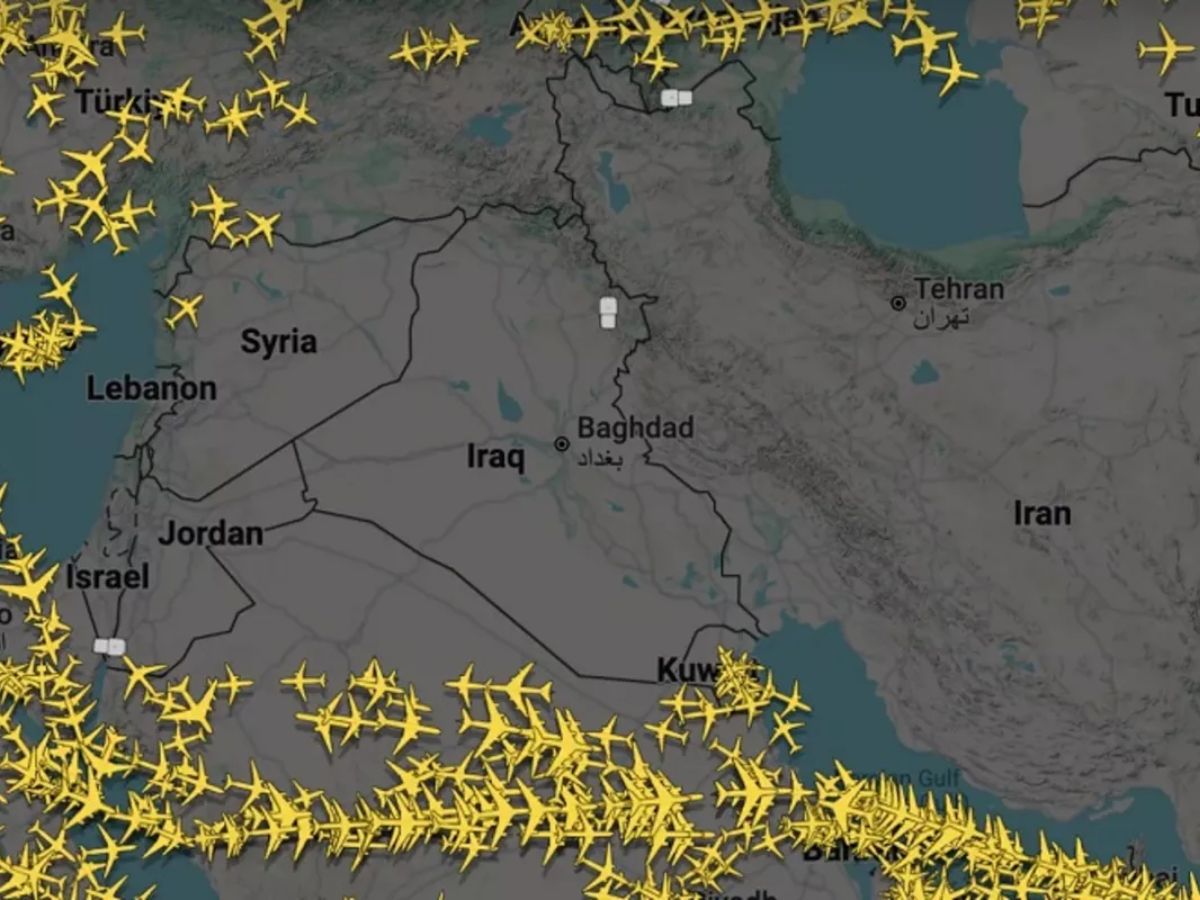
Global airlines suspended or diverted flights across the Middle East on Saturday after the United States and Israel launched airstrikes on Iran. Countries including Israel, Iran, Iraq, Jordan, the UAE, Kuwait and Oman temporarily closed their airspace, disrupting one of the world’s busiest aviation corridors. A live map from Flightradar24 showed aircraft rerouting to avoid the affected areas.
Middle East Airspace Closures After US-Israel Strikes on Iran
Following airstrikes by the United States and Israel on Iran, several Middle Eastern countries, including Israel, Iran, Iraq, Jordan, UAE, Kuwait, and Oman, temporarily closed their airspace. The airspace is one of the world’s busiest aviation corridors, and has faced repeated disruption amid rising tensions.
Major Flight Disruptions Across the Region
Airlines had to cancel, divert, or delay flights. Qatar Airways, Lufthansa, Air France, KLM, Wizz Air, Air India, British Airways, Japan Airlines, Turkish Airlines, Virgin Atlantic, and many others were impacted. Some flights were forced to circle in holding patterns or return to their original airports due to safety concerns.
Russia’s transport ministry announced that all Russian airlines have temporarily suspended flights to both Iran and Israel in response to the escalating military tensions in the region. Germany’s Lufthansa also confirmed it would suspend its scheduled services to and from Dubai for the time being. Meanwhile, Kuwait’s aviation authority has halted all flights to Iran until further notice, and Oman Air reported a suspension of all flights to Baghdad, citing safety concerns amid the recent airstrikes and regional instability.
Impact on International Travel
The Middle East is a key corridor for flights between Europe and Asia, especially since much of the Russian and Ukrainian airspace remains restricted. The closure of airspace was to ensure the safety of commercial flights, which face the risk of accidental or deliberate shoot-downs. On the other hand, the longer rerouted journeys increase fuel consumption and costs for commercial flights, and anxiety and delays for international passengers.
Advice for Travelers: What to Check Before Flying
Passengers should check flight statuses regularly and follow airline and government advisories. Rebooking and scheduling changes are expected while the situation remains volatile. Travelers are advised to stay updated on airspace developments and exercise caution before planning trips through the region.
The escalation of the US-Iran War has led to the closure of airspace across the Middle East, causing flight delays and cancellations. Travelers should keep checking their flight updates and expect longer journeys. Safety is the main concern, so plan ahead and be ready for changes while the situation remains uncertain




