
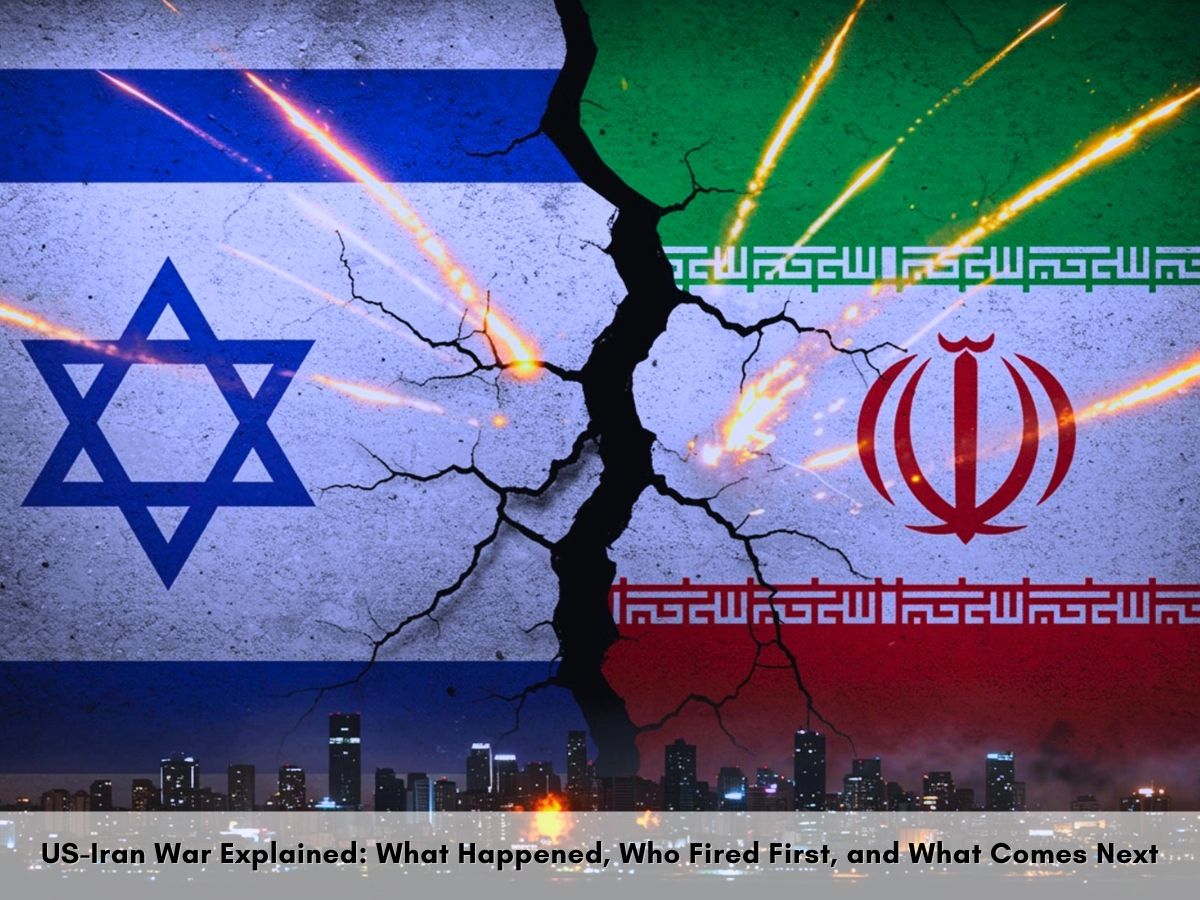
The United States and Israel launched joint military strikes on Iran on February 28, 2026, triggering Iranian missile attacks on US bases across the Middle East and Israel. Here is a simple, step-by-step explanation of why the war is happening, who is involved, and what we know so far .
Why are the US and Israel attacking Iran right now?
The current war did not start overnight. It is the result of decades of tension that came to a head in recent weeks. Here is the simple timeline:
- The long-standing issue: For years, the US and Israel have claimed that Iran’s nuclear program and missile development pose a threat to their security. Iran has repeatedly stated it is not building a nuclear bomb. Israel is the only country in the Middle East with nuclear weapons .
- The breaking point: In the weeks before February 28, the US and Iran were holding negotiations mediated by Oman over Iran’s nuclear program. Reports said Iran had agreed to stop enriching uranium and allow full UN inspections .
- Trump’s threats: President Donald Trump spent weeks issuing mounting threats against Iran. The US assembled its largest military fleet in the region since the Iraq War, including fighter jets and warships .
- The attack: On the morning of February 28, Israel announced it had launched missile strikes on targets inside Iran. A US official confirmed the strikes were a joint operation with Israel. Trump called it “major combat operations” under the name “Operation Epic Fury” .
What exactly did the US and Israel hit in Iran?
Explosions were reported across multiple Iranian cities beginning at around 9:27 am Tehran time . Here is where strikes were reported:
- Tehran: Explosions near the office of Iran’s Supreme Leader Ayatollah Ali Khamenei. Roads to his compound were shut down
- Other cities: Kermanshah, Qom, Tabriz, Isfahan, Ilam, Karaj, and Lorestan province
- Targets: The stated goal, according to Trump, is to “destroy their missiles and raze their missile industry to the ground” and “annihilate their navy”
What did Iran do in response?
Iran retaliated within hours. The attacks happened in two waves:
First wave: Targeting Israel
- Iran launched missiles toward northern Israel
- Air-raid sirens sounded across Israel
- The Israeli military activated its air defense systems
- Blasts were heard in northern Israel
Second wave: Targeting US bases across the Middle East
Iran fired missiles at multiple locations housing US military forces :
| Location | Target |
|---|---|
| Qatar | Al Udeid airbase |
| Kuwait | Al-Salem airbase |
| UAE | Al-Dhafra airbase |
| Bahrain | US Fifth Fleet headquarters |
| Saudi Arabia | Explosions reported in Riyadh |
| Jordan | US bases reportedly attacked |
What did Trump say about the war?
In his announcement of “Operation Epic Fury,” Trump made several key points :
- Military goals: Destroy Iran’s missiles, target its navy, disrupt Iran-backed armed groups, and prevent Iran from getting a nuclear weapon
- Offer to Iranian soldiers: If they lay down their weapons, Trump promised amnesty
- Warning to Iranian soldiers: If they do not surrender, they face “certain death”
- Call to Iranian people: Trump said Iranians should “take over your government. It will be yours to take. This will be, probably, your only chance for generations”
Al Jazeera’s Alan Fisher said this appears to be an attempt to trigger a revolution in Iran, similar to the 1953 CIA-orchestrated coup, but “this time, they’re doing it with weapons and bombs rather than covertly” .
What did Israel’s Netanyahu say?
Israeli Prime Minister Benjamin Netanyahu announced that Israel’s part of the military operation is called “Lion’s Roar.” He said the operation “will continue as long as necessary” .
Who is on whose side in this war?
The conflict has divided the region into two main groups :
Israel’s allies:
- United States: Primary military backer, directly involved in strikes
- United Kingdom: Participating in defensive regional operations
- Germany and France: Provided weapons and logistical support
- Regional partners (defensive): Jordan, UAE, Saudi Arabia, Bahrain, and Qatar have helped intercept Iranian missiles or provided intelligence
Iran’s allies (“Axis of Resistance”):
- Hezbollah (Lebanon): Powerful non-state ally with strong military ties to Iran
- Houthi Movement (Yemen): Provides long-range drone and missile support
- Militias in Iraq and Syria: Groups like the Popular Mobilization Forces
- Palestinian groups: Hamas and Palestinian Islamic Jihad (though weakened in recent conflicts)
- Global partners: Russia and China maintain strategic ties with Iran and have shielded it from UN sanctions, but are not directly involved in fighting
Where are Iran’s leaders now?
- Supreme Leader Ayatollah Ali Khamenei (age 86): His location is unknown. He has not been seen publicly in days. Roads to his compound in Tehran were shut down after the blasts
- President Masoud Pezeshkian: Iran’s state-run IRNA news agency confirmed he was unharmed
What has the world said about the attacks?
- Oman: Foreign Minister Badr Albusaidi said Omani-mediated negotiations between Iran and the US were “yet again undermined” and urged the US “not to get sucked in further” .
- Qatar: Condemned the Iranian attack as “a flagrant violation of its national sovereignty” .
- UAE: Condemned Iranian missile attacks that reportedly killed a Pakistani national, warning of “grave consequences” .
- European Union: Foreign policy chief Kaja Kallas called the situation “perilous” and urged protection of civilians .
- France: President Emmanuel Macron warned the conflict carries “grave consequences for international peace and security” and said “it must stop” .
- Russia: Security Council Deputy Chairman Dmitry Medvedev accused Washington of using negotiations as a “cover operation” for the attack .
- UK: Said Iran must never be allowed to develop nuclear weapons .
- Canada: Prime Minister Mark Carney expressed support for US efforts to prevent Iran from obtaining a nuclear weapon .
FAQs: US-Iran War Explained
Q. Why did the US and Israel attack Iran?
A. The US and Israel say they attacked to destroy Iran’s missile program and prevent it from developing nuclear weapons. The attack came after weeks of negotiations over Iran’s nuclear program collapsed .
Q. Did Iran attack first?
A. No. The US and Israel launched the first strikes on February 28, 2026. Iran retaliated afterward by firing missiles at Israel and US bases .
Q. Is this a new war?
A. This is a major escalation of tensions that have existed for decades. The US and Israel previously waged a 12-day war against Iran eight months ago, in June 2025 .
Q. Will other countries join the fighting?
A. So far, the fighting involves the US, Israel, and Iran. Iran’s allies like Hezbollah and the Houthis have not yet joined the fight, but they are watching closely. Russia and China have not sent troops .
Q. Is Iran trying to build a nuclear bomb?
Iran has repeatedly and publicly stated it has no intention of building a nuclear bomb. Israel is the only nuclear-armed country in the Middle East. However, the US and Israel say Iran’s nuclear program is a threat .
Q. Were Iran’s leaders killed in the attack?
A. Iran’s Supreme Leader Ayatollah Ali Khamenei’s location is unknown, but he has not been seen publicly. President Masoud Pezeshkian has been confirmed unharmed .
Disclaimer: This information is based on inputs from news agency reports. TSG does not independently confirm the information provided by the relevant sources.




