
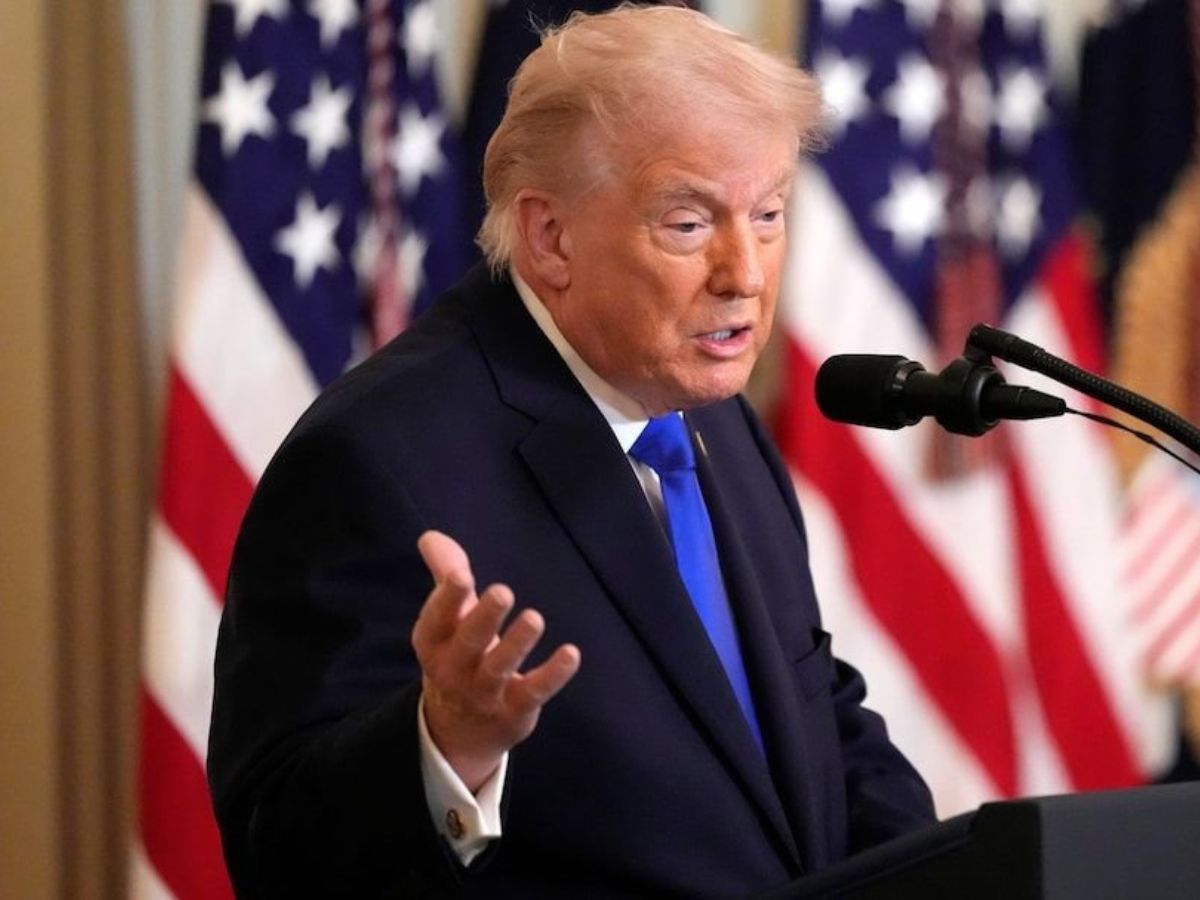
If there were a Nobel Prize for creating dizzying hype and sweeping bravado about one’s achievements, US President Donald John Trump will deserve it more than anyone else. In his first State of the Union address in his second term on 24 February, he claimed, “Our nation is back: bigger, better, richer and stronger than ever before…this is the golden age of America” and ended his address in the same triumphal mode: “Our future will be bigger, better, brighter, bolder and more glorious than ever before.” While his one-hour and 47-minute-long speech was greeted with standing ovation and chants of “USA, USA” by his Republican supporters, not surprisingly, the Democrats remained seated and attracted his ire: “You should be ashamed of yourself.”
Though the phrases used and the tone adopted aren’t as strident, the report card of the last 10 years or so pronounced by the present dispensation—or any government for that matter—at different fora tends to be a long list of shining achievements which have transformed India and strongly asserts that India is marching confidently towards the goal of becoming Viksit Bharat by 2047; expectedly, the opposition parties are routinely accused of weakening the country.
Trump claimed that his policies have spurred the economy, brought down inflation and unemployment, driven the stock market to record highs, introduced tax cuts, lowered drug prices, collected billions of dollars from tariffs imposed on imports and blamed the Biden administration for high prices. He referred to the Democrats as “crazy” and “anti-national”, destroying the nation; some aspects of his rhetorics sound familiar; we witness them in our Parliament too. One wonders how positive it will be if we were more nuanced in our claims of success and tempered in our criticism of our opponents. Yes, one can’t clap with one hand, and both sides ought to show willingness; but somebody has to take the initiative.
While a CNN opinion poll suggested that 64% speech watchers had a positive opinion of Trump’s speech, majority of ordinary Americans feel that prices of groceries, housing, insurance and utilities haven’t come down and he has failed on his campaign assurances of making life more affordable. In India too, the government is often blamed of not fulfilling promises made during election campaigns. Trump claimed success in deporting and stopping entry of undocumented migrants (aliens) whom he squarely blamed of drug peddling and violent crimes. Many Americans believe his administration has gone too far in immigration crackdown and statistics show that claims of immigrants’ involvement in criminal incidents are exaggerated, if not untrue. He flagged a new “Save America Act” which would require voter registrations to keep non-citizens out of the elections process. Don’t these measures look similar to our campaign against illegal infiltrators, whom some political parties are accused of sheltering for electoral benefits?
But there is a striking difference between what the POTUS can say about the judiciary in the USA and what our government cannot even dream of. When, on February 20, the US Supreme Court threw out his tariff regime initiated under IEEPA (International Emergency Economic Power Act), in a blistering attack, Trump called the judges “fools” and “lapdogs”; in his SOTU speech he termed the judgement as “unfortunate”. In India such utterances would have severe consequences. Taking suo motu cognisance of a chapter on “Corruption in Judiciary” in a Class 8 social sciences book brought out by the NCERT (National Council of Educational Research and Training), the Supreme Court of India banned it and its circulation in any form. Chief Justice of India Surya Kant, in a blunt statement said, “I will not allow anyone on earth to defame the Institution (judiciary).”
Notwithstanding the Supreme Court’s rejection of his tariff regime, Trump has lost no time in announcing new 10% (later raised to 15%) duties on all imports and vowed to continue the tariffs under different laws which might need Congressional approval after 150 days; he claims he needs no Congressional approval. He has also issued a stern warning to all those who had signed trade deal: “don’t try to renegotiate or you will get far worse.” So, the tariffs scene remains uncertain; India may have to live with the current status despite the luncheon meeting between US Commerce Secretary Howard Lutnick, Union Commerce Minister Piyush Goyal and US Ambassador Sergio Gor in Delhi; but the positivity generated by the Joint statement on the Framework for an Interim Agreement (February 7) should stay.
Lastly, no matter how much we squirm, Trump again claimed that he had brokered ceasefire between India and Pakistan. India has adopted the right stance on this issue: not to react at all. Sometimes, silence is more effective than a thousand words.
-
Surendra Kumar is a retired ambassador of India.




