
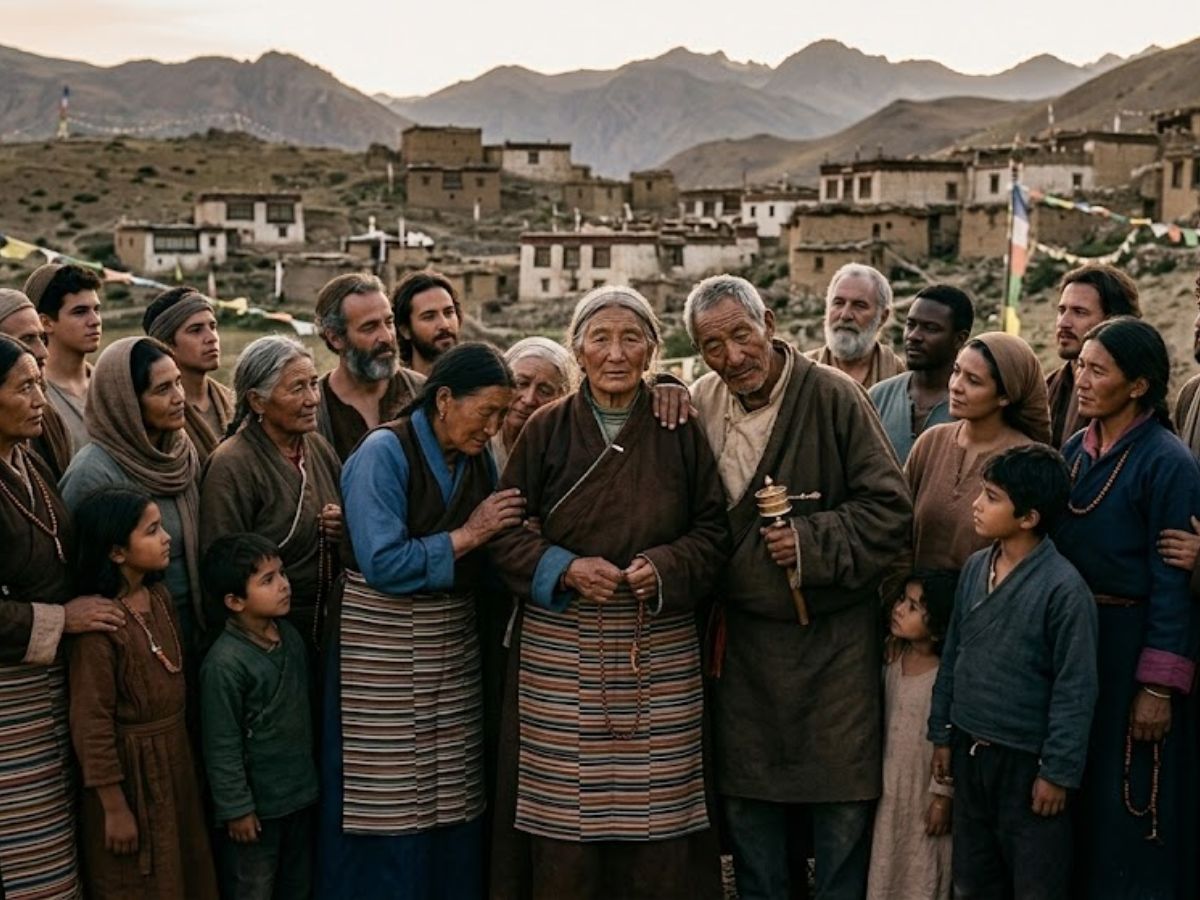
China’s problems with Tibet endure because Beijing is trying to solve a political and civilizational question with instruments of coercion, assimilation, and demographic engineering—tools that cannot manufacture legitimacy where none exists. The core reality is simple and immovable: Tibetans are not Chinese, and no amount of pressure, propaganda, or “ethnic fusion” campaigns can turn a distinct people with their own history, language, faith, and memory into something they are not. Beijing’s policies can suppress, but they cannot transform.
The Chinese state has spent seven decades insisting that Tibet is an inseparable part of China. Yet the intensity of its efforts betrays its insecurity. A territory that is truly secure does not require mass surveillance and grid-style policing, boarding schools designed to separate children from their families, restrictions on language, religion, and movement, criminalization of loyalty to one’s own culture, and a permanent military presence to enforce “stability”. These are not the hallmarks of confidence. They are the architecture of a government that knows it has not won the consent of the governed. Tibetans have never internalized Beijing’s narrative of belonging to the Chinese nation. Their sense of identity predates the People’s Republic by centuries and is rooted in Buddhism, the land, and the institution of the Dalai Lama. This identity is not a political slogan; it is a lived inheritance. It cannot be erased by decree.
Beijing’s strategy rests on the belief that identity is malleable if pressure is applied long enough. But the state misunderstands the nature of Tibetan resilience. Language is not just communication—it is worldview. Mandarin-language schooling, especially the boarding school system that now houses nearly a million Tibetan children, aims to produce a generation that thinks and dreams in Chinese. Yet Tibetan families continue to teach their children prayers, stories, and songs at home. Even when language is suppressed, cultural memory persists.
Religion cannot be nationalized. The Communist Party’s attempt to control monasteries, appoint reincarnate lamas, and dictate the future of the Dalai Lama misunderstands the spiritual authority of Tibetan Buddhism. Faith is not granted by the state, and legitimacy cannot be manufactured by political committees. The more Beijing interferes, the more Tibetans cling to their traditions.
Demographic engineering cannot dissolve belonging. Large-scale migration of Han settlers into Tibetan areas has changed the urban landscape, but it has not changed Tibetan consciousness. Instead, it has deepened the sense of being colonized in one’s own homeland. Surveillance breeds defiance, not loyalty. The omnipresent security apparatus—cameras, checkpoints, informant networks—creates compliance, not conviction. Tibetans know the difference between silence and acceptance.
The Chinese government often frames Tibetans as backward minorities who must be “modernized.” But Tibetans have shown a remarkable ability to adapt without surrendering their identity. They use technology to preserve language, share teachings, and maintain community across borders. They keep alive the memory of a free Tibet through oral history, religious practice, and cultural continuity. Even inside Tibet, where expression is dangerous, the persistence of Tibetan identity is unmistakable.
The state’s own internal documents—leaked over the years—acknowledge that Tibetans remain “ideologically resistant” and “politically unreliable.” Beijing’s campaigns are not failing because they are insufficiently forceful; they are failing because they target the wrong thing. You cannot coerce a people into forgetting who they are.
China’s Tibet problem is not a temporary challenge. It is structural, rooted in contradictions that cannot be reconciled through authoritarian means. A state that demands loyalty cannot tolerate a people whose spiritual leader lives in exile. A government that fears cultural difference cannot accept a civilization built on nonviolence, compassion, and monastic authority. A political system that equates unity with uniformity cannot coexist with a nation that insists on being itself.
As long as Beijing insists that Tibetans must become Chinese in order to be loyal, the conflict will remain unsolvable. Identity is not a policy variable. It is a truth people carry within them. China’s leaders often speak as if time is on their side—that with enough years, enough schools, enough surveillance, Tibetans will eventually assimilate. But history suggests the opposite. Cultures under pressure do not dissolve; they harden. Nations denied self-expression do not fade; they deepen their sense of purpose.
Tibetans have survived exile, occupation, and cultural assault. They have preserved their language, their faith, and their dignity. They have raised new generations who know exactly who they are.
China’s problem with Tibet is not that Tibetans resist. It is that Tibetans endure.
-
Khedroob Thondup, a geopolitical analyst, is the nephew of the Dalai Lama.




