
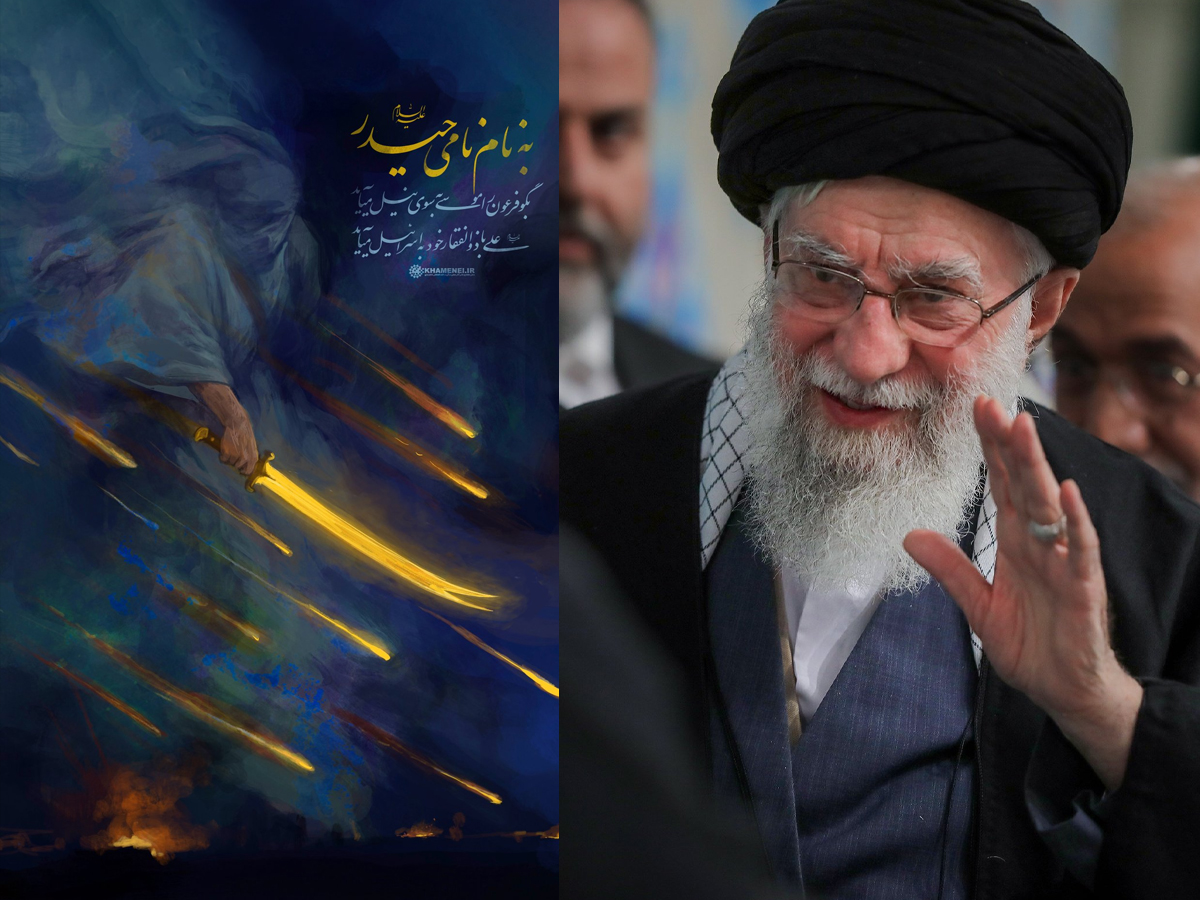
As the Middle East faces one of its most volatile moments in years after US and Israeli strikes on Iranian targets, a late-night social media post from Ayatollah Ali Khamenei has sparked intense discussion, not because of what it said directly, but because of what it appeared to signal.
In the early hours of February 28, 2026, Khamenei’s official Persian-language X account shared a religious image during Ramadan. The post showed Imam Ali, revered in Shia Islam, holding the legendary Zulfiqar sword amid fire, streaking meteors, and a darkened sky. On the surface, the post looked devotional. But its timing — just hours after Donald Trump claimed that Iran’s Supreme Leader had been killed, gave it a far more powerful meaning.
به نام نامی حیدر علیهالسلام pic.twitter.com/n848j6KASq
— KHAMENEI.IR | فارسی (@Khamenei_fa) February 28, 2026
The message landed when uncertainty surrounded Iran’s leadership and when reports of strikes near Tehran dominated global headlines. In that context, the imagery appeared deliberate, symbolic, and politically loaded.
Ayatollah Ali Khamenei Killed: What Is the Zulfiqar Sword and Why Is It Important?
The Zulfiqar (also spelled Dhulfiqar) holds deep meaning in Shia Islam. According to tradition, the sword belonged to Imam Ali, the cousin and son-in-law of Prophet Muhammad. It represents divine justice, bravery, and moral authority.
A well-known devotional line linked to the symbol states: “There is no hero like Ali, and there is no sword like Zulfiqar.”
The sword often appears with a split blade, a design that has come to symbolise resistance against injustice and unwavering courage. Over centuries, believers have viewed it not just as a weapon, but as a sign of righteous struggle.
Supreme Leader Ayatollah Ali Khamenei Killed
The United States and Israel carried out a large-scale military operation that resulted in the killing of Iran’s Supreme Leader Ayatollah Ali Khamenei, US President Donald Trump claimed on Saturday, in what could become a turning point for the Middle East.
Trump said the strike opened what he called a rare opportunity for the Iranian people to reclaim their country, even as the development deepened fears of wider regional turmoil and uncertainty about Iran’s political future.
In a social media post, Trump declared, “Khamenei, one of the most evil people in History, is dead.” He also warned that the United States would continue “heavy and pinpoint bombing” in the coming days and beyond, as part of a wider campaign aimed at crippling Iran’s nuclear programme.
Iranian authorities, however, have not issued any immediate confirmation regarding the reported death of Ayatollah Ali Khamenei, leaving the claim unverified amid rapidly evolving tensions.
Israel Attacks Iran: Why Did the Zulfiqar Image Appear During the Iran War Crisis?
The post’s timing matters as much as its content. It appeared during Ramadan, a month of reflection, sacrifice, and endurance. It also came at a moment when Iran faced military pressure and global speculation over its leadership.
In modern Iranian political culture, Zulfiqar imagery often conveys strength during conflict. Flames in the artwork suggest destruction and suffering, while meteors imply events of historic or cosmic scale. The raised sword signals defiance rather than retreat.
For many observers, the post looked like a message of resolve — aimed both at Iranians at home and rivals abroad.
Is the Post a Signal About Khamenei’s Status?
While Iranian authorities have not officially addressed Trump’s claim, the very presence of a post from Khamenei’s account carries meaning. Many analysts believe it functions as reassurance: a sign that authority and direction remain intact despite the chaos.
Even critics of Iran’s leadership recognise that religious symbols resonate deeply with the public. Imam Ali stands for justice and integrity across sects, making the image emotionally powerful beyond politics.
Israel Attacks Iran: What Does This Mean for Iran’s Leadership and Succession?
Questions about succession naturally rise during wartime. Iran’s constitution assigns the Assembly of Experts the task of choosing a new Supreme Leader if needed. Though no transition has been confirmed, moments of crisis sharpen such speculation.
In that setting, invoking Imam Ali and Zulfiqar can signal continuity and divine legitimacy. The message suggests stability, not a leadership vacuum.
Israel Attacks Iran: Why This Post Matters Beyond Religion
This was not a routine religious greeting. In a time of war, symbols speak louder than statements. The image projected endurance, unity, and resistance — themes deeply rooted in Iran’s political and religious identity.
Whether intended as reassurance, warning, or quiet defiance, the Zulfiqar sword post shows how symbolism plays a crucial role when words alone may fall short.




