
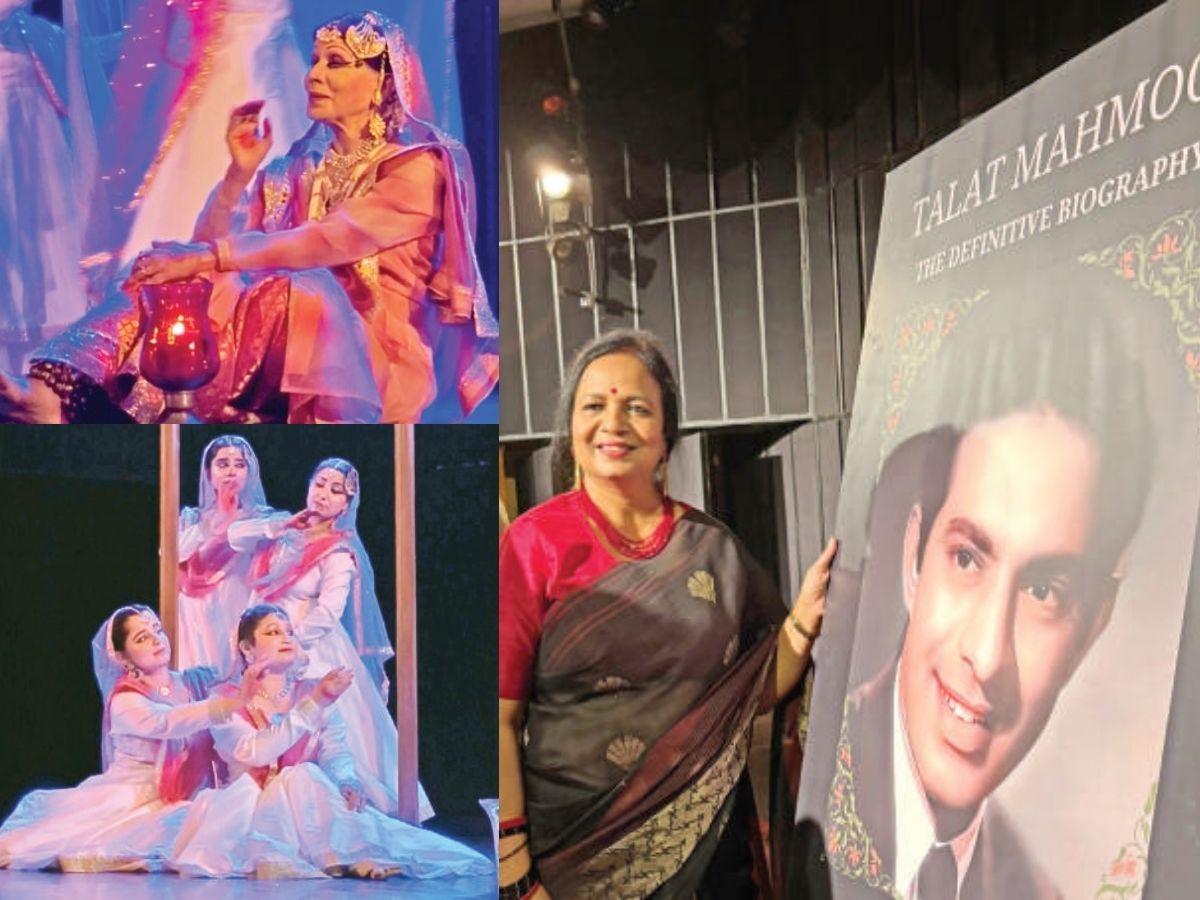
Picture this. A blockbuster Ghazal of 1944 depicted in modern Kathak in 2026, 82 years later! These unlikely interpretations of Talat Mahmood’s cult music have been a special feature since the launch of his tribute festival almost a decade ago. Called ‘Jashn-e-Talat’, the festival celebrates the genius of Mahmood’s music and films, through dance, Live music and visual arts.
Curated by author and Mahmood’s grand-niece, Sahar Zaman, the festival’s latest offering was an immersive confluence of music, movement, and memory. This was further elevated as Zaman spoke about Mahmood’s adventurous life from her book, ‘Talat Mahmood The Definitive Biography’.
Iconic dancer Dr. Shovana Narayan’s Kathak performance on Mahmood’s Golden Era hits became the evening’s focus to celebrate his birth anniversary that falls in February. It was not merely a dance recital, but a layered cultural homage to an era when poetry, voice, and refinement defined artistic expression.
Set to the velvety flirtation of his classic ghazal ‘Tasveer teri dil mera’, Narayan’s movements unfolded like a living tapestry of memory, longing and restrained passion. Talat’s voice—known for its tremulous softness and understated pathos—became the emotional spine of the choreography, guiding each gesture, glance and turn with lyrical inevitability of the dancing legend.
She approached the ghazal not as a mere musical accompaniment but as poetic text embodied. In the opening passages, the tehraav (measured stillness) mirrored the contemplative quality of Talat’s rendition. A fleeting look over the shoulder, a hesitant extension of the hand, the delicate tracing of an invisible silhouette in space. Each nazakat (graceful nuance) resonated with the ghazal’s imagery of unattainable love.
The audience was regaled with 10 such classic hits of Mahmood. Zaman drew upon her deep engagement with India’s cultural histories and her biographical insights into Mahmood’s life. She contextualized his songs —the lyrical nuances, their place in the golden age of Indian music, and his unique contribution to the subcontinent’s sonic memory. Her voice acted as a reflective bridge, guiding the audience into the emotional and historical layers of the composition.
Another song softened by candlelight, Kathak became a vessel of memory as Mahmood’s immortal ‘Jaltey Hain Jiskey Liye’ floated through the space. The gentle flicker of diyas and candles transformed the stage into a sanctum of remembrance. Their glow seemed to echo the very metaphor of the ghazal—the quiet flame that burns for love, hope, and longing. Against this luminous stillness, Narayan’s Kathak entered with measured grace, embodying the inward tremor so characteristic of Mahmood’s voice.
“I am speechless. When your eyes have seen such beauty and ears have heard such unique stories, so its better to give rest to my words and not add anymore”, expressed the First Lady of Delhi, Mrs. Sangeeta Saxena who was the Chief Guest for the evening.
In the finale, the melancholic melody chosen as the epitaphic song was ‘Meri yaad mein tum na aansoo bahana’. Narayan along with her young disciples on stage dissolved generational boundaries—guru and shishya united in a shared act of homage. The entry of her disciples altered the emotional register.
A striking visual element was the wooden frame used as stage prop. Positioned evocatively, it suggested multiple metaphors at once: a window into the past, a portrait frame holding memory, perhaps even the threshold between presence and absence. At moments, dancers moved within and around it, as if stepping in and out of recollection.
Together, they all created a triptych of expression: Talat Mahmood’s recorded voice evoking nostalgia; Shovana Narayan’s dance rendering poetry into gesture; and Sahar Zaman’s narration anchoring the experience in history and lived artistry. The result was a rare interdisciplinary dialogue—where biography met choreography, where journalism met classical tradition, and where the golden timbre of a bygone era found renewed resonance on the contemporary stage.
It was, ultimately, a meditation on remembrance—of love, of music, and of artistic lineage—brought alive through voice, word, and movement in perfect, contemplative harmony.




