
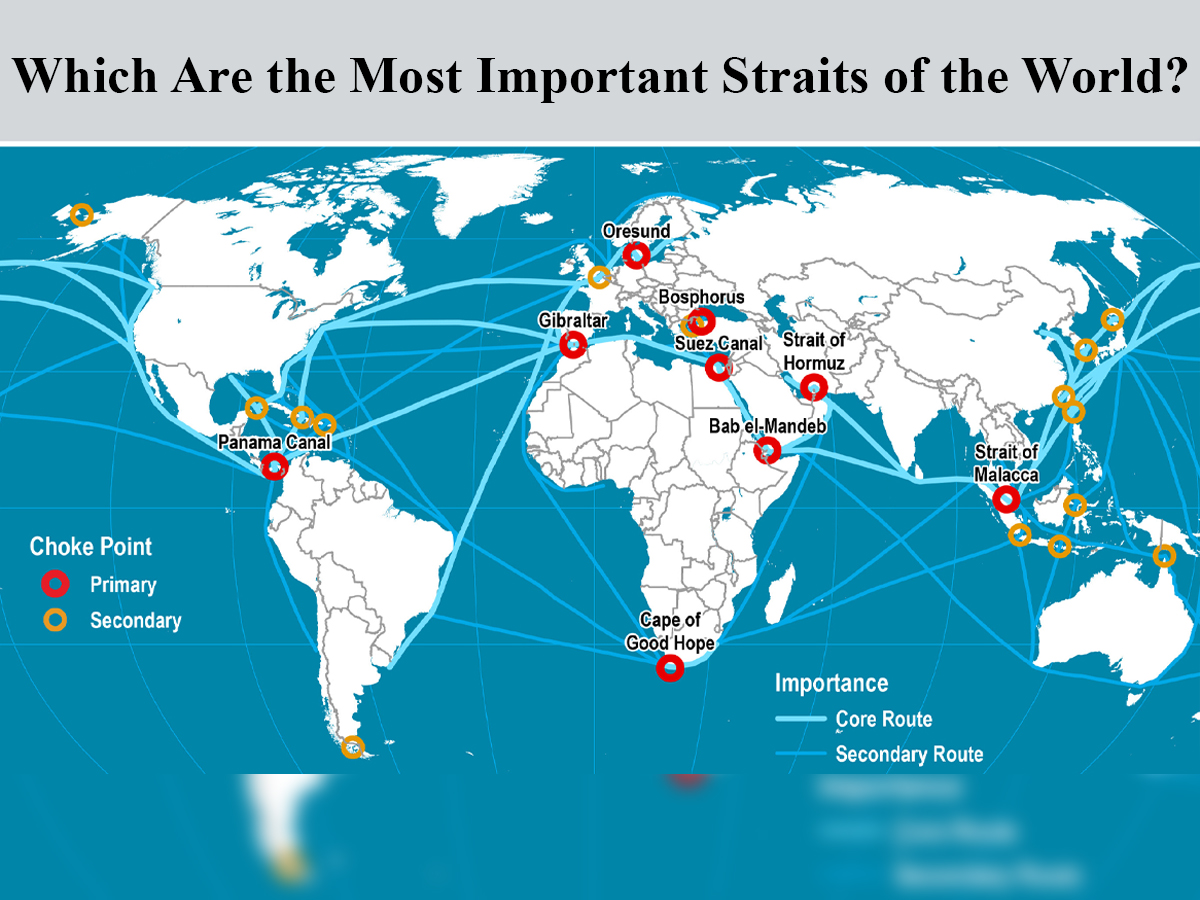
Global attention has recently turned to the Strait of Hormuz, one of the world’s most critical shipping routes, as tensions linked to the Israel-Iran-US conflict raise concerns about a possible closure. The narrow waterway carries a large portion of the world’s oil supply, and any disruption could affect global energy markets and shipping routes.
The situation highlights the importance of straits, which are narrow natural water passages connecting two larger seas or oceans. These waterways act as major gateways for global trade, military movement, and cultural interaction. Even though they appear small on the map, many straits hold enormous economic and geopolitical value.
Across the world, several straits serve as crucial maritime corridors, enabling ships to move quickly between continents while shaping international trade patterns.
What is a Strait?
A strait is a narrow natural water channel that connects two larger bodies of water, such as seas or oceans. Land masses usually surround these waterways on both sides, including continents or islands.
These channels play a major role in global geography because they provide shorter and more efficient routes for ships travelling between different regions.
Straits are important for several reasons:
- They support international navigation and shipping routes
- They influence geopolitical power and security
- They help promote trade and cultural exchanges between regions
- They affect ocean circulation and climate systems
Because of these factors, many nations closely monitor strategic straits around the world.
Most Important Straits of the World
Many straits play a key role in international trade and geopolitics. Some of the most important examples include:
Strait of Hormuz
Located between Iran and Oman, this narrow waterway connects the Persian Gulf to the Gulf of Oman. It handles a large share of the world’s oil exports and is one of the most important energy routes on Earth.
Strait of Malacca
The Strait of Malacca, located between Malaysia and Indonesia, links the Andaman Sea with the South China Sea. It is among the busiest shipping routes in the world and carries a large portion of global trade between Asia, Europe, and the Middle East.
Bab-el-Mandeb Strait
This strategic waterway lies between Yemen and Djibouti/Eritrea and connects the Red Sea with the Gulf of Aden. Ships passing through this strait usually head toward the Suez Canal, making it a major trade corridor.
Bosporus Strait
Located in Turkey, the Bosporus Strait separates Europe and Asia. It links the Black Sea with the Sea of Marmara, forming part of the Turkish Straits system that plays a key role in regional security.
Strait of Gibraltar
The Strait of Gibraltar connects the Atlantic Ocean with the Mediterranean Sea. It separates Spain and Morocco and acts as the only natural gateway into the Mediterranean.
Other Important Straits of the World
Apart from the major global chokepoints like the Strait of Hormuz and the Strait of Malacca, several other straits also play an important role in regional trade, navigation, and geopolitics. Here are some other significant straits across the world:
Bering Strait
The Bering Strait lies between Russia and the United States and connects the Bering Sea (Pacific Ocean) with the Chukchi Sea (Arctic Ocean). It also marks the maritime boundary between Asia and North America.
Dardanelles Strait
Located in northwestern Turkey, the Dardanelles connects the Aegean Sea with the Sea of Marmara. It has been historically important for empires and played a major role during the Gallipoli Campaign in World War I.
Taiwan Strait (Formosa Strait)
This strait separates Taiwan from mainland China and connects the East China Sea with the South China Sea. It is one of the most sensitive geopolitical hotspots in the Indo-Pacific region.
Strait of Tartary
The Strait of Tartary lies between Russia’s Sakhalin Island and mainland Asia. It links the Sea of Japan with the Gulf of Tartary and supports regional shipping and fishing industries.
Yucatán Strait
Situated between Mexico and Cuba, this strait connects the Gulf of Mexico with the Caribbean Sea. It is an important shipping route for oil tankers and cargo vessels entering the Gulf.
Strait of Messina
The Strait of Messina separates Italy’s mainland from the island of Sicily. It connects the Tyrrhenian Sea with the Ionian Sea and is known for its strong tidal currents.
Otranto Strait
This strait lies between Italy and Albania and links the Adriatic Sea with the Ionian Sea. It serves as an important maritime passage in the Mediterranean region.
Cook Strait
Cook Strait separates New Zealand’s North Island and South Island. It connects the Tasman Sea with the South Pacific Ocean and is known for unpredictable currents and strong winds.
Hudson Strait
Located in Canada, the Hudson Strait connects the Atlantic Ocean with Hudson Bay. It has historically served as an important route for Arctic exploration and shipping.
Mozambique Channel
The Mozambique Channel lies between Mozambique and Madagascar in the Indian Ocean. It is known for its rich marine biodiversity and is an important regional shipping route.
Ten Degree Channel
The Ten Degree Channel separates the Andaman Islands and Nicobar Islands in India and connects the Andaman Sea with the Bay of Bengal. It holds strategic importance for India’s maritime security.
Sunda Strait
Located in Indonesia, the Sunda Strait lies between Java and Sumatra. It connects the Indian Ocean with the Java Sea and serves as an important route in Southeast Asian maritime trade.
Palk Strait
The Palk Strait separates India and Sri Lanka and connects the Bay of Bengal with the Palk Bay. It has historical, cultural, and geopolitical significance in South Asia.
Bass Strait
The Bass Strait lies between mainland Australia and Tasmania. It connects the Tasman Sea with the Southern Ocean and is important for shipping routes around Australia.
The Davis Strait
Located between Greenland and Canada, the Davis Strait connects the Labrador Sea with Baffin Bay and plays a role in Arctic navigation and climate systems.
Why Straits Are Important for Global Trade?
Straits play a crucial role in the global economy because most international trade travels by sea. Ships carrying oil, gas, raw materials, and consumer goods often pass through narrow maritime chokepoints.
Major straits allow vessels to reduce travel time and avoid longer routes around continents. This makes them vital for energy supply chains and global commerce.
Some of the most important trade routes include:
- Strait of Hormuz – one of the world’s largest oil shipping routes
- Strait of Malacca – among the busiest trade corridors globally
- Bab-el-Mandeb – a key link between Asia and Europe via the Suez Canal
- Turkish Straits – essential for Black Sea nations
How Are Straits Formed?
Natural geological forces usually create straits over long periods of time. Several processes contribute to their formation. Tectonic activity is one of the main causes. Movements of Earth’s plates can separate land masses and form narrow water channels between them.
Erosion also shapes straits when powerful ocean currents or rivers gradually cut through land. In some regions, glacial activity creates deep valleys that later fill with seawater once glaciers melt.
Another common cause is rising sea levels, which can flood low-lying land and leave behind narrow water passages connecting larger bodies of water. These natural processes have created some of the most important waterways in the world.
Why Strategic Straits Matter in Geopolitics
Beyond trade, straits also influence global politics and military strategy. Countries often build naval bases or monitor maritime traffic near these waterways to protect their interests.
Control of a strategic strait can affect energy supply, global shipping, and regional security. This is why many of these waterways frequently appear in international news during geopolitical tensions.
As the current situation around the Strait of Hormuz shows, even a small maritime passage can have a massive impact on the global economy.




