
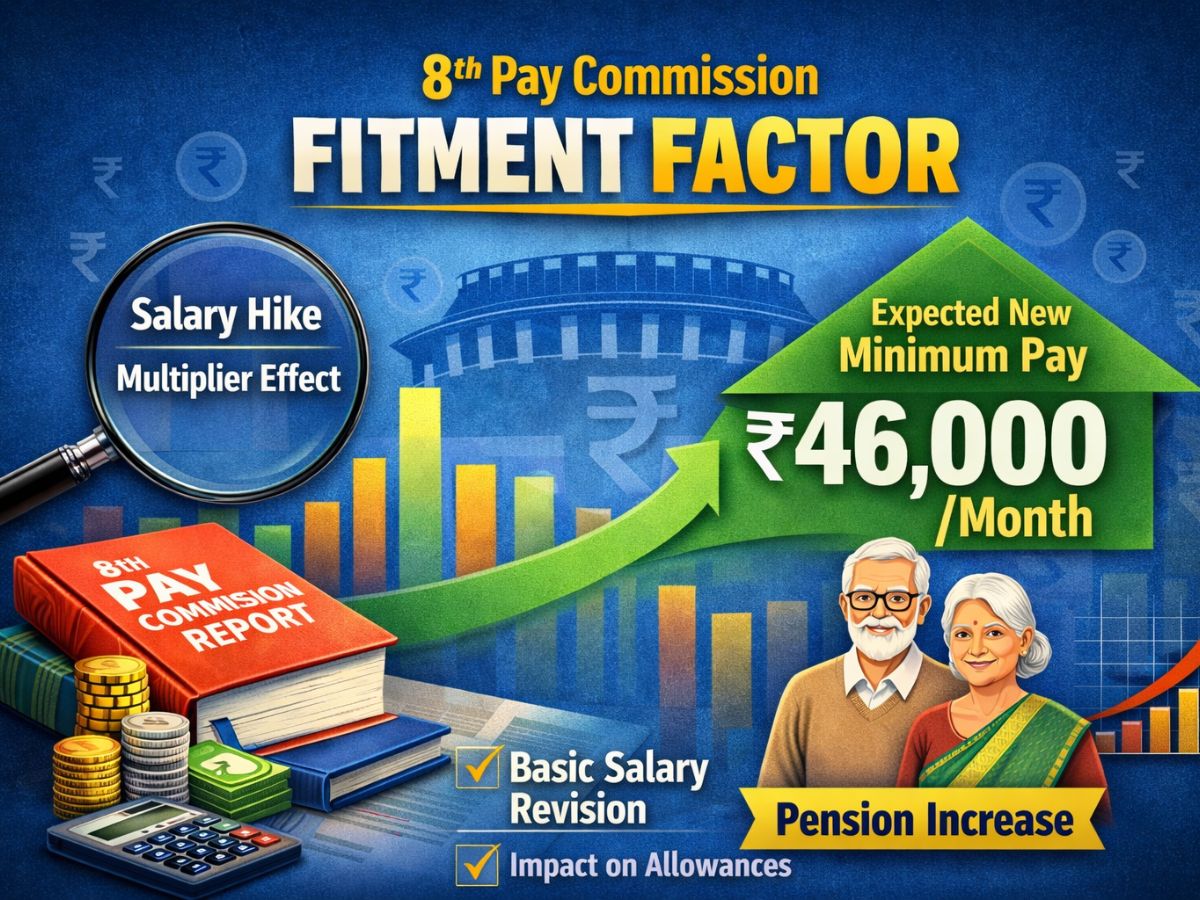
8th Pay Commission Fitment Factor: Central government employees and pensioners across India are closely tracking updates related to the 8th Pay Commission, especially the term known as the fitment factor, which plays a crucial role in determining salary increases.
The Government of India has already constituted the 8th Central Pay Commission to review salary structures, pensions and allowances. Officials have given the panel 18 months to submit its recommendations, raising expectations about possible salary revisions from January 2026.
Among all the factors under review, the fitment factor remains the most important because it directly determines how much salaries may increase across different pay levels.
What is the Fitment Factor in the 8th Pay Commission?
The fitment factor is a multiplication number used to revise the basic salary of government employees. It helps convert existing pay into a new salary structure when a new pay commission is implemented.
For example, under the 7th Central Pay Commission, the government used a fitment factor of 2.57, which significantly increased salaries across all levels. This multiplier replaced the earlier system of pay bands and grade pay and introduced a new pay matrix system that simplified salary calculations.
Public finance expert A K Bhattacharya explained the importance of this concept, saying, “The fitment factor is critical because it determines the baseline increase in salaries across all levels.”
“It incorporates inflation, dearness allowance, and expected economic growth.”
This makes the fitment factor the foundation of any salary revision.
8th Pay Commission Fitment Factor: How Fitment Factor Affected Salaries in the 7th Pay Commission
To understand the expected impact of the 8th Pay Commission, it is important to review what happened during the previous revision.
Under the 7th Central Pay Commission, the government applied a 2.57 fitment factor, which resulted in:
- Minimum basic salary increasing from ₹7,000 to ₹18,000
- Maximum salary reaching ₹2.5 lakh per month
- Introduction of a structured pay matrix system
Earlier, the 6th Central Pay Commission, implemented in 2008, had also revised pay scales with retrospective effect from 2006. These historical examples show how fitment factors influence salary outcomes.
8th Pay Commission Fitment Factor: What Fitment Factor is Expected in the 8th Pay Commission
Experts believe the 8th Pay Commission may consider retaining or adjusting the previous fitment factor depending on economic conditions.
If the government keeps the same 2.57 multiplier, estimates suggest:
- Minimum basic salary may rise to around ₹46,000 per month
- Higher pay levels may also increase proportionately
- Pension benefits may also rise accordingly
However, final decisions will depend on multiple factors, including inflation, revenue conditions and government finances.
A senior government official said, “The challenge will be to ensure sustainability while addressing demands for higher real wages.”
8th Pay Commission Fitment Factor: Why the Fitment Factor Matters for Employees and Pensioners
The fitment factor affects more than just salary figures. It also influences:
- Pension calculations
- Dearness allowance adjustments
- Annual increments
- Overall pay structure
For millions of employees and pensioners, even a small change in the multiplier can significantly impact monthly income. The Ministry of Finance has confirmed that the commission will review pay, allowances and pension systems before finalising recommendations.
Minister of State for Finance Pankaj Chaudhary said, “The Commission will make its recommendations on various issues such as pay, allowances and pension within 18 months of its constitution.”
8th Pay Commission Fitment Factor: When Will the 8th Pay Commission Salary Changes Be Implemented?
The government constituted the 8th Central Pay Commission on November 3, 2025.
Based on the 18-month timeline:
- Recommendations may arrive by mid-2027
- Implementation may happen later
- Arrears could be calculated from January 1, 2026, as seen in previous pay commissions.
This means employees may receive revised salaries along with backdated benefits once the final approval is issued.
8th Pay Commission Fitment Factor: What Employees Can Expect Next
The 8th Pay Commission is expected to review several key aspects, including:
- Basic salary revisions
- Pension structures
- Allowances and benefits
- Annual increment rates
The previous 7th Pay Commission cycle ended on December 31, 2025, making the new revision necessary under the government’s usual 10-year cycle. While early projections provide estimates, the final salary hike will depend on the commission’s calculations and government approval.
For now, employees and pensioners continue to monitor updates, especially regarding the fitment factor, which remains the most important element in determining future salary growth.




