Economic Survey 2026 will be tabled ahead of Budget Day. Check what it is, why it matters, key themes, timings, and what to watch before Budget 2026.
Economic Survey 2026 will be tabled ahead of Budget Day
Ahead of the Union Budget, all eyes are on the Economic Survey, which is scheduled to be tabled in Parliament a day before the finance minister presents Budget 2026.
The Economic Survey is typically released just ahead of the Budget to provide lawmakers, markets and the public with a data-backed snapshot of how the Indian economy has performed over the past year and where it may be headed next.
The Economic Survey is an annual publication prepared by the Department of Economic Affairs under the Ministry of Finance, under the guidance of the Chief Economic Adviser (CEA).
It offers a detailed assessment of the Indian economy’s performance in the previous financial year, supported by official data, trends and analysis. The document reviews growth, inflation, employment, fiscal health and sectoral performance across agriculture, industry, services and infrastructure, while also flagging emerging risks and policy challenges.
Released every year ahead of the Union Budget, the Survey helps set the broader economic context within which budgetary decisions are made. Over the years, it has become an important reference not only for policymakers, but also for economists, researchers, students and market participants.
The Economic Survey is divided into two parts:
The Economic Survey 2026 is expected to be tabled in Parliament between 11:00 am and 12:00 pm on Thursday, 29 January. A media briefing by Chief Economic Adviser V. Anantha Nageswaran will follow this.
The full document will be available for download in PDF format from the government’s official website after it is tabled in Parliament on the given link - click here.
The Economic Survey reviews key economic developments over the past year and often provides early signals about the government’s fiscal thinking. This year, the Survey is expected to focus on:
The Survey also puts forward policy perspectives aimed at addressing structural challenges. First presented in 1950–51 as part of the Budget documents, it has evolved into a standalone report that shapes economic debate ahead of the Budget.
The Economic Survey is prepared by the Department of Economic Affairs under the Ministry of Finance. It serves as the government’s annual economic report card, assessing the previous year’s performance and outlining the outlook for the year ahead.
Until 1964, the Economic Survey was presented as part of the Union Budget. It was later separated to function as an independent economic record that could inform parliamentary debate ahead of the Budget.
Releasing the Survey before the Budget allows lawmakers and the public to evaluate government policy choices against a detailed, data-driven assessment of the economy’s condition and challenges.
In 2017, the government advanced the Union Budget presentation to February 1 to ensure that parliamentary approval could be completed before the end of March, allowing Budget measures to take effect from April 1.
Earlier, when the Budget was presented at the end of February, implementation was often delayed until May or June due to the lengthy approval process.
For decades, the Budget was also presented at 5 pm, a colonial-era convention designed to align working hours in India and the UK. This practice ended in 1999, when then finance minister Yashwant Sinha presented the Budget at 11 am—a timing that has continued since.
The Economic Survey reviews:
It also includes special chapters on emerging themes, which markets often read closely to gauge the government’s broader economic priorities.
The Economic Survey 2025–26 is being released ahead of Budget 2026, at a time when India’s growth trajectory remains strong but global risks persist. Recent projections show that Survey estimates have often been conservative:
According to a PTI report, India is expected to record 7.4% growth, compared with the 6.3–6.8% projection made in last year’s pre-Budget Survey. Market participants will watch the Survey’s commentary on global risks, fiscal consolidation and sectoral trends, as these can influence equity, bond and currency sentiment.
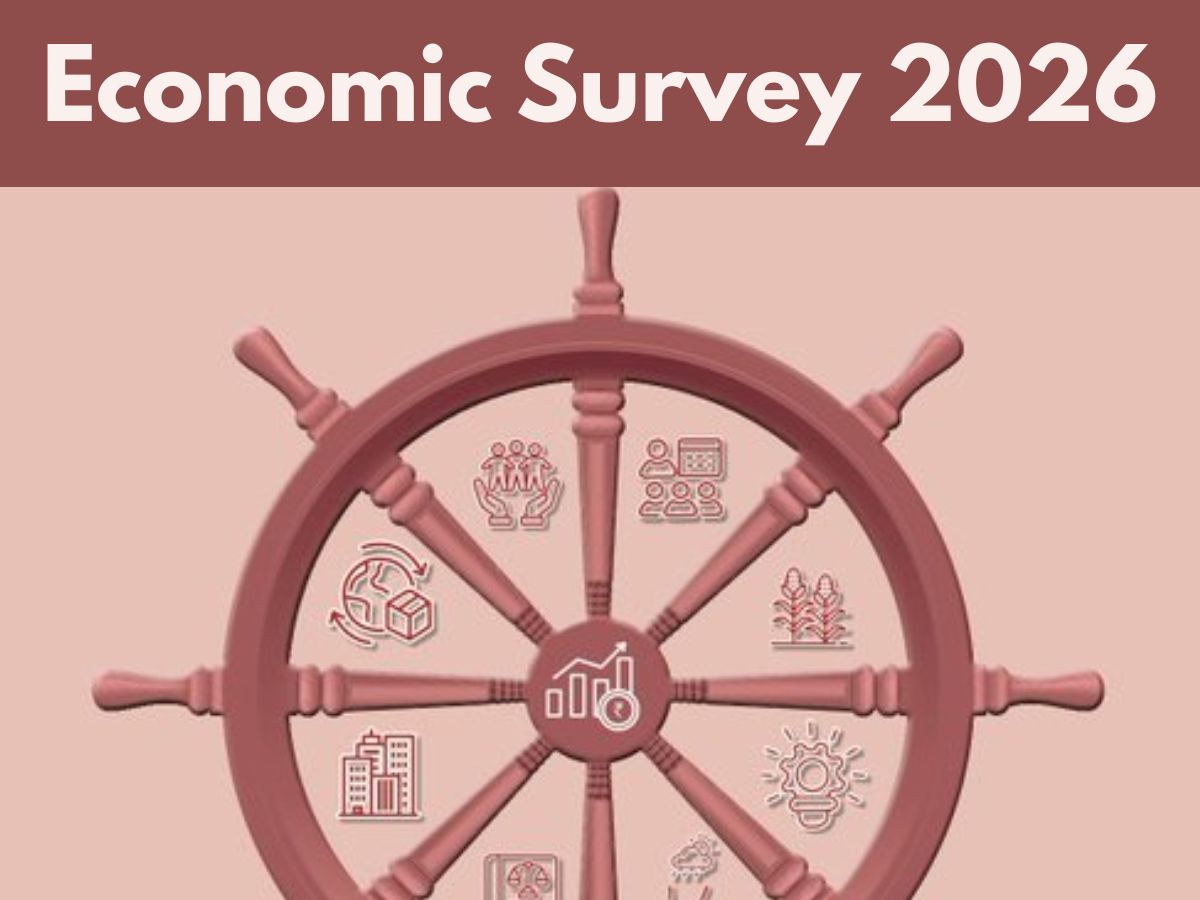
In recent years, the cover design of the Economic Survey has carried symbolic meaning:
These themes offer visual cues to the Survey’s broader narrative.
Even without detailing Budget arithmetic, the Survey often hints at the government’s fiscal comfort level. Economists expect the government to target a fiscal deficit of around 4.2% of GDP in FY27, compared with about 4.4% in FY26, while maintaining high capital expenditure.
References to revenue momentum, expenditure quality and debt sustainability will be closely watched for clues on how tight or flexible the government’s fiscal stance could be.
The Economic Survey 2024–25 projected real GDP growth of 6.4% in FY25 and emphasised deregulation as key to achieving the goal of “Viksit Bharat.” It noted that retail inflation eased from 5.4% in FY24 to 4.9% during April–December 2024, while gross FDI inflows rose 17.9% year-on-year to $55.6 billion in the first eight months of FY25.
The Survey also underscored the need for sustained infrastructure investment to support long-term growth.
The Economic Survey does not announce policy, but it sets the tone. Its assessment of growth, risks and fiscal space will shape expectations from Budget 2026, and offer early clues on how the government plans to balance growth ambitions with global uncertainty.
