
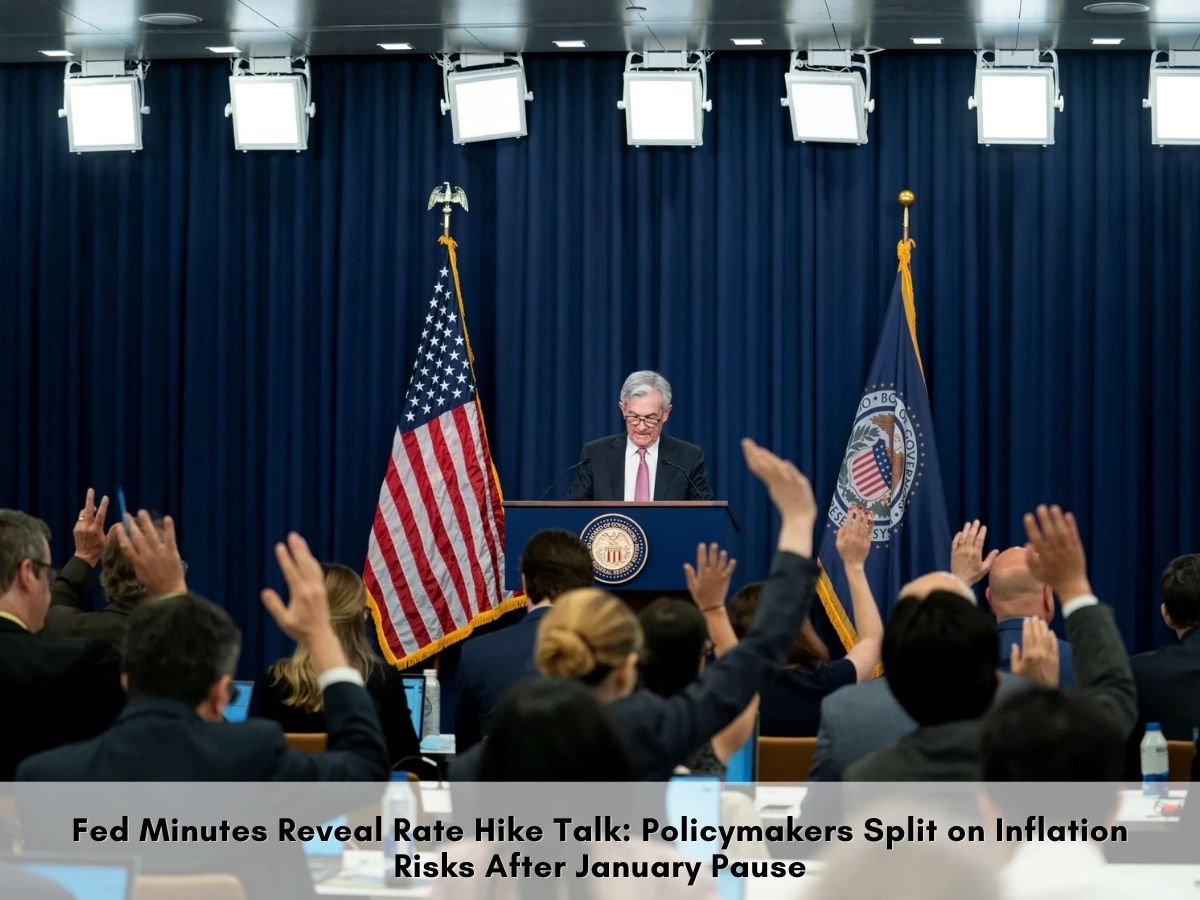
Federal Reserve policymakers were broadly united behind a pause in interest rate cuts at their January meeting but revealed a sharp divide over the future path of policy, with some officials openly discussing the possibility of rate hikes if inflation remains stubbornly high.
The minutes of the Fed’s Jan. 27-28 Federal Open Market Committee (FOMC) meeting, released Wednesday, show that while “almost all” participants supported holding the benchmark federal funds rate steady in the 4.25% to 4.5% range, the debate beneath the surface was far more contentious than the unanimous vote implied.
Who is pushing back against further rate cuts?
A significant faction within the FOMC is signaling that the fight against inflation is not yet won. The minutes reveal that “several participants indicated they could have supported a two-sided description of the Committee’s future interest rate decisions.” This marks the first explicit acknowledgment in the official record that the next move for the central bank might not be a cut, but a hike.
This faction is concerned that progress on inflation has stalled. With the personal consumption expenditures (PCE) price index—the Fed’s preferred inflation gauge—running roughly a full percentage point above the 2% target, these officials argued that language in the post-meeting statement should reflect the risk that “upward adjustments to the target range for the federal funds rate could be appropriate if inflation remains at above-target levels.”
What does the split mean for the timeline of rate cuts?
The internal debate has fractured the FOMC into at least three distinct camps regarding the timing and necessity of future policy easing. According to the minutes:
The Hold Steady Camp: “Some” participants argued that rates would need to remain restrictive “for some time” while policymakers await clearer data on inflation and economic activity. A subset of this group went further, stating that rate cuts may not be justified at all until there is definitive evidence that “disinflation is back on track.”
The Cut Advocates: In contrast, “several” officials maintained that their baseline economic outlook—which anticipates a continued easing of price pressures this year—still includes further rate reductions later in 2025.
The Hike Consideration Camp: As noted, “several” others pushed for a two-sided risk assessment, explicitly opening the door to the possibility of tightening policy again.
Why were there dissenting votes at the January meeting?
The decision to hold rates steady was not without opposition, though it did not appear in the final vote tally due to the composition of the voting roster. The minutes noted that only a “couple” of policymakers supported an immediate quarter-percentage-point rate cut at the January gathering.
However, two Federal Reserve governors—Christopher Waller and Michelle Bowman—voted against keeping interest rates unchanged. They were not calling for immediate rate cuts, but warned that the central bank was acting too slowly. They said signs of a weakening job market may require earlier action to support employment.
How is the Fed interpreting current economic data?
The central bank is currently in a “wait-and-see” mode following 75 basis points of cumulative rate cuts in the last four months of 2024. Policymakers feel that holding the policy rate steady allows them to assess the lagging effects of those cuts on the broader economy.
The minutes suggest that while most officials believe inflation will ease over the course of the year, clearing a path for cuts, there is a palpable anxiety that this forecast may be wrong. The discussion reflects a central bank that is highly data-dependent, with future decisions hinging entirely on whether incoming reports show a resumption of the disinflationary trend or a renewed spike in prices.
Frequently Asked Questions (FAQ)
Q: Did the Fed cut rates in January?
A: No. The Fed held rates steady at 4.25% to 4.5%. Only a “couple” of policymakers supported an immediate cut.
Q: Are rate hikes actually coming?
A: Not necessarily. The minutes show “several” officials want the option kept open, but no decision has been made. Future moves depend entirely on incoming inflation data.
Q: Why did Waller and Bowman dissent?
A: They voted against the pause because they fear the job market may be weakening and wanted immediate rate cuts to protect employment.
Q: What inflation rate is the Fed watching?
A: The Fed targets 2% based on the PCE price index. It’s currently running about one percentage point above that level.
Q: When will we know the next move?
A: Markets will parse every inflation report between now and the March FOMC meeting for clues on whether prices are cooling enough to satisfy the hold camp—or staying hot enough to justify hike discussions.
Disclaimer: This information is based on inputs from news agency reports. TSG does not independently confirm the information provided by the relevant sources.




