
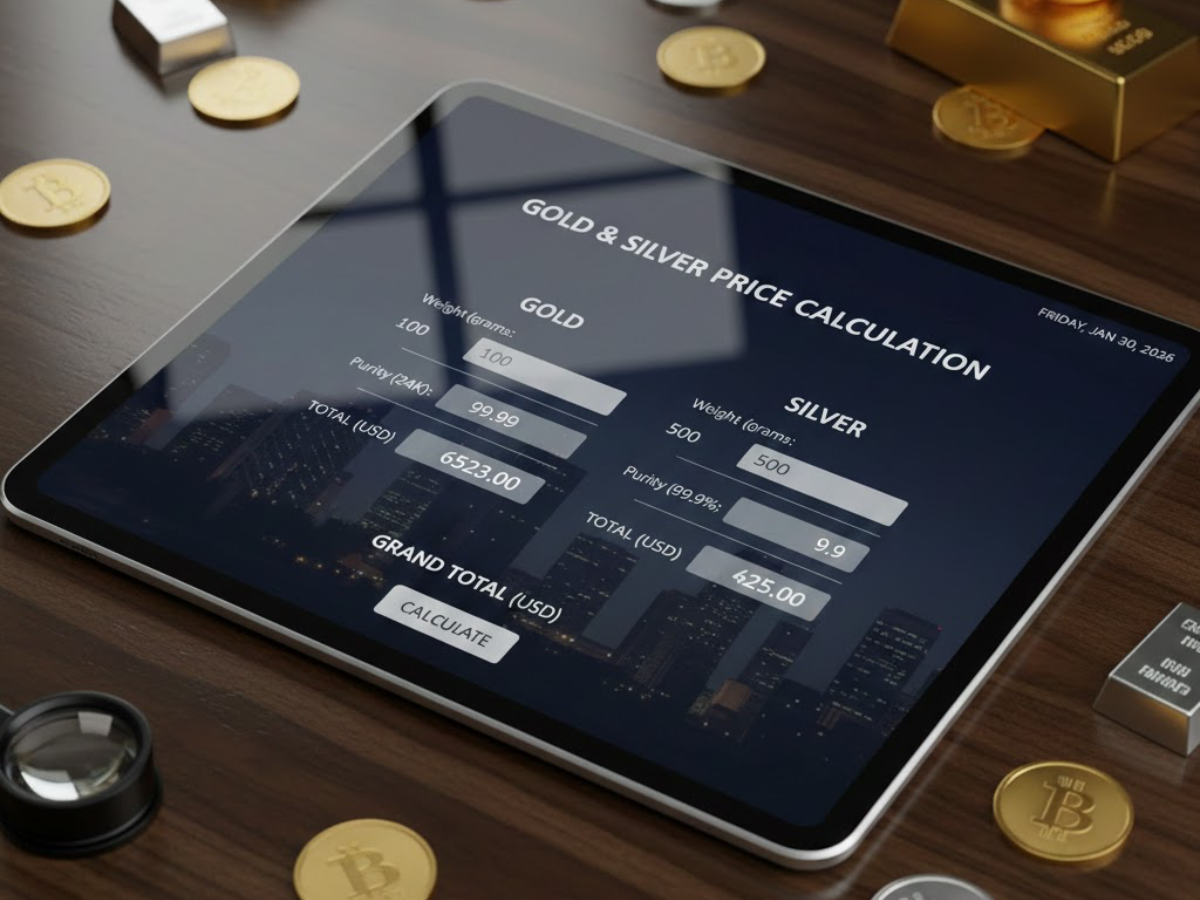
Gold & Silver Price: Every day, you will notice gold and silver prices flashing on screens, in newspapers and outside jewelry stores but for the average consumer, such prices seem remote and confusing. What drives the prices from one day to another? Why is the same metal costlier in one place than in another? Why does the price tag on the shelf appear so much higher than the market price?The explanation for this complex pricing matrix is in the web of international trade, currency fluctuations, government regulations and local market factors. Understanding this complex is important for investors, traders, and consumers alike.
How Daily Gold & Silver Price Is Calculated
- The pricing process begins with the international spot price and quoted per ounce for pure metal
- Spot prices are driven by live trading activity across global bullion hubs
- These prices react instantly to economic data, geopolitical developments and financial flows
- Once the global price is set, it is converted into local currency using prevailing exchange rates
- Import-related costs such as freight, insurance and handling are added
- Customs duty and regulatory charges are applied at the port of entry
- Domestic bullion associations release benchmark prices for the local market
- Retail jewellers add operational costs, margins, making charges and taxes
This multi-step process explains why the final retail price differs from the global quote.
Why is the Price Different in Every State?
Gold and silver prices vary across Indian states due to differences in taxation structures, logistics and regional demand while transportation costs, local levies and the density of jewellery markets all influence pricing. States with strong wedding demand or higher operating expenses tend to reflect slightly elevated rates compared to others.
How Many Times is the Gold Price Calculated in a Day?
- Global benchmark prices are officially fixed twice daily by the London bullion market
- Spot prices fluctuate continuously as markets trade around the clock
- In India, bullion rates are updated once daily while futures prices move in real time during exchange hours
- Retail prices may change once or twice a day depending on volatility
What are the Sources of Pricing?
Gold and silver prices are discovered through a mix of global spot markets, futures exchanges and institutional trading hubs while the following key exchanges and platforms play a direct role in price formation worldwide:
|
Category |
Exchange / Source |
Location |
Role in Pricing |
|
Global Exchange |
TOCOM |
Japan |
Influences precious metal prices during Asian trading hours, especially yen-based contracts |
|
Global Exchange |
Shanghai Gold Exchange |
China |
Key benchmark for physical gold demand and delivery-driven pricing in Asia |
|
National Exchange |
MCX |
Mumbai |
India’s primary platform for gold and silver futures, guiding domestic price trends |
|
Global Exchange |
DCGX |
Dubai |
Reflects Middle East demand and USD-denominated bullion trading |
|
Regional Exchange |
Istanbul Gold Exchange |
Istanbul |
Strategic hub linking European and Asian bullion markets |
|
Global Exchange |
COMEX |
New York |
World’s leading futures exchange, heavily impacting international spot prices |
|
Market Source |
Spot Market |
Global |
Provides real-time benchmark prices based on immediate supply and demand |
|
Market Source |
OTC Markets |
Global |
Dealer-driven pricing through banks and bullion desks outside formal exchanges |
|
Market Source |
Futures Exchanges |
Global |
Capture investor sentiment, hedging activity, and forward price expectations |
|
Market Source |
Bullion Banks |
Global |
Influence prices through high-volume institutional trading and liquidity provision |
|
Market Source |
Domestic Associations |
Country-specific |
Convert global prices into local benchmarks factoring taxes, duties, and currency |
International Factors Influencing Gold Prices in India
- India imports most of its gold and making it the second-largest gold-importing nation globally.
- The base price starts with the global spot price and quoted per ounce of 24K gold in the London bullion market.
- Import-related costs are added including transportation, insurance, handling and transaction charges.
- The dollar-denominated spot price is converted into Indian rupees and making the USD–INR exchange rate a key factor.
- A weaker rupee raises domestic gold prices even if global rates remain steady.
- Customs duty is applied when gold enters India and increasing the landed cost.
- Importing banks and authorised agencies add margins and service fees before selling to bullion dealers.
National Factors Affecting Gold Prices in India
- Domestic market dynamics and government regulations are directly influence gold price movements in India.
- The Indian Bullion Jewellers Association (IBJA) is an important reference point as it publishes daily benchmark rates that are adopted across the country.
- Inflation trends affect gold consumption because investors often turn to gold as a means of preserving value.
- Changes in demand and supply patterns, especially during wedding seasons and affect gold prices.
- Local levies such as VAT, state taxes and regional charges are added before gold reaches consumers.
- Gold futures prices reflect investor sentiment and expectations about future price movements.
- Exchanges like MCX and NCDEX provide daily pricing for gold derivatives in India.
- The final retail price is higher than market rates due to making charges, taxes and the form of gold purchased.
How the Gold-Silver Ratio Has Changed Over Time
- For centuries, the gold-silver ratio are remained relatively stable as governments fixed it to support currency systems.
- The Roman Empire officially maintained the ratio at 12:1 and setting an early standard for precious metal valuation.
- In medieval Europe, the ratio dropped to 9.4:1 around 1350 and before returning to 12:1 by the 1450s.
- The United States fixed the ratio at 15:1 under the Coinage Act of 1792 to stabilize its monetary system.
- In 1934, President Franklin D. Roosevelt set gold at $35 per ounce and pushing the ratio sharply higher.
- By 1939, the gold-silver ratio surged to 98:1 and reflecting weakening silver prices.
- After World War II, the Bretton Woods Agreement (1944) linked global currencies to gold, leading to a gradual decline in the ratio.
- The collapse of the gold standard in the 1970s triggered major volatility in the ratio.
- The ratio peaked again at 97.5:1 in 1991, when silver prices fell below $4 per ounce and highlighting silver’s relative weakness.
Step-by-Step: How Gold Price Is Calculated When Buying Jewellery
- Identify the base gold rate: Check the current market price of 24K gold per gram and then Convert it to 22K gold by multiplying the 24K rate by 0.916, as most jewellery is 91.6% pure.
- Calculate the gold value: Multiply the jewellery’s net gold weight in grams by the purity-adjusted gold rate per gram.
- Add making charges: These may be charged as a fixed amount per gram (for example, Rs. 350 per gram). Alternatively, they may be calculated as a percentage of the gold value, often between 5% and 15%.
- Include additional costs: Hallmarking charges for purity certification, usually a fixed fee. Stone or gemstone costs, added separately since they are not part of the gold weight.
- Apply GST: A 3% Goods and Services Tax is levied on the total of gold value, making charges and stone costs.
- Arrive at the final price: Final Price = (Gold Rate per Gram × Weight) + Making Charges + Stone Cost + GST
Example With Today’s Gold & Silver Rate (30 January, 2026)
- 24K gold rate: Rs. 17,885 per gram
- 22K adjusted rate: Rs. 16,395 per gram
- Gold value for 10 grams: Rs. 1,63,950
- Making charges at 8%: Rs. 13,116
- GST at 3%: Rs. 5,313
- Final payable amount: Rs. 1,82,379
Silver is priced at Rs. 4,10,000 per kilogram, using the same layered pricing structure.




