Schools must shift from rote learning to digital fluency, ethics, and creativity to prepare students for an AI-driven future.
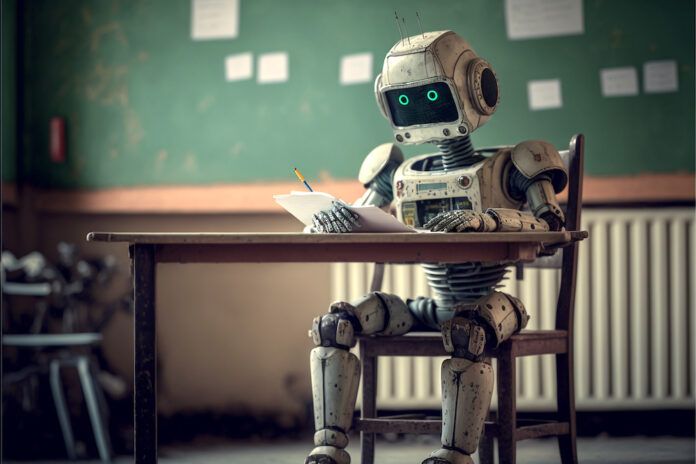
Students explore robotics and digital tools in a modern classroom designed to build curiosity, problem-solving, and tech fluency (Photo: File)
With AI, automation, and digital transformation growing rapidly, the way we live, work, and shape our futures is being fundamentally reimagined. With machines taking on even complex tasks, learners of the next generation hold different expectations. Schools, therefore, play a crucial role in preparing learners to excel both academically and in a highly adaptive, innovative, and ethically minded world. Now is the time for the education system to move from the traditional model to a more holistic one for learners, to prepare them with cognitive, interpersonal and technological skills, to be able to thrive successfully in life.
INTRODUCTION TO DIGITAL FLUENCY AND AI AWARENESS AT EARLY GRADES
Children today grow up in an algorithm-driven world of data and intelligent systems. Being familiar with them from early childhood makes them easier to understand, thus building curiosity and not fear. When incorporated into education early enough, digital literacy builds a student who learns to use technology as an active participant. Foundational coding logic, robotics, pattern recognition, and interpretation of data form a sound technological base introduced in the primary and middle grades. At this stage, students acquire the capability to think in terms of computer science, i.e., they can decompose a problem into its simpler parts, arrange the solutions to it and digitize the testing of their hypotheses. These learners, as they grow, can gradually be introduced to more high-level AI concepts.
EXPANDING REAL-WORLD LEARNING THROUGH INTER-DISCIPLINARY AND EXPERIENTIAL APPROACHES
For the last twenty years or so, the professional boundaries among various sectors have decreased considerably. The collaboration not only within but also across different disciplines has become necessary for finding solutions in every field, climate change, healthcare, etc.. The schools that provide interdisciplinary learning prepare their students to get the most out of every aspect of a problem. Project-based learning is a way in which students get to think of and talk about current issues through the application of their theoretical knowledge. Whether it is creating sustainable models, doing the prototypes in the tech labs, or studying the social issues, students are being taught how to scrutinize the situations, work on the solutions, and make the ideas better. Such activities in real-life situations make the students more resilient, critical thinkers, and adaptable, which will help them survive in the ever-changing technology world. Such a methodological approach will also create interdisciplinary links among the students by enabling them to consider that technology, science, art, and ethics often overlap considerably.
INNOVATION SPACES INVITING CURIOSITY AND EXPLORATION
Modern learners benefit greatly from environments that encourage both creativity and experimentation. Innovation labs, makerspaces, robotics zones, and digital studios provide dedicated spaces where students can engage with a wide range of tools and technologies through hands-on exploration. Such learning spaces develop their entrepreneurial mindset while fine-tuning their technical capability. Students develop knowledge of how technology works through modeling or programming robots, or operating 3D printers. More importantly, they learn to iterate and experiment and take failure as part of this process. It is through experiences like these that students become inquisitive, enterprising, and confident, developing qualities that will be professionally required later on.
ENSURING TEACHERS ARE PREPARED FOR MODERN, TECHNOLOGY-ENHANCED CLASSROOMS
Students may be ready to learn, but the teacher certainly plays the most important role in bringing about any transformation. Continuous professional development thus becomes very important. Training programs in AI-assisted teaching tools, digital classroom management, and hybrid learning strategies are among the latest educational technologies that would keep teachers updated and relevant in their work. This would, in fact, be a source of confidence for the teachers in handling digital tools, integrating technology into their projects, and managing students through tech-enabled learning environments. The giving of modern competencies to educators not only supports the inspiration of students toward active learning and engagement but also in contexts that are technology-driven for deep understanding, not overwhelming.
TRANSITION FROM MEMORIZATION TO CONCEPTUAL, ANALYTICAL, AND CREATIVE THINKING
For a very long time, rote learning was viewed as the only way to get good grades in schools. But today the situation is quite different as simple memorization offers only a minimal advantage. The future jobs will require people who can look at complex situations, spot patterns, think out of the box and come up with ingenious solutions. The concept driven approach allows students to grasp deeper concepts and work out the underlying principles rather than merely recalling content. If one encourages the learner to investigate the reason behind formulas in mathematics, theories in science, or events happening in history, they are flexible in applying their acquired knowledge in new, unfamiliar situations. By prioritizing conceptual understanding over mere facts, schools nurture analytical thinkers prepared to navigate the complex challenges posed by AI and automation. Here, creativity is the core competence. The human capacity to innovate through design, problem-solving, or simply imaginative thinking will be of immense significance in the times to come. Allowing students to brainstorm, question, and see things from different perspectives encourages this creative competence.
ENCOURAGING RESPONSIBLE AND POSITIVE UTILIZATION OF TECHNOLOGY
With the advancement of technology, ethical consequences also increase. Therefore, schools have a significant role in making students understand what AI and automation mean to society. Students learn that technology is very powerful but ultimately guided by human values through discussions about ethics and inclusivity, making them more responsible persons. The technology debate is a critical aspect in the development of future professionals whether they will decide to be involved in the technological research and development or to use technology based on the values of responsibility and integrity.
PREPARING LEARNERS FOR A DYNAMIC, TECH-DRIVEN FUTURE
In the age of AI and automation, schools have to digitize themselves in order to meet the new requirements. Education will be about concept clarity, emotional intelligence, ethical reasoning, digital fluency, and innovation-led learning that readies students for a world where change is the only constant. It is not so much a matter of merely providing students with job skills that will be in demand in the future, but of molding mindsets and values that will be the foundation for a better, more responsible, and more inclusive future.
Anita Paul is Principal of Amity Global School, Noida.
