
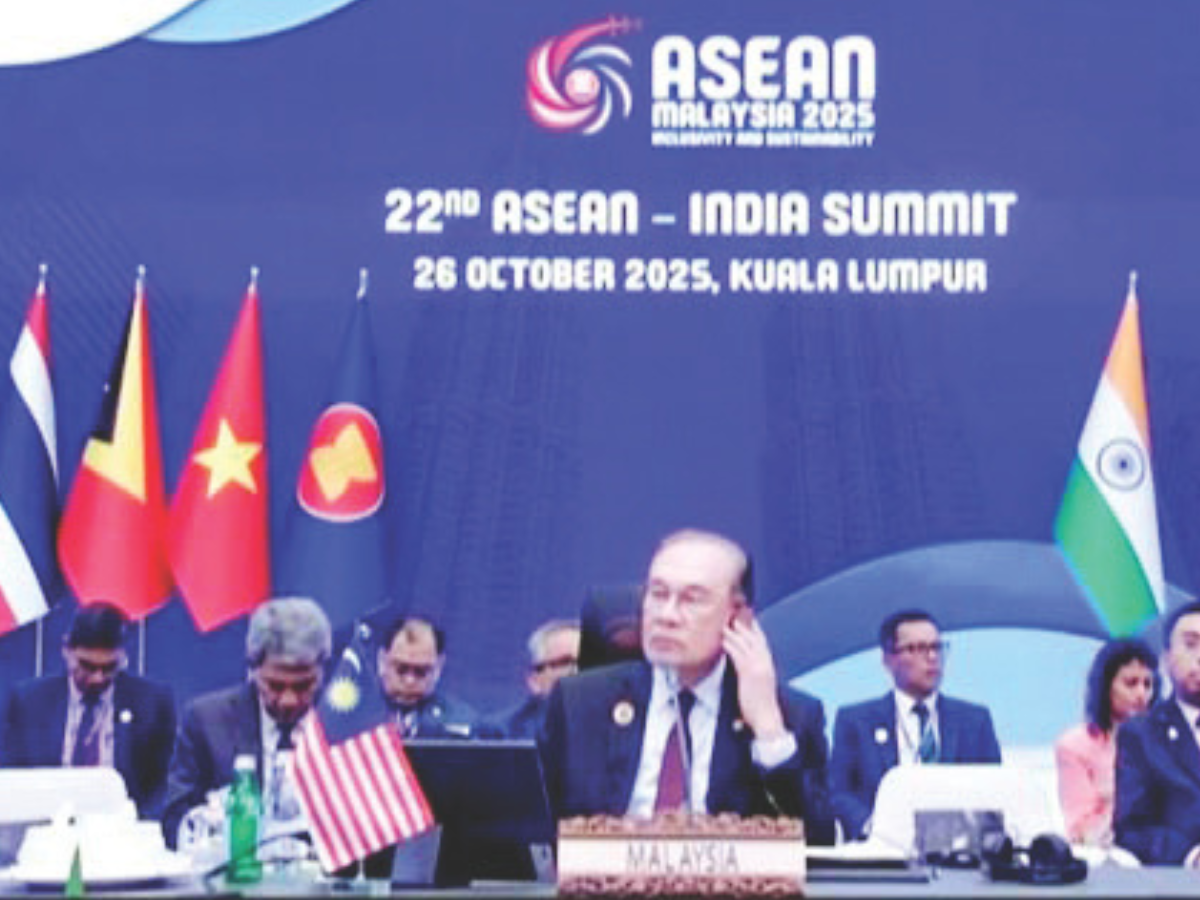
The recent 22nd ASEAN-India Summit was held on October 26, 2025, in Kuala Lumpur, Malaysia. Prime Minister Narendra Modi participated virtually in the Summit. While PM Modi has consistently attended ASEAN summits in the past, his decision to skip the in-person meeting this year was seen by some as a calculated move to manage priorities amid shifting geopolitical dynamics and domestic political needs.
India’s official explanation why PM Modi did not attend the Summit in person was due to scheduling issues related to the ongoing Deepavali celebrations in India. However, media reports and analysts point to a number of strategic and domestic political factors. One of the most cited reasons was avoiding an awkward encounter with the US President Donald Trump, who also attended the summit. Relations between India and the US have become strained due to trade disputes, with the Trump administration imposing 50% tariffs on Indian exports partly in response to India’s continued purchase of Russian oil. New Delhi was wary of a meeting between PM Modi and Trump with no clear positive outcome.
ASEAN is important for India due to its strategic location in the Indo-Pacific, its role as a major economic partner and its importance for regional stability and security. Key benefits include enhanced trade and connectivity, a counterbalance to China’s influence, and a platform for maritime security cooperation. ASEAN also serves as the gateway for India’s “Act East” policy, promoting its influence in a vital and dynamic region. Deep-rooted historical, cultural, and civilizational links provide a strong foundation for diplomatic relations. The large Indian diaspora in Southeast Asia acts as a bridge between the two regions.
On the other hand, India is important to ASEAN as a strategic partner for maintaining a multipolar order in the Indo-Pacific, a key economic partner, and a supporter of regional connectivity and maritime security. India offers an alternative to great power competition, contributes to economic growth through trade and investment, and enhances security cooperation in areas like maritime defense.
The summit took place amid an “era of uncertainties and growing Chinese influence in the Indo-Pacific, underscoring the significance of a robust and stable India-ASEAN partnership. By stressing regional cooperation and a rules-based order, India positioned itself as a key partner for regional stability and an important counterbalance to China. The summit reviewed the progress of the ASEAN-India Comprehensive Strategic Partnership and discussed initiatives for its future growth. During the summit, 2026 was declared the “ASEAN-India Year of Maritime Cooperation”.
Prime Minister Narendra Modi’s virtual address at the 22nd ASEAN-India Summit on October 26, 2025, highlighted the growing comprehensive strategic partnership between India and the Southeast Asian bloc. PM Modi placed the India-ASEAN partnership in a broader geopolitical context and termed the 21st century as belonging to both India and ASEAN, noting their shared values as “companions in the Global South” and representing nearly a quarter of the world’s population. He reiterated India’s firm commitment to ASEAN’s central role in the Indo-Pacific region, aligning with India’s Act East Policy.
PM Modi’s speech emphasized deepening cooperation on maritime security, reinforcing India’s Act East Policy, and establishing a shared vision for a stable and prosperous Indo-Pacific. A central theme of the address was a significant expansion of maritime engagement. He stressed that the announcement of 2026 as “ASEAN-India Year of Maritime Cooperation” underscores the joint commitment to increasing collaboration in maritime security, Humanitarian Assistance and Disaster Relief (HADR) and the blue economy. He proposed the Second ASEAN-India defence ministers’ meetingand the second ASEAN-India maritime exercise to promote a secure and rules-based maritime environment.
PM Modi also called for an early review and modernization of the India-ASEAN Trade in Goods Agreement (AITIGA) which was signed in 2009. He stressed that updating the 15-year-old pact is necessary to unlock the full economic potential between India and the ASEAN bloc. His call for an early review reflects the need to update the pact to reflect current global challenges and evolving economic dynamics. The modernization is aimed at fully unleashing the economic potential of the partnership, enhancing trade liberalization, and promoting better economic integration.
New Delhi has complained that Indian exporters face higher tariffs and non-tariff barriers, despite the free trade deal. Indian industries, including steel, plastics, and agriculture, have reported concerns about duties and inconsistent standards. Moreover, India’s Commerce and Industry Minister, Piyush Goyal, had stated that some ASEAN countries were being used as conduits for Chinese goods to enter the Indian market, taking advantage of the trade pact. With the Indo-Pacific region seeing growing Chinese military assertiveness, a stronger, more modernized trade agreement is seen as a key component of India’s “Act East Policy” and a way to bolster strategic autonomy. The updated agreement would likely focus on new areas of cooperation, including digital trade, integration of micro, small, and medium enterprises (MSMEs), and sustainable investment flows.
PM Modi also outlined a wide range of cooperative initiatives across various sectors. He re-emphasized India’s support for infrastructure projects like the India-Myanmar-Thailand Trilateral Highway and the Kaladan Multi-Modal Transport Project, crucial for improving physical connectivity. He also addressed the need for joint action on issues like terrorism and cyber threats, reinforcing the partnership’s role in promoting regional stability. PM Modi said that India is committed to supporting ASEAN’s digital transformation, including adapting its UPI system, and offered to train 400 professionals in renewable energy to support the ASEAN power grid. New initiatives were proposed to foster stronger cultural and people-to-people connections, such as establishing a Centre for Southeast Asian Studies at Nalanda University.
Summing up, the ASEAN-India summit emphasized the partnership’s role in ensuring global stability and development in an era of uncertainty. India’s focus in its relations with ASEAN centers on strengthening the Comprehensive Strategic Partnership to promote stability, economic growth, and security in the Indo-Pacific. The path ahead for the India-ASEAN partnership involves strengthening cooperation in maritime, economic and digital areas, focusing on a new Plan of Action (2026-2030) that includes new technologies and climate resilience. Key initiatives include declaring 2026 the “ASEAN-India Year of Maritime Cooperation,” organizing a second defense ministers’ meeting and maritime exercise, enhancing connectivity projects, and reviewing the ASEAN-India Free Trade Agreement. India will continue to focus on correcting its persistent trade imbalance with the ASEAN countries and updating the 15-year-old trade deal to reflect modern economic realities while aligning economic integration with its broader Indo-Pacific strategy.
Prabhu Dayal is a retired ambassador of India.




