
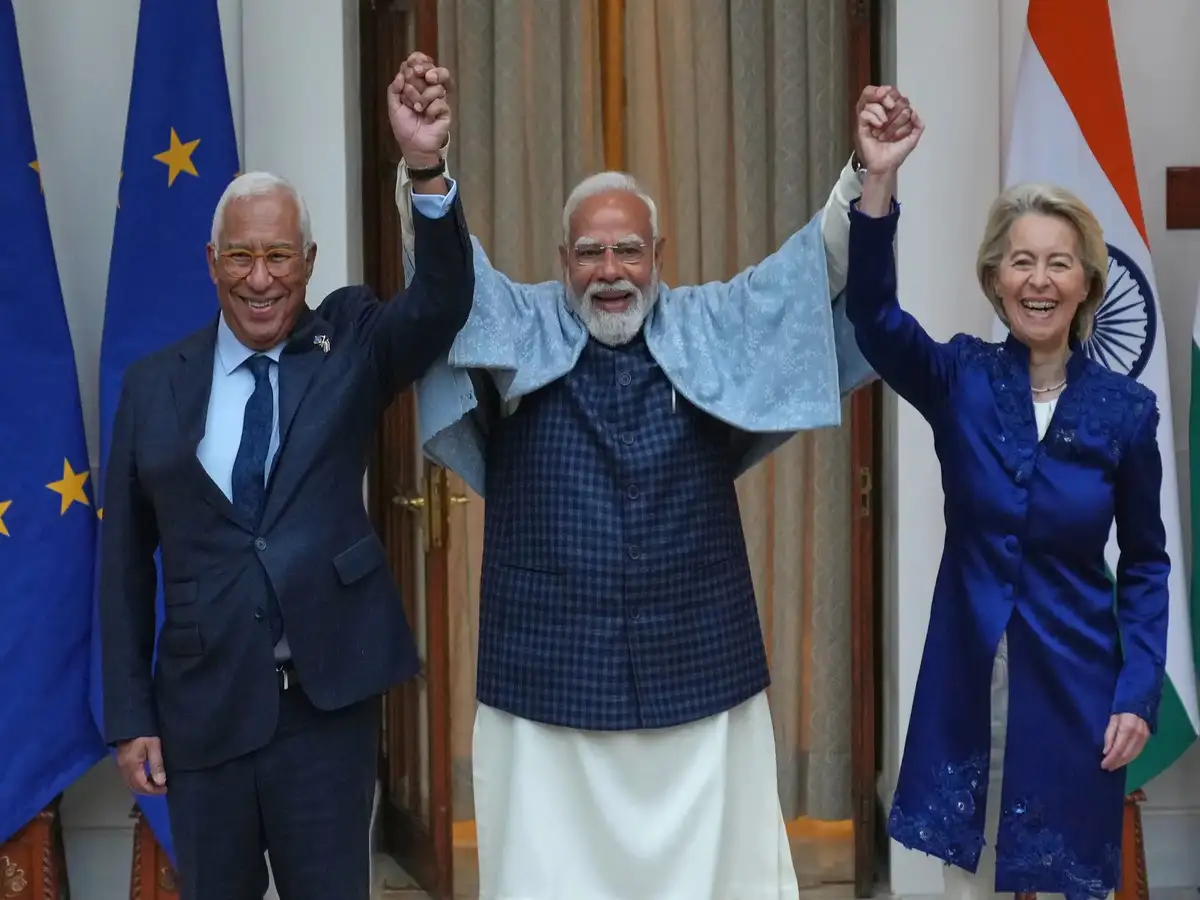
On 27 January 2026, India and the European Union reached a historic milestone by finalising a long-awaited Free Trade Agreement, marking one of the most significant developments in global trade diplomacy in recent years. After nearly two decades of negotiations marked by repeated pauses, political transitions, and complex economic disagreements, both sides announced the conclusion of what has been described as the “mother of all trade deals.” The agreement reflects a major step forward in strengthening economic, strategic, and political relations between India and the 27-nation European Union at a time when the global trading system is undergoing rapid transformation. Leaders on both sides emphasised that the deal is not merely commercial in nature but represents a long-term partnership built on shared interests, mutual growth, and economic resilience.
Prime Minister Narendra Modi described the agreement as a transformative moment that would benefit India’s population of over 1.4 billion people while also opening vast opportunities for European businesses seeking access to one of the world’s fastest-growing markets. European Commission President Ursula von der Leyen echoed this sentiment, highlighting the scale and ambition of the pact and calling it the largest trade agreement ever negotiated by the European Union. At the heart of the agreement lies a comprehensive framework aimed at liberalising trade in goods and services while promoting investment and economic cooperation. Under the pact, tariffs will be eliminated or substantially reduced on nearly all traded goods over a phased period. This move is expected to deepen market access and significantly increase bilateral trade, which already stands at hundreds of billions of dollars annually. Indian exporters are expected to gain easier entry into European markets for products such as textiles, garments, leather goods, gems and jewellery, chemicals, engineering goods, and marine products, sectors in which India holds strong competitive advantages. For the European Union, the agreement opens doors for expanded exports of automobiles, machinery, electrical equipment, chemicals, high-end consumer goods, and industrial technology to the Indian market. One of the most discussed aspects of the deal is the reduction of tariffs on luxury cars and premium products. Until now, imported European automobiles entering India were subject to duties exceeding 100 percent, making them accessible only to a limited segment of consumers. Under the new agreement, these tariffs will be progressively reduced, initially falling sharply and eventually declining to significantly lower levels within defined quotas. This is expected to make European car brands more affordable while also encouraging greater competition and technological advancement within India’s automotive sector. Similarly, duties on European wines and spirits, which were among the highest in the world, will be gradually lowered, potentially reshaping India’s premium beverage market and expanding consumer choice.
Beyond luxury items, the agreement also focuses heavily on industrial inputs and technology-driven sectors. Tariff reductions on aircraft components, medical equipment, electronic parts, and advanced machinery are expected to reduce production costs for Indian manufacturers who rely heavily on imported inputs. This could strengthen India’s manufacturing ecosystem, particularly in sectors aligned with initiatives such as “Make in India,” while improving productivity and efficiency. The services sector, a major pillar of the Indian economy, forms another crucial component of the agreement. The FTA provides enhanced market access in areas such as information technology, financial services, professional services, maritime transport, and digital trade. Indian service providers may find greater opportunities across European markets, while European firms are likely to benefit from a clearer regulatory framework when operating in India. Importantly, the agreement includes provisions facilitating temporary movement of skilled professionals, addressing long-standing concerns regarding labour mobility and recognition of qualifications. The broader economic impact of the deal is expected to be substantial. For Indian consumers, reduced import duties could translate into lower prices for a wide range of products, including automobiles, electronics, medical equipment, and premium food and beverage items. For businesses, simplified customs procedures, predictable regulations, and enhanced investment protection could create a more stable environment for long-term planning. European companies view India as a critical growth market at a time when domestic demand in parts of Europe remains sluggish, while Indian firms see the EU as a gateway to high-value markets with strong purchasing power.
It is noted that the deal reflects a broader shift in global economic alliances, where countries are increasingly seeking trusted partners to ensure supply chain security and economic stability. By deepening cooperation between two of the world’s largest democratic economies, the agreement reinforces shared values related to open markets, rules-based trade, and multilateral cooperation. At the same time, it signals India’s growing role as a central player in global economic governance. However, not all issues have been fully resolved. Certain environmental and regulatory concerns remain subjects of ongoing dialogue, particularly regarding the European Union’s Carbon Border Adjustment Mechanism. India has repeatedly expressed apprehensions that such measures could act as disguised trade barriers affecting exports such as steel and cement. While the FTA does not remove these mechanisms, both sides have committed to continued engagement to address their impact and ensure fair implementation. Similarly, matters related to intellectual property rights, labour standards, and sustainability were carefully negotiated to balance developmental priorities with global norms. Despite these complexities, policymakers on both sides have emphasised that the agreement represents a pragmatic compromise reflecting economic realities rather than ideological rigidity. The FTA is designed as a living framework, allowing future cooperation in areas such as renewable energy, climate technology, digital innovation, and research collaboration. These dimensions are expected to gain increasing importance as India and the EU align their long-term growth strategies. The agreement now moves into the ratification phase, requiring approval from the European Parliament, relevant EU member states, and Indian legislative authorities. While this process may take time, both sides have expressed confidence that implementation could begin within the next year or two. Tariff reductions and market access commitments will be rolled out gradually, allowing domestic industries sufficient time to adjust to increased competition.
Dr. Sharanpreet Kaur is an Assistant Professor of International Relations at School of Social Sciences, Guru Nanak Dev University, Amritsar. She is an alumna of Jawaharlal Nehru University, New Delhi and is the author of the book “India’s Soft Power Diplomacy, Prospects, Challenges and the Way Forward”.




