Israel vs Iran Currency: Israeli Shekel vs Iranian Rial: 1 USD = 3.14 ILS vs 1 USD = 1.75 million IRR after Iran attacks. Full currency comparison, why Shekel is strong, why Rial collapsed, and impact on Indian rupee.
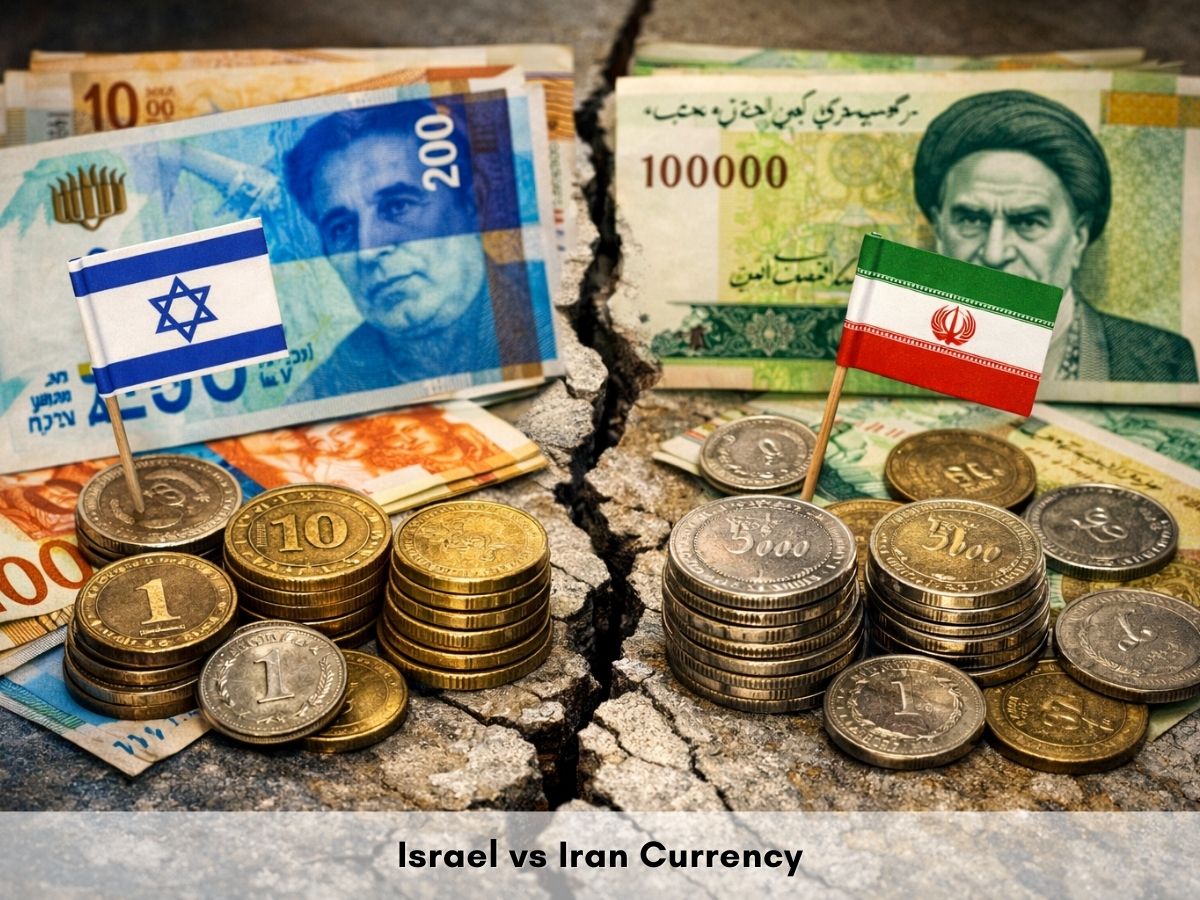
1 US Dollar = 3.14 Shekels vs 1.7 million Rials: Why Israel's currency is 500,000 times stronger than Iran's (Image: File)
Israel vs Iran Currency: Israeli and US strikes on Iranian targets, set off retaliatory missile attacks across the Middle East, revealing a clear economic divide. The Israeli Shekel stayed resilient at 3.14 per dollar, while the Iranian Rial slid to an all-time low of 1.75 million per dollar, reflecting sharply different economic conditions.
The Israeli Shekel (ILS) is overwhelmingly stronger than the Iranian Rial (IRR). As of March 1, 2026:
| Currency Pair | Exchange Rate |
|---|---|
| 1 Israeli Shekel | = 421,031 Iranian Rials (approx.) |
| 1 Iranian Rial | = 0.00000237 Israeli Shekels |
This means that one Israeli Shekel buys more than 400,000 Iranian Rials, showing the Rial's full devaluation due to decades of economic isolation and sanctions.
| Rate Type | Exchange Rate |
|---|---|
| Market Rate | 1 USD = 3.14 ILS |
| 1 ILS = 0.3189 USD | NA |
| Historical (Feb 8, 2026) | 1 USD = 3.11068 ILS |
| Historical (Jan 21, 2026) | 1 USD = 3.15195 ILS |
| Historical (Dec 17, 2025) | 1 USD = 3.2299 ILS |
The Shekel has shown resilience despite the conflict, trading within its recent range of 3.09 to 3.23 per dollar over the past two months .
| Rate Type | Exchange Rate |
|---|---|
| Open Market (Free) Rate | 1 USD = 1,749,500 IRR |
| Official Rate | 1 USD = 42,086 IRR |
| Central Bank Rate | 1 USD = 1,113,328 IRR |
| Early January 2026 | 1 USD = 1,350,000 IRR |
| Early February 2026 | 1 USD = 1,600,000+ IRR |
The Rial has lost approximately 30% of its value since the start of 2026, with the open market rate deteriorating from 1.35 million to 1.75 million per dollar as military tensions mounted .
For Indian readers and the 9-million strong Indian diaspora in the Gulf, understanding these currency values is critical .
| Rate Type | Exchange Rate |
|---|---|
| 1 Israeli Shekel | = ₹29.04 |
| 1 Indian Rupee | = 0.0344 Israeli Shekels |
| Rate Type | Exchange Rate |
|---|---|
| Official Rate | 1,000 IRR = ₹1.97 (1 INR = 507 IRR) |
| Open Market Rate | 1,000 IRR = less than ₹0.07 (1 INR ≈ 14,466 IRR) |
| Period | 1 INR = |
|---|---|
| November 25, 2025 | 472.51 IRR (high) |
| January 28, 2026 | 457.25 IRR (low) |
| February 23, 2026 | 462.34 IRR |
| 6-month change | -3.33% |
The Indian rupee has weakened against the Iranian Rial over the past six months, meaning Indian importers pay more rupees for the same amount of Rials. However, with the Rial's open market collapse, the effective exchange rate for informal transactions is dramatically different .
Multiple structural factors support the Israeli shekel. Israel’s position as a global tech and cybersecurity hub brings in sustained foreign investment and export income, creating reliable dollar inflows. This is strengthened by foreign exchange reserves of about $212.93 billion, offering a buffer against uncertainty and regional stress. A diverse economy—spanning medical devices, pharmaceuticals, and diamond trading—adds to hard-currency revenues. Historically, the shekel has remained resilient, often recovering swiftly after conflict-driven swings.
The Iranian rial’s collapse is the result of long-standing, compounding economic stresses. Decades of tight international sanctions have crippled oil exports, restricted banking access, and cut Iran off from global capital flows. The currency's value has been eroded and the difference between official and market values has grown as a result of significant inflation, which is presently estimated to be above 48%. Iran's dual exchange-rate system has exacerbated distortions and eroded confidence, while ongoing economic instability has prompted widespread capital flight and further weakened the rial.
These structural flaws were starkly exposed by the February 28, 2026 strikes on Tehran, which targeted neighborhoods near Ayatollah Ali Khamenei's compound. The unexpected rise sparked market fear, which was exacerbated by airspace closures and mobile service outages, giving a further jolt to an already vulnerable economy.
The Shekel initially fluctuated somewhat after the strikes, but it stayed in its recent trading range of 3.09–3.14 per dollar. Because of Israel's solid economic foundations and reserve buffers, analysts observe that the Shekel has typically recovered swiftly following regional crises.
The Rial plunged to a record low of 1,749,500 per dollar on the open market immediately after the strikes. This marks a sharp deterioration from the 1,350,000 level seen at the start of January 2026—a nearly 30% decline in two months. The British pound traded at 2,353,500 IRR, the euro at 2,067,500 IRR, and the Russian rouble at 22,650 IRR on the free market .
