
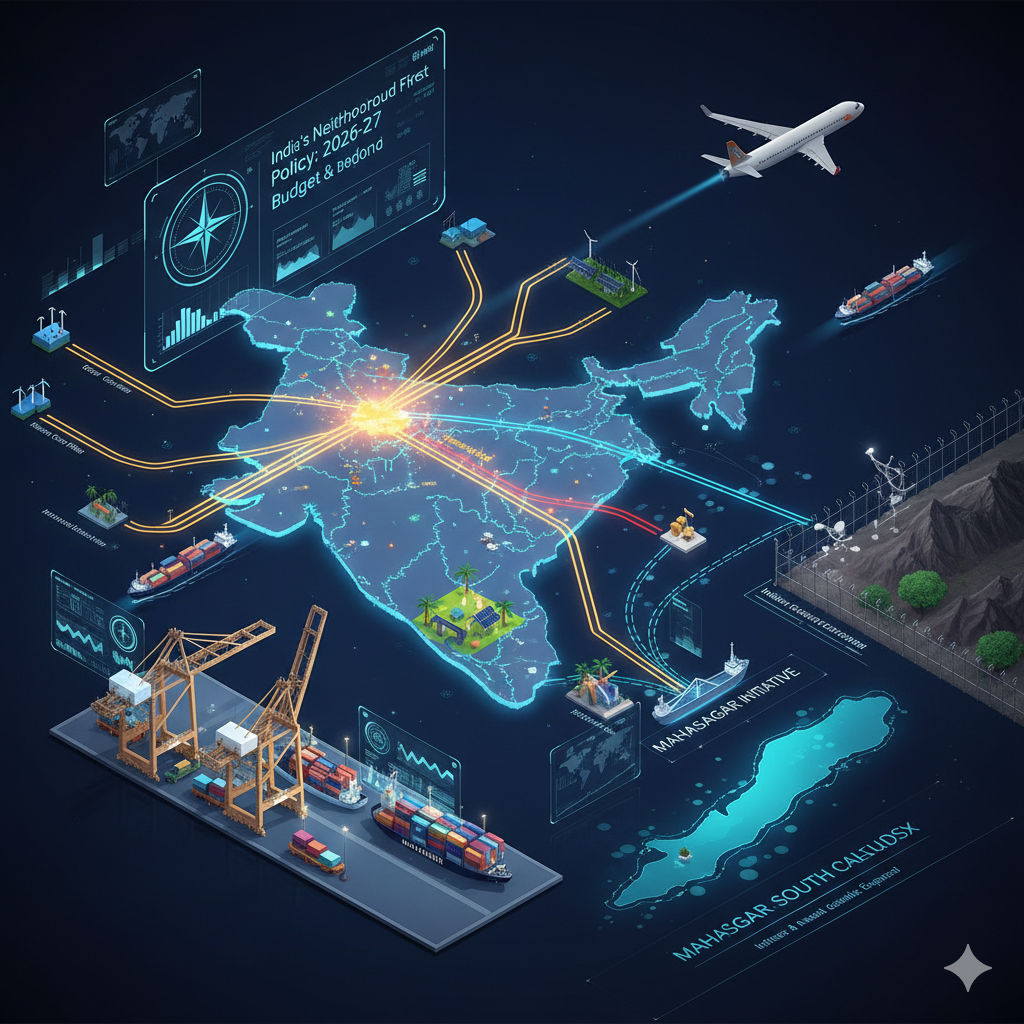
Through budgetary allocations to neighbouring states, the Government of India operationalises and commits to its “Neighbourhood First” policy. These allocations are best understood not as linear trends but as context-driven decisions shaped by regional political, economic, and security considerations. While the Neighbourhood First policy remains a core pillar, its implementation is becoming increasingly nuanced and pragmatic.
In the 2026-27 Budget, allocations are likely to see a moderate nominal increase; however, amid political transitions and upcoming elections in Myanmar, Bangladesh, and Nepal, aid disbursement is expected to be more carefully calibrated.
Further, the budget is likely to reflect an expansion of India’s interests in the Indian Ocean Region and beyond to the wider Global South, with higher allocations for Africa and Southeast Asia. This aligns with the MAHASAGAR policy launched in April 2025 by PM Modi, signalling a broader geographic scope through enhanced connectivity, deeper economic engagement, and strengthened defence cooperation.
EASTERN NEIGHBOURS: STABLE YET FORMIDABLE CHALLENGES
Bhutan remains the largest recipient of India’s budgetary support backed by substantial Indian grants and loans, underscoring that it remains at the core of India’s “Neighbourhood First” policy. Deep cooperation in hydropower and now large-scale initiatives like the Gelephu Mindfulness City, along with high-level visits from both sides in 2025, have been the key focus. Drawing on the patterns of previous year allocations, it is expected that Bhutan will receive increased support for its 13th Plan support, hydropower (Punatsangchhu-I and II and downstream projects) and Gelephu-linked infrastructure. Last year, Nepal remained as a stable second-tier recipient after Bhutan. At present, Nepal faces political instability, especially the Gen Z protests in September 2025, which led to the overthrow of the previous government, and now the election is scheduled for 2026. Even economically, the country has faced a slowdown, especially post the protests. Additionally, Nepal has deepened ties with both China and Gulf partners. In nominal terms, Nepal’s allocation is likely to remain stable or increase only modestly, but with a compositional shift toward climate-resilient infrastructure and cross-border transmission.
India’s allocation for Bangladesh remained unchanged in the current budget, signalling policy continuity. However, most Indian-assisted projects are suspended or delayed due to operational, administrative, and political disruptions following the 2024 ouster of the Sheikh Hasina government. Therefore, the February 2026 elections will be decisive for both project implementation and India’s future budgetary commitments to the country.
Finally, Myanmar remains India’s most complex eastern neighbour. Since 2023-24, aid to Myanmar has been lowered. This reflects risk hedging rather than disengagement. The military rule in Myanmar, humanitarian crisis, and instability in border regions coexist with India’s requirements for secure transit to Southeast Asia. Over the past year, India has moved toward tighter border control (replacing the Free Movement Regime, planning fencing, and scaling up Assam Rifles deployment). Given that work on fencing has started, allocations are expected to increase, with the Border Roads Organisation and Assam Rifles, as well as a flexible humanitarian assistance line to support conflict-affected communities.
WESTERN FRONT: COMPLEX YET CRUCIAL
The 2025-26 Union Budget allocated Rs 100 crore for development assistance to Afghanistan, reaffirming India’s long-standing commitment to the Afghan people. The allocation signals New Delhi’s resolve to continue humanitarian and development aid despite the absence of formal diplomatic recognition of the Taliban administration. Given the evolving geopolitical dynamics in the Afghanistan-Pakistan region, India is likely to prioritise the resumption and completion of Indian-assisted projects stalled since August 2021. This development-focused approach was reinforced by the recent visit of Taliban Foreign Minister to New Delhi. Consequently, budgetary allocations for Afghanistan are expected to remain stable or see a modest increase in the upcoming budget.
An additional allocation of Rs 100 crore was earmarked for the Chabahar Port project last year, underscoring its strategic importance in India’s connectivity outreach to Central Asia and beyond. Progress, however, faced considerable setbacks after the Donald Trump administration revoked India’s sanctions waiver for Chabahar. Nonetheless, a notable breakthrough came in October 2025, when the US granted a six-month exemption, enabling the resumption of key infrastructure and connectivity initiatives. Despite persistent challenges, the sustained Indian commitment to Chabahar remains strategically essential.
MARITIME PARTNERS: PILLARS OF MAHASAGAR INITIATIVE
India launched the MAHASAGAR initiative in April 2025, which laid emphasis on its maritime neighbours in the Global South. This initiative builds on the SAGAR doctrine, which focuses on the IOR region. Maldives in the IOR remains key to India’s maritime interests and security, and therefore, contrary to the popular narrative, Maldives became the third-largest recipient of aid in 2025-26. With the visit of PM Modi to the country in July 2025, the relations received a significant boost with progress on FTA and a large line of credit. Any future increase beyond Rs 600 crore should be tied to progress benchmarks on Indian-funded projects and defence cooperation.
Sri Lanka has moved from acute crisis toward fragile stabilization, supported by the IMF, World Bank, and bilateral creditors like Japan and China. India’s strategic stake lies in preventing relapse into crisis, balancing China’s economic presence, and keeping Colombo aligned on Indian Ocean security. A step-up to Rs 300 crore could be expected as a three-to-five-year “Sri Lanka Stabilization and Resilience Window” that co-finances health, social-protection, and climate-adaptation projects alongside the World Bank and IMF, with an in-built humanitarian/disaster-response component of at least 20-25% to address shocks like Cyclone Dilwah.
To conclude, forthcoming budgetary allocations are anticipated to move beyond the logic of “mercaid” toward structured, clearly labelled, and conditional sub-windows tailored to country-specific trends rather than abstract aggregates. A key focus is likely to be investments in trade and connectivity projects, particularly in light of initiatives such as IMEC and EMC, aimed at strengthening regional trade architecture. Priority is also expected for the rapid operationalisation of air freight corridors, including Kabul-Delhi and Kabul-Amritsar. Additionally, greater attention may be directed toward renewable energy projects and the development and acquisition of rare earth processing capabilities. Furthermore, security and border-management spending is expected to increase along the most sensitive frontiers both on the west (Paluhganz area) as well as east (rise of insurgency in North East). Finally, in alignment with the Modi government’s importance accorded to the diaspora, it is expected that the current Rs 77 crore allocation could expand to include strategic diaspora outreach programs.
The forthcoming 2026 Union Budget is expected to mirror shifts in India’s “Neighbourhood First” policy amid economic challenges and geopolitical realignments. While framed as non-reciprocal, these development assistance programs increasingly function as a strategic geopolitical instrument, with aid allocations calibrated to evolving security priorities, economic constraints, and regional dynamics.
Dr Cchavi Vasisht is Associate Fellow, Chintan Research Foundation; Dr Anchita Borthakur holds a PhD from the School of International Studies, JNU.




