
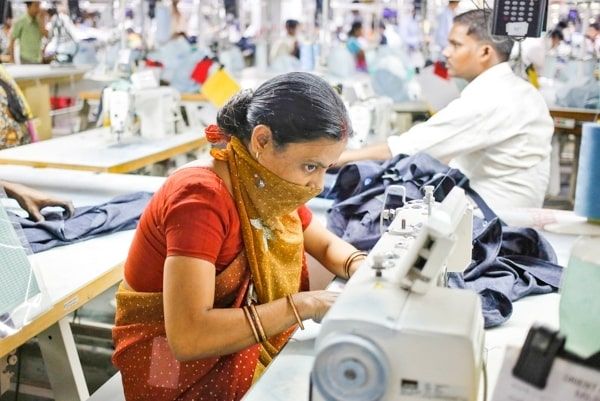
India’s economic growth and export economy greatly depends upon its Micro, Small and Medium Enterprises (MSMEs) and the US trade and tariffs particularly the punitive tariffs for buying the Russian oil directly targeted them. In the context of the newly emerging tariff-geopolitics, securing MSMEs is vital to India’s national security.
The MSMEs constitute 40 percent of India’s total manufacturing capacity, 40 percent of total exports and 120.6 million jobs 11 million of which were created between 2023 and 2024. They are the backbone of the Indian economy with a 27.3 percent contribution to the country’s GDP in 2020-21, 29.6 percent in 2021-22 and 30.1 percent in 2022-23. Their contribution to Indian exports has also risen exponentially from 3.95 lakh crores in 2020-21 to 12.39 lakh crores in 2024-25. The number of exporting MSMEs during this period also increased from 52,849 in FY2020-21 to 1,73,350 in FY2024-25 (upto May 2025). In total India today has 73.4 million MSMEs and they constitute India’s national entrepreneurship base.
The Union budget 2025-26 identified four key engines of India’s national development agriculture, investments, exports and MSMEs. This means that they are key to India’s economic growth and its becoming the third largest global economy by 2027.
India’s next generation GST reforms introduced in September particularly support MSMEs because they incentivise the youth to enter into businesses and initiate their own startups (MSMEs). The lower GST rates under these reforms are expected to cut costs for the MSMEs and increase the tax base.
Tariffs and Competition Leagues
The US 50 percent tariffs on Indian exports including 25 percent of punitive tariffs for buying Russian oil became effective on August 27. These tariffs substantially hit the Indian exports and the MSMEs took 70 percent share in the sectors impacted. In response the Indian government approved a $51 billion package for its exporters last week.
A report by Crisil Intelligence, an industry analytics organization said that textile, diamond and chemical MSMEs are the worst impacted by the US tariffs. Textiles, gems, jewellery and seafood are all labour intensive industries and constitute 25 percent of the total Indian exports to the United States. In the Chemicals industry MSMEs have a 40 percent share and the additional tariff is shocking and unsettling because in the competition league. India’s disadvantage turns an advantage for Japan and South Korea with lower tariffs but equally robust industry.
Pushan Sharma, the Director of Crisil Intelligence said the tariffs reduce the already slim-margins of the MSMEs and pose a “material challenge to their competitiveness”. “For instance, those into readymade garments (RMG) are expected to lose ground in the US as the tariff increases to 61%, including 50% additional ad valorem duty, compared with peers in Bangladesh and Vietnam tariffed at 31%”. The Tirupur cluster, which accounts for over 30% of India’s RMG exports, will be severely impacted as ~30% of its exports are to the US, he said in a statement.
The comparative tariffs in the matrix of global industrial relations thus not only unsettle the Indian MSMEs but they create new trends in the regional and global competition leagues where old cliques are broken, interest groups are pitted against each other while the prime interest adhered to is that of the tariff imposer. Non conformity certainly means a disadvantage while innovative solutions get tougher. Negotiating teams thus need to almost put up a political feat to get a settlement.
Smart Strategies
In the emerging geo-politics where everything is getting weaponsized and economic rise is proportional to geo-political power and global leadership, MSMEs become much more than a means to India’s economic rise. Their connections with issues of labour, employment, economic formalization, national upskilling, and entrepreneurship at scale makes them important for our democratic functioning and our national security.
Things become concerning because nearly half of the Indian MSMEs are still unorganized. Indian government’s Udyam portal witnessed 39 million registration of MSMEs by March 2024 (24 million MSMEs and 15 million Udyam assisted informal micro enterprises) which means that they are now visible to those providing credit, subsidies, and government support mechanisms. However this also means that the rest 36.4 million are unregistered, unaccounted and unorganized. Such a large number of unorganized MSMEs increases vulnerability and makes analysis and intervention difficult.
A report by KPMG, a multinational professional services network released on September 4 said that MSME clusters are facing increased stress due to the tariffs because of limited customer diversification and fragile supply chains. The latter is a result of a substantial unorganized sector.
Learnings for India
It becomes important to see India’s ongoing economic rise from a national security perspective. On its march towards the mid-century while India is estimated to be the third largest global economy in a few years, its economic rise and geopolitical power will constantly be challenged by adversaries inside and outside. In fact many other multifaceted and diverse geopolitical factors in the region and across the globe will interact constantly to impact India’s rise.
Thus national security interventions for MSMEs and security interventions for India’s economic growth at large would first need identifying their complex and unconventional security needs because they are under threat in unprecedented ways. Next will obviously involve being prepared and building resilience.
The KPMG report said that “India should expedite trade negotiations with the US, to address its tariff challenges and to secure product-level exemptions for critical sectors”. “In parallel, targeted financial interventions such as subsidies, working capital support and export insurance could safeguard MSMEs and employment-intensive clusters, ensuring short-term stability and long-term competitiveness”.
Moreover the US trade and tariffs should serve as a wake up call for Indian lawmakers because such challenging situations aren’t one time and will repeat in the future to test our preparedness. In this context it becomes indispensable for India to consider issues of its labor, demographic trends, employment, MSMEs and further unorganized sector from the prisms of national security.
Venus Upadhayaya is a MOEA 2025 Taiwan Fellow and a Visiting Scholar at the NCHU-Taichung city, Taiwan. Her doctoral work is about perspectives on India’s unorganized sector




