PM Modi’s Jordan, Ethiopia and Oman tour deepened strategic ties, boosted trade, defence and energy cooperation, and expanded India’s global outreach.
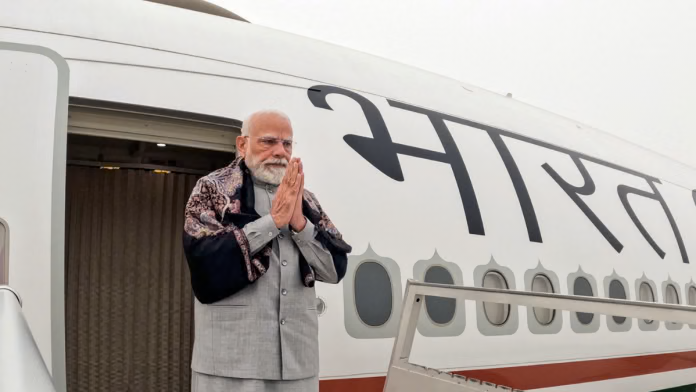
Prime Minister Narendra Modi during his three-nation visit to Jordan, Ethiopia and Oman, engaging leaders to strengthen India’s strategic and economic partnerships (Photo: PMO)
NEW DELHI: Prime Minister Modi's three-nation tour to Jordan, Ethiopia and Oman from December 15 to 18, 2025 was significant for deepening strategic and economic cooperation, reinforcing long-standing partnerships, and expanding India's diplomatic footprint in the Middle East and Africa.
India's outreach to West Asia and Africa has evolved into a comprehensive and strategic engagement, moving beyond traditional economic ties to encompass security, technology, and multilateral cooperation.
Prime Minister Modi's visit to Jordan on December 15-16, the first full bilateral visit by an Indian Prime Minister in 37 years also coincided with the 75th anniversary of the establishment of diplomatic relations between the two countries, providing an opportunity to boost ties and explore new areas of collaboration in sectors such as renewable energy and information technology.
Jordan is a stable and moderate voice in a volatile Middle East region, making it a crucial partner for India's engagement in West Asia. Both nations share concerns about terrorism and cooperate on counter-terrorism efforts, with high-level discussions and agreements on defense and security cooperation.
Jordan is also very important for India due to strong economic and commercial ties. India is Jordan's fourth-largest trading partner, with bilateral trade valued at approximately US$ 2.8 billion annually. Both sides have set the goal of almost doubling bilateral trade to $5 Billion in five years.
Fertilizer and phosphate trade is a cornerstone of the economic relationship. India imports large quantities of phosphates, phosphoric acid, and potash from Jordan for its fertilizer industry. A major joint venture project, the Jordan-India Fertilizer Company (JIFCO) between IFFCO India and the Jordan Phosphate Mines Company (JPMC), is a key investment worth over US$ 860 million.
Indian companies have invested considerably in Jordan's textile sector. Many Indian-owned garment manufacturing units operate in Jordan's Qualified Industrial Zones (QIZs), leveraging Jordan's free trade agreements with the US and other countries for exports.
India exports a wide range of goods to Jordan, including electrical machinery, cereals, frozen meat, organic and inorganic chemicals, and automotive parts. People-to-people and cultural ties with Jordan are also very important.
There are around 17,500 Indian nationals living and working in Jordan, primarily in the textile, construction, and manufacturing sectors, contributing to both economies. The two countries have active educational and cultural exchange programs.
Jordan offers visa on arrival or e-Visas for Indian tourists, and direct flights have been established, boosting tourism and people-to-people contacts. During Prime Minister Narendra Modi's visit, India and Jordan signed five important agreements or MoUs to enhance cooperation across several strategic sectors such as Technical Cooperation in New and Renewable Energy, Cooperation in Water Resources Management Development a Twinning Agreement between Jordan's ancient city of Petra and India's Ellora Caves... the Renewal of the Cultural Exchange Programme for 2025-2029 and a Letter of Intent on Sharing Digital Solutions to support Jordan's digital transformation and promote inclusive governance.
After Jordan, PM Modi visited Ethiopia on Dec 16-17, 2025 at the invitation of Prime Minister Dr. Abiy Ahmed Ali. The visit, the first by an Indian Prime Minister since 2011, provided new momentum to the historically deep relationship between the two nations, which dates back over 2,000 years.
Ethiopia hosts the headquarters of the African Union (AU), making it a crucial diplomatic hub for India's engagement with the entire African continent. In essence, Ethiopia serves as a vital anchor for India's broader Africa outreach strategy, encompassing economic growth, capacity building, and geopolitical alignment.
India is one of the top three foreign investors in Ethiopia, with over 650 companies involved in manufacturing, agriculture, floriculture, engineering, and pharmaceuticals. The total investments by Indian companies exceed USD 6.5 billion.
Bilateral trade has shown consistent growth making India one of Ethiopia's largest trading partners. India exports pharmaceuticals, steel, machinery, and textiles, while importing pulses, oilseeds, spices, and leather.
Ethiopia has been the largest recipient of Indian concessional Lines of Credit in Africa, with over US$1 billion committed to major projects in power transmission and the sugar industry. Education has been a core element of the relationship.
Thousands of Indian teachers and professors have worked in Ethiopian schools and universities for decades, contributing significantly to human capital development. India has provided numerous scholarships and technical training slots under the ITEC program and the Pan-African e-Network project to Ethiopian students and professionals.
Prime Minister Modi was conferred with the Great... Honor Nishan of Ethiopia, the country's highest award, by Prime Minister Abiy Ahmed Ali. PM Modi also addressed a Joint Session of the Ethiopian Parliament, which was the 18th parliament in the world to be addressed by him.
It was a significant diplomatic event which underscored the importance of the relationship. During Prime Minister Narendra Modi's visit, India and Ethiopia signed eight key agreements and Memorandums of Understanding (MoUs). The primary outcome was the official elevation of bilateral ties to a Strategic Partnership, marking a new phase of long-term cooperation.
Thus, Prime Minister Narendra Modi's visit to Ethiopia is assessed as a landmark diplomatic success that transitioned long-standing historical ties into a modern Strategic Partnership. In a rare personal gesture, PM Abiy Ahmed Ali personally drove PM Modi to the airport at the conclusion of the visit.
In the final leg of the 3-nation tour, PM Modi visited the Sultanate of Oman at the invitation of His Majesty Sultan Haitham bin Tarik. This was his second visit to Oman and marked 70 years of diplomatic relations between the two nations.
Oman is important for India due to its strategic location, serving as a crucial pillar of India's West Asia policy and an essential partner for energy security, defense cooperation, and economic ties. Oman is strategically located at the mouth of the Persian Gulf and controls the southeastern entrance to the Strait of Hormuz, a critical chokepoint for a significant portion of the world's oil shipments.
This position is vital for India's maritime security and energy trade interests. Oman continues to be one of India's key partners in the region and an important interlocutor within the Gulf Cooperation Council, the Arab League and the Indian Ocean Rim Association.
India's ties with Oman are rooted in centuries of exchange, with documented contacts spanning nearly... 5,000 years. Diplomatic relations were formalised in 1955 and elevated to a Strategic Partnership in 2008.
Oman is India's closest defense partner in the Gulf region and the only country with which all three wings of India's armed forces hold regular joint exercises—Army (Al Najah), Air Force (Eastern Bridge), Navy (Naseem Al Bahr). India has secured access to Oman's strategically important Duqm Port for military use and logistical support, including using its dry dock for maintenance of Indian naval vessels.
This enhances the Indian Navy's operational reach in the Indian Ocean region and helps counter the influence of other powers like China. Both nations cooperate closely on ensuring maritime security, combating piracy, and protecting sea lanes of communication, which is crucial for India's trade and energy shipments.
Economic and commercial ties between India and Oman are also very important. India is one of Oman's top trading partners. Bilateral trade reached approximately $10.61 billion in the financial year 2024-2025.
Oman is a significant and reliable source for India's energy requirements, including crude oil and liquefied natural gas (LNG) imports. There are over 6,000 Indo-Oman joint ventures in Oman with an estimated total investment of over $7.5 billion.
The Oman-India Joint Investment Fund (OIJIF) facilitates strategic investments in India. Oman's ports Duqm, Sohar, Salalah are important logistics hubs. India has an interest in developing these ports, and an undersea gas pipeline project SAGE from Oman to India has been under consideration as an alternative energy route.
The two countries have signed an MoU to link their payment systems—India's UPI is proposed to link with Oman's mobile wallet app, Thawani, facilitating digital transactions. Oman is India's third-largest export destination in the GCC, after the UAE and Saudi Arabia.
India-Oman bilateral trade stood at $10.5 billion in FY25, with exports of $4 billion and imports of $6.54 billion. India's exports to Oman include mineral fuels, chemicals, precious metals, iron and steel, cereals, ships and boats, electrical machinery, boilers, tea, coffee, spices, apparel and food items.
India's imports from Oman are dominated by crude oil, LNG, urea, chemicals and aluminium products. Energy and fertilisers account for over 70% of India's imports from the country. Other imported items include propylene and ethylene polymers, pet coke, gypsum, chemicals, iron and steel, and unwrought aluminium.
During PM Modi's visit to Oman, the two sides signed the Comprehensive Economic Partnership Agreement (CEPA) and reviewed cooperation in areas like trade, investment, energy, defence, and technology. CEPA is a major step in strengthening bilateral economic ties.
It aims to cut or eliminate tariffs on a wide range of goods, ease rules for services trade, and encourage investment flows between the two countries. CEPA is expected to improve market access for Indian goods, provide greater certainty on energy supplies, and deepen cooperation in services and investment.
Strategically, CEPA strengthens India's economic and geopolitical footprint in the Gulf. One key aspect to watch will be how India navigates Oman's Omanisation policy, which prioritises local employment while opening up trade and investment.
The large Indian expatriate community in Oman around 700,000 people—serves as a living bridge between the two nations, contributing significantly to the Omani economy and society. The Omani government has long acknowledged their role.
The deep socio-cultural bonds are rooted in millennia-old maritime trade routes and historical people-to-people exchanges. There are old Hindu temples and other religious structures in Oman that have been permitted for decades.
Summing up, Prime Minister Modi's forthcoming visits to Jordan, Ethiopia and Oman are important for a variety of strategic, economic, and diplomatic reasons and are aimed at advancing India's national interests and enhancing its global standing.
Summit-level visits serve as a crucial mechanism to foster closer ties, mutual understanding, and solidarity with partner nations. These interactions allow leaders to build personal rapport, which can facilitate smoother diplomatic and economic cooperation, even amidst geopolitical tensions.
Ultimately, these foreign visits are considered an essential component of an active and pragmatic foreign policy designed to position India as a key player and a reliable partner in an increasingly multipolar world.
Prabhu Dayal is a retired Indian ambassador
