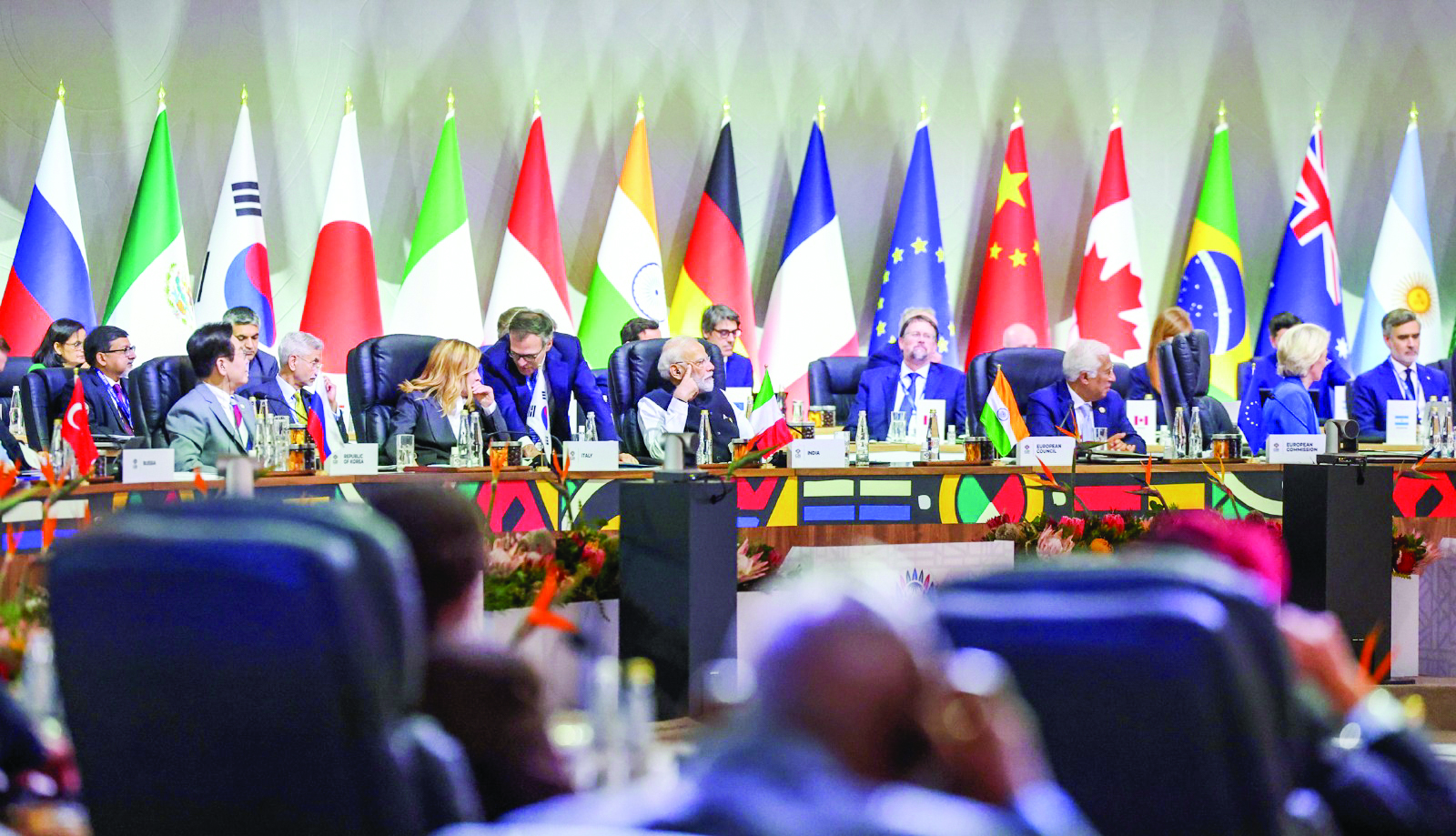
The recent G20 Summit was held in Johannesburg, South Africa, on November 22-23, 2025. It was the first time the Summit was hosted on the African continent. It achieved significant diplomatic results and made strides on issues important to the Global South. The summit's ability to produce a consensus declaration despite a US boycottdemonstrated a continued commitment to multilateral problem-solving among most major economies.
India's Role and Initiatives
India's participation was significant. India amplified the voice of the Global South to promote human-centric development and proposed key global initiatives on health, technology, and security. The summit highlighted the lasting influence of India's 2023 Presidency on the G20's ongoing agenda, particularly on issues of inclusive growth and sustainable development.
PM Modi proposed several concrete initiatives at the Summit, including:
- A G20 Initiative on Countering the Drug Terror Nexus to address drug trafficking.
- A Global Healthcare Response Team comprising G20 experts for rapid deployment during health emergencies.
- An Africa Skills Multiplier to train one million certified professionals in Africa over the next decade.
- A G20 Open Satellite Data Partnership to share satellite data for agriculture, disaster management, and other vital sectors with the Global South.
- A Critical Minerals Circularity Initiative focused on promoting recycling, urban mining, and innovation in the critical minerals sector.
India's participation reinforced its diplomatic influence, allowing it to engage with major economies, strengthen strategic partnerships through bilateral talks, and position itself as a responsible global actor committed to finding practical solutions for shared challenges.
Key Outcomes of the Leaders Declaration
The 122-point G20 Leaders' Declaration was adopted under the theme of "Solidarity, Equality and Sustainability".
- Prioritizing the Global South: Being the first G20 summit in Africa, it brought the continent's development priorities to the forefront. The operationalization of the African Union's permanent membership (secured during the 2023 New Delhi summit) gave the Global South a stronger collective voice in global economic governance.
- Climate Action and Energy Transition: The declaration emphasized the urgent need to scale up climate finance from "billions to trillions" and supported the tripling of global renewable energy capacity. A new G20 Critical Minerals Framework was adopted, and the "Mission 300" initiative was launched to connect 300 million Africans to electricity by 2030.
- Debt Relief and Financial Stability: Leaders committed to strengthening the G20 Common Framework for debt treatments and improving debt transparency to support low-income countries struggling with high debt burdens.
- Global Governance Reform: The declaration called for "transformative reform" of the United Nations Security Council (UNSC) and stronger multilateral cooperation to better reflect 21st-century realities and the representation of underrepresented regions like Africa, Asia-Pacific, and Latin America.
- Social and Inclusive Growth: Set specific goals, including the Nelson Mandela Bay Target to reduce the rate of youth not in education, employment, or training (NEET) by 5%, and a commitment to achieving 25% gender parity in labor force participation by 2030
- AI Governance: The declaration addressed the need for safe, secure, and trustworthy AI development with human oversight and transparency.
Areas of Weakness and Geopolitical Fragmentation
While the declaration was symbolically strong, many of its statements were general and lacked specific, accountable commitments, timelines, or deliverables.
- The US boycott (due to diplomatic tensions over South Africa's agenda priorities) and the absence of several other leaders, including China's Xi Jinping and Russia's Vladimir Putin, highlighted significant geopolitical fragmentation.
- The declaration contained only minimal and general references to ongoing global conflicts like the war in Ukraine and the Gaza conflict, reflecting the difficulty in achieving consensus on hard security issues.
- The Summit did not secure new specific financial pledges for development banks or a new debt refinancing plan for low-income nations. Key recommendations from expert panels on issues such as progressive taxation were largely watered down or left out.
By and large, South Africa successfully steered the Summit agenda to prioritize the needs of developing nations and secured a strong, consensus-based declaration despite major geopolitical tensions.
The US is the incoming host for the 2026 G20 Summit. The US approach is expected to be less focused on a broad, inclusive global agenda and more on specific, self-interested economic outcomes, potentially moving towards a narrower, transactional approach.
Prabhu Dayal is a retired ambassador of India.