
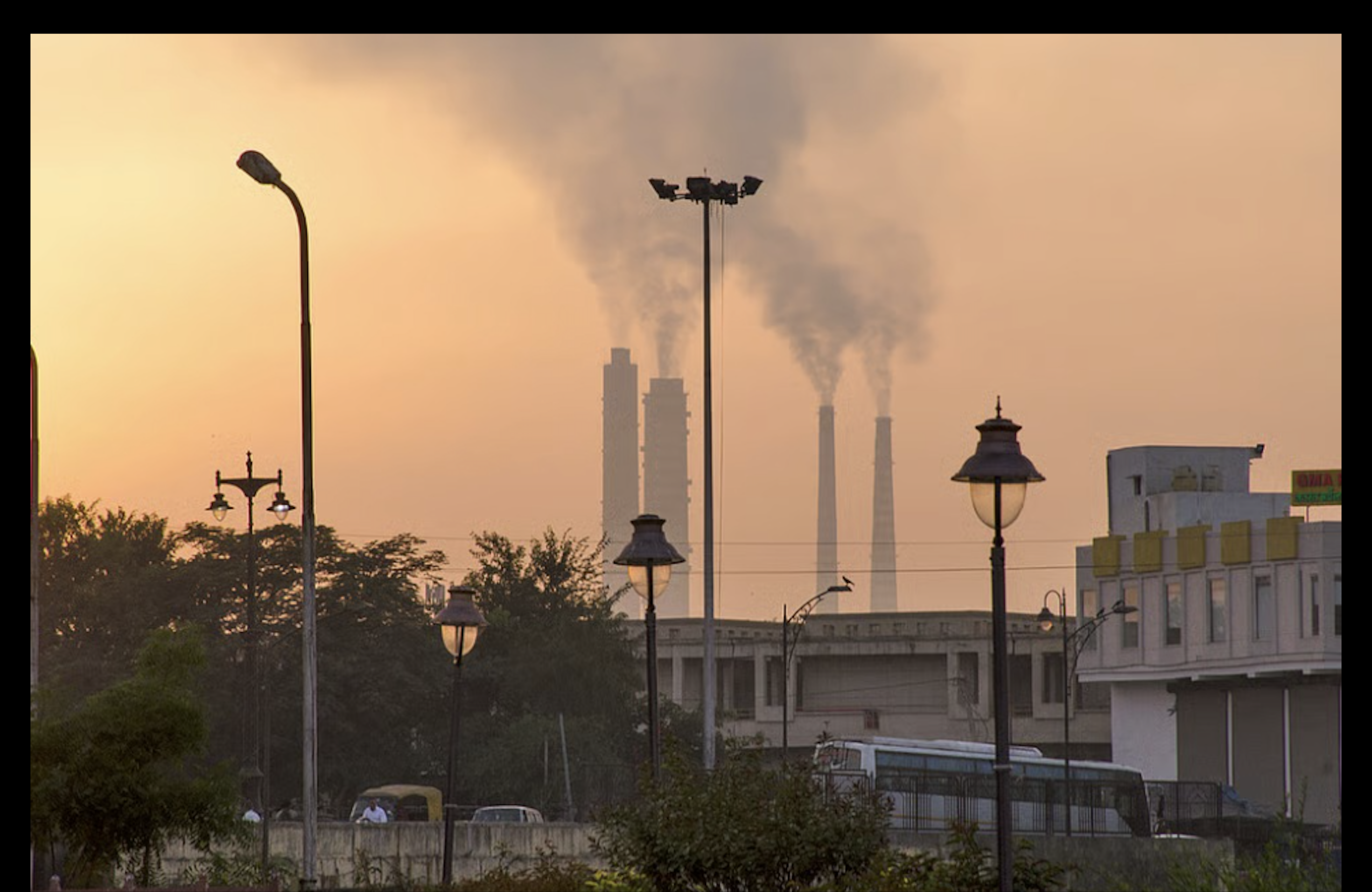
Every winter, Delhi wakes up to an unsettling orange-grey haze that slows traffic, shuts schools, and overwhelms hospitals. For years this has been treated primarily as a public-health emergency. Yet it is equally an economic one. Air pollution now costs India nearly 1.3% of its GDP annually, driven by lost labour productivity, disrupted logistics, construction bans, and increased medical expenditure. A single smog episode can bring construction to a halt, cancel flights, and choke supply chains, costs that ultimately surface on the balance sheets of households, firms, and banks.
Delhi’s crisis is therefore not an isolated urban problem. It is a microcosm of a deeper truth: climate and environmental degradation are already translating into measurable economic losses. As India pushes toward its ambition of becoming a $5-trillion economy, ignoring these linkages is no longer tenable.
Climate Impacts Are Becoming Systemic Financial Risk
India is one of the world’s most climate-vulnerable nations. The year 2022 saw more than 300 extreme weather disasters, causing losses of over Rs 1 lakh crore. In 2023, the India Meteorological Department recorded 34 heatwave days, the highest in decades. Erratic monsoons now trigger both destructive floods and extended dry spells, destabilising agriculture and rural incomes.
These events are fundamentally economic shocks. Banks and non-banking financial companies are particularly exposed because nearly 60% of India’s credit portfolio is tied to climate-sensitive sectors such as agriculture, real estate, infrastructure, and MSME.
Banks face two channels of vulnerability. The first is direct and immediate: floods that damage factories, cyclones that shut ports, or heatwaves that halt construction quickly lead to cash-flow disruptions and repayment delays. Insurance is often assumed to provide a buffer, but penetration remains low and exclusions and payout delays limit its usefulness. Climate shocks therefore translate swiftly into rising delinquencies and restructuring demands.
The second channel is indirect and long-term, arising from supply chain disruptions, labour migration, pollution-induced illnesses, and transition policies that render existing assets unviable. Agriculture, employing nearly half the workforce, often faces yield declines of 30 to 50% in drought-affected regions, destabilising rural credit markets and contributing to persistent NPAs. Climate risk is thus not merely an environmental issue; it is a structural financial-stability concern.
REGULATORS HAVE MOVED, BUT BANKS MUST GO FURTHER
The Reserve Bank of India has taken notable steps. Its 2022 Discussion Paper on Climate Risk and Sustainable Finance, followed by the 2024 climate-risk disclosure framework, marks a shift toward international best practice. The ISSB-aligned framework requires banks to disclose governance, strategy, risk management, and climate metrics over the next few years, with the largest institutions reporting from FY 2025-26.
However, climate resilience cannot be left solely to regulatory compliance. Climate-related mandates are emerging across ministries and government agencies, from emissions standards to water-use regulations. And these will materially affect borrowers’ repayment capacity. Banks must anticipate these changes, not react belatedly. Biodiversity loss further complicates the landscape. Industries dependent on natural resources face rising input costs from diminished pollinator populations, soil degradation, and water scarcity. Such pressures rarely appear in traditional credit models, yet they increasingly affect firm profitability.
A Global Shift: Climate at the Centre of Economic Planning
Developed economies have internalised a lesson India must heed: the cost of inaction is exponentially greater than the cost of transition. The IMF now classifies climate change as a macro-critical risk. The Bank of England, European Central Bank, and Australian Prudential Regulation Authority conduct climate stress tests as part of prudential oversight. Major economies have embedded climate into industrial policy through sweeping measures like the US Inflation Reduction Act, EU Green Deal, and Japan’s GX Transition Strategy. Climate considerations now shape interest rate policy, financial regulation, industrial strategy and fiscal planning. India’s banking sector will need to align with this global shift to remain competitive and resilient.
DIGITAL FRAGILITY IS COMPOUNDING CLIMATE VULNERABILITY
At the same time, India’s financial institutions are undergoing rapid digital transformation. Mobile banking, AI-based underwriting, cloud migration, and real-time payments have become commonplace. Yet these innovations bring new vulnerabilities – cyberattacks, data breaches, digital fraud, cloud-dependency risks, and system outages.
The RBI’s July 2024 Fraud Risk Management guidelines highlight the seriousness of digital threats. Enterprise Fraud Risk Management systems and cyber resilience frameworks are now essential. Climate and digital risks also intersect. A heatwave-induced power-grid collapse, a flood damaging a data centre, or a cyclone disrupting internet connectivity can cripple digital banking operations. The convergence of climate volatility and digital fragility requires integrated risk management.
A NEW IMPERATIVE: INTERNALISING THE COST OF CLIMATE MITIGATION
For decades, climate mitigation costs were treated as externalities absorbed by the state or society. That approach is no longer viable. Climate risk is now a credit risk, a pricing risk, a provisioning risk, and ultimately a solvency risk. Banks must internalise these costs and embed them into their decision-making framework. The path forward requires deep reform in governance, pricing, disclosure, and risk architecture.
BOARD-LEVEL CLIMATE STEWARDSHIP MUST BECOME STANDARD PRACTICE
Banks need to treat climate and technological risk as strategic priorities. This begins with board-level oversight. Dedicated board committees for climate and digital risk, supported by a Chief Sustainability and Climate Risk Officer, should lead enterprise-wide integration of climate resilience. Annual disclosures must reflect a clear assessment of exposures, mitigation actions, and transition readiness.
LOAN PRICING SHOULD REFLECT CARBON INTENSITY AND TRANSITION READINESS
Banks must begin incorporating borrowers’ carbon footprints into credit assessments. Firms with high emissions and weak transition plans should face higher interest rates or stricter collateral terms, while those investing in low-carbon or climate-resilient technologies should receive preferential pricing. Sustainability-linked loans, where interest rates adjust based on environmental performance, offer a model that India can adopt at scale.
Climate Covenants Should Become Part of Loan Documentation
Loan agreements need to evolve to incorporate climate-related obligations. Borrowers should regularly disclose emissions, environmental risks, and mitigation strategies. Failure to meet targets could trigger margin adjustments or corrective actions. Such clauses would promote transparency and incentivise borrowers to align with India’s climate goals.
CLIMATE STRESS TESTING SHOULD GUIDE LENDING DECISIONS
Banks must conduct regular climate scenario analyses to evaluate how heatwaves, floods, droughts, and transition policies would affect their portfolios. These findings should inform sectoral exposure limits, collateral valuations, and provisioning norms. A robust green taxonomy classifying assets as green, transition, or high-emission will strengthen this process.
Agricultural Finance Needs Climate Smart Innovation
Agriculture remains one of the most climate-sensitive sectors. Climate-smart financial products, including climate-index insurance, risk-sharing mechanisms, and incentives for water-efficient crops and resilient seeds, can stabilise rural incomes and reduce credit volatility. Strengthening this segment is essential not only for farmers but for the stability of banks’ priority sector portfolios.
DIGITAL-RISK GOVERNANCE MUST STRENGTHEN ALONGSIDE CLIMATE GOVERNANCE
With digitalisation accelerating, cyber-resilience testing, stronger cloud-governance frameworks, and enhanced oversight of fintech partnerships must become core components of risk strategy. Climate events often disrupt digital infrastructure, meaning banks must integrate their climate and digital continuity plans rather than treat them as separate domains.
CONCLUSION
Climate Risk Is No Longer External, It Is Central to India’s Financial Future.
Delhi’s pollution, the increasing frequency of floods and heatwaves, and the growing unpredictability of monsoons all reveal that climate change is already eroding India’s economic foundations. Developed economies have responded by placing climate at the centre of their financial and regulatory systems. India must do the same.
Climate and technology risk should become core pillars of banking strategy. Informing governance, pricing, disclosure, and stress testing. This is not merely about regulatory compliance; it is about safeguarding India’s long-term economic resilience. If India is to achieve its $5-trillion aspiration in a sustainable and stable way, climate risk must be understood not as an environmental variable but as a fundamental economic and financial one.
Rahul Prakash is Manager at EY and PhD Candidate at The University of Texas, USA. Dr. Neeti Shikha is a Senior Lecturer at the University of the West of England, UK.




