
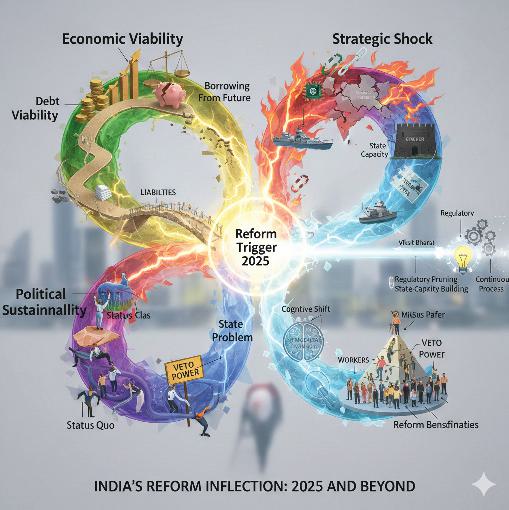
In standard economic theory, reform should be continuous. Institutions are expected to adjust incrementally as technology, demographics, and markets evolve. Distortions should be corrected at the margin, before they cumulate into binding constraints. This is how optimal policy is modelled. Empirically, this is not how reform occurs. Across countries, big and strategic reforms cluster in time (not the process reforms). Long periods of institutional inertia are followed by short, compressed episodes of change. It is a consequence of how political economies internalise cost, power, belief, and, increasingly, strategic risk.
A useful way to think about reform triggers is as the intersection of four curves—or at least three out of four.
The first curve is that of economic viability. Inefficient systems persist as long as they are self-financing. Growth can slow, productivity can stagnate, and allocative distortions can widen, yet reform is postponed while fiscal capacity, borrowing ability, or external inflows continue to bridge the gap. Reform is triggered when this arithmetic fails. This does not require collapse. It occurs when continuation depends on borrowing from the future in increasingly fragile ways: rising debt, contingent liabilities, regulatory forbearance, or administrative coercion. At that point, inefficiency becomes a solvency risk rather than a welfare loss.
Second curve is that of strategic shock. Strategic shocks differ from economic stress. They do not accumulate gradually, they arrive abruptly: Wars, tariff weaponisation, supply chain disruptions, technological decoupling, and regional instability impose hard tests of state capacity. They shorten time horizons and expose institutional slack. Under strategic stress, regulatory complexity, legal uncertainty, and administrative delay stop being domestic inefficiencies and become liabilities. Tax systems affect mobilisation capacity. Labour laws affect resilience. Dispute resolution affects investment continuity. Governance quality becomes a strategic variable. It forces reform because state capability is tested under pressure.
Third curve is that of political sustainability. Economic unviability does not automatically translate into reform because institutions are defended by coalitions, not equations. Systems persist when the groups benefiting from them retain veto power. Reform becomes feasible only when the political coalition sustaining the status quo weakens, through rent erosion, structural change, generational turnover, or the rise of alternative constituencies that benefit from reform.
The fourth curve is cognitive. Governments delay reform not only because it is costly, but because they believe delay is safer than action. As long as shocks are interpreted as cyclical, temporary, or externally driven, postponement remains rational. Reform begins when this belief collapses. This occurs when repeated short-term fixes fail, when uncertainty compounds rather than dissipates, and when policymakers internalise that the problem is structural. At this point, delay ceases to be a risk-minimising strategy. Reform becomes the least-bad option. This cognitive shift is often rapid, which is why reform episodes appear sudden despite long intellectual gestation.
Why 2025 Mattered
Reform windows open when at least three of these curves intersect. 2025 was such a convergence year.
India posted strong headline growth in Q1 & Q2. However, growth was increasingly consumption and public-capex-led, while private investment and export momentum lagged, raising questions about how self-financing the growth model remained over the medium term. Fiscal arithmetic still held, but with tightening margins, rising state-level borrowing, higher interest burdens, and growing contingent liabilities meant continuation relied more on borrowing from the future than on productivity gains.
Similarly, a sequence of strategic shocks sharply compressed India’s reform timeline by turning governance quality into a matter of national resilience. The success in Operation Sindoor and a few challenges gave an impetus towards more investment in indigenous defense R&D. Simultaneously, US tariff actions and the wider weaponisation of trade policy repriced competitiveness abruptly rather than gradually, exposing how regulatory delays and compliance frictions directly affected export continuity and investment decisions. Ongoing instability across India’s neighbourhood also was a trigger. Under these conditions, complexity in taxation, labour regulation, and dispute resolution translated into slower response times and higher strategic risk, forcing reform not as an efficient choice but as a test of state capacity under pressure.
Further, resistance to simplification-led reforms in India was lower because the political costs of complexity had become widely visible and poorly defensible. Digitisation, formalisation, and judicial backlogs had already exposed how regulatory opacity benefited narrow intermediaries rather than workers, MSMEs, or consumers, weakening the moral and political legitimacy of obstruction. At the same time, opposition parties found limited traction in defending procedural complexity when simplification directly translated into tax relief, faster dispute resolution, and easier compliance for large and electorally salient constituencies such as the middle class, small businesses, and formal-sector workers. As a result, while disagreement remained on distributional issues, there was little credible political case for preserving complexity itself, reducing veto power and allowing reform to proceed with relatively muted resistance.
Finally, cognitive shift in 2025 occurred because repeated short-term fixes no longer restored predictability and instead compounded uncertainty. Successive rounds of ad-hoc relief, regulatory forbearance, and piecemeal tweaks (across taxation, compliance, dispute resolution, and labour) failed to materially reduce litigation backlogs, informality, or investment hesitation. The government increasingly recognised that postponement was no longer the safer strategy. Delay amplified risk, raised compliance costs, and weakened state capacity under stress. Once this belief took hold, reform shifted from being politically difficult to being the least-bad option, explaining the speed and concentration of changes in 2025 despite years of prior debate and preparation.
Against this backdrop, the reforms that unfolded in 2025 can be read less as isolated policy initiatives and more as the first expression of a broader shift triggered by the convergence described above. The changes focused deliberately on friction points where economic viability, strategic resilience, political feasibility, and cognitive clarity intersected:
- Simplifying the tax framework to restore predictability and reduce litigation.
- Operationalising labour codes to replace fragmented, high-discretion regulation with portable and rule-based coverage.
- Accelerating dispute resolution to address time, rather than statute, as the binding constraint on investment.
- Decriminalising minor compliance failures to reorient enforcement toward risk and material harm.
Importantly, the reform cycle has not stopped there. The establishment of two high-level committees (both chaired by Rajiv Gauba) signals an attempt to convert a crisis-driven reform window into a reform pipeline. One committee is tasked with translating the Viksit Bharat ambition into measurable, system-wide outcomes, while the other focuses explicitly on non-financial regulatory reform (licences, approvals, inspections, and compliance architectures) that shape everyday economic activity but rarely attract headline attention.
This suggests that 2025 was not treated as a culmination, but as an inflection point: a move from episodic reform under pressure toward a more continuous process of regulatory pruning and state-capacity building, before the next convergence of constraints forces action again.
Aditya Sinha writes on geopolitical and macroeconomic issues.




