
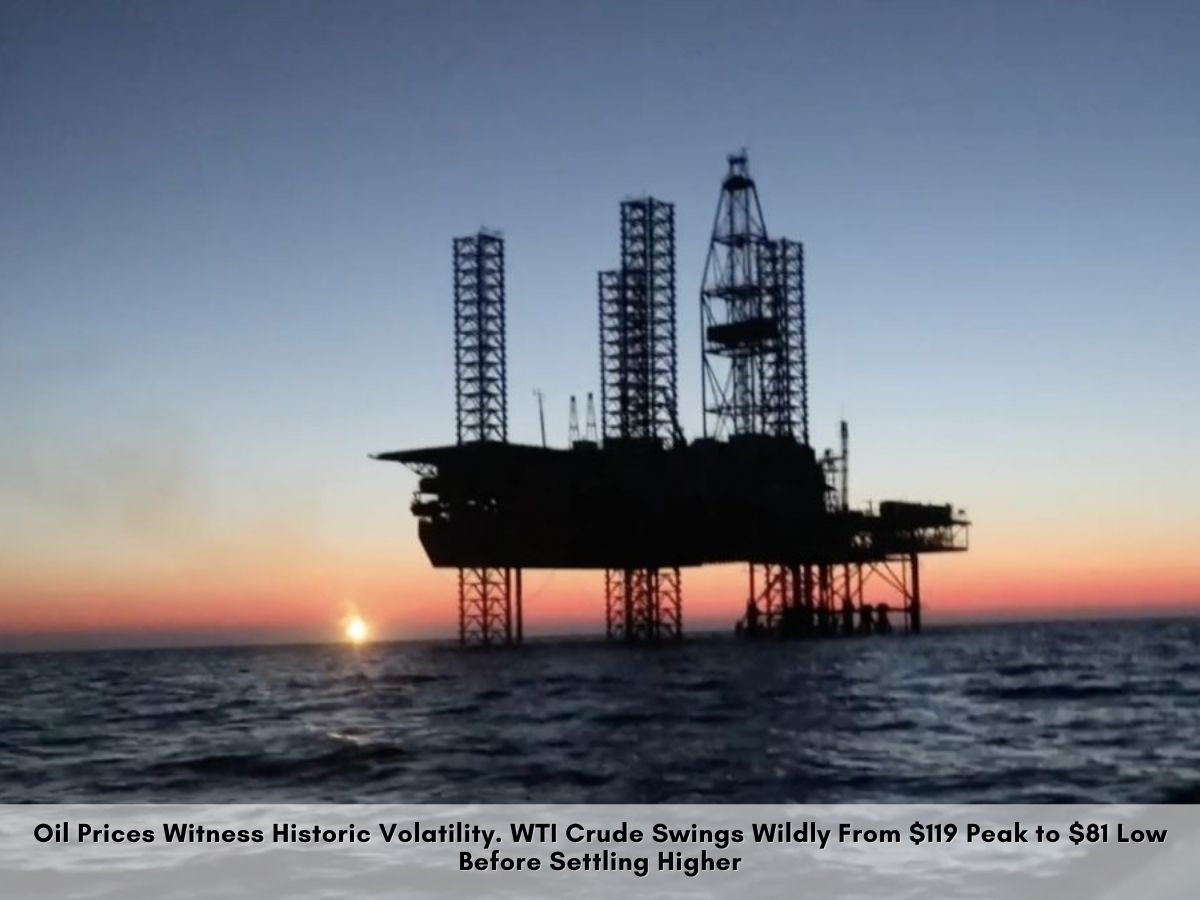
Crude oil markets experienced unprecedented turbulence on March 9, 2026. West Texas Intermediate futures surged nearly 30 percent to an intraday high of $119.48. Prices then plunged more than 32 percent to touch $81.19 before recovering to settle at $94.77. This $38 intraday swing stands as one of the most dramatic reversals in crude trading history. Brent crude followed a similar path. It peaked near $119.50 before closing at $98.96, up 6.8 percent from Friday.
What Sparked the Morning Surge to Record Highs
Traders reacted violently to mounting supply disruptions in the Persian Gulf. Tanker tracking data showed approximately 80 percent of normal oil transits through the Strait of Hormuz had ceased. This vital chokepoint normally carries 20 percent of global petroleum supply. Iraq stated that its oilfield production in the south has dropped from 4.3 million barrels per day to just 1.3 million. Fears of widespread shortages were heightened by the abrupt loss of three million barrels per day. Kuwait reduced its daily production from its baseline of 2.6 million barrels as a precaution. QatarEnergy declared force majeure on certain operations. These factors combined to ignite a panic buying frenzy that propelled WTI toward $120 per barrel.
How Did Prices Suddenly Reverse Course
A single headline changed everything in dramatic fashion. Reports emerged that G7 nations discussed releasing 300 to 400 million barrels from strategic petroleum reserves. Traders dumped positions aggressively on the unconfirmed speculation. No official decision materialized. No barrels entered the market. President Trump’s CBS interview declaring the Iran war “very complete” added downward pressure. The Pentagon’s defiant social media post of “We have only just begun to fight” and “no mercy” created mixed signals. Oil crashed from morning peaks despite zero improvement in underlying supply conditions.
Where Did Benchmarks Actually Settle After Chaos
WTI closed at $94.77, reflecting a 4.3 percent gain from Friday despite the stomach-churning swings. Brent settled at $98.96 with a 6.8 percent advance. Global demand remains steady near 104.9 million barrels per day. Strategic reserve rumors provided temporary relief. Markets recognize these stockpiles cannot indefinitely replace Hormuz volumes. The occurrence is compared by analysts to the oil crises of the 1970s, but they also point out that Monday’s dollar range surpasses previous records, omitting the negative price anomaly of 2020.
Why Reserves Cannot Fully Resolve Gulf Shock
The Strait of Hormuz crisis extends beyond crude flows. War risk insurance premiums have skyrocketed, deterring all but the bravest tankers. Iraq faces overflowing storage tanks with exports halted after two final loadings. Kuwait and Qatar curtail output amid infrastructure threats from Iranian drones. G7 reserves might calm futures temporarily. They fail to restore physical barrels currently trapped in the Gulf. President Trump’s hints at Hormuz takeover add uncertainty while Pentagon rhetoric signals prolonged engagement.
FAQs
Q: What created Monday’s $38 WTI intraday swing.
A: Hormuz 80 percent transit halt drove $119 peak. G7 SPR rumors crashed prices to $81. Settled $94.77 higher.
Q: Has any strategic reserve oil been released.
A: No barrels tapped despite 300 to 400 million speculation. Purely headline-driven reversal.
Q: How much Iraqi production vanished suddenly.
A: Three million barrels daily. Output fell from 4.3 million to 1.3 million barrels per day.
Q: How does this rank in oil history.
A: Largest dollar swing ever. Trails 2020 negative pricing for percentage drop record.
Disclaimer: This information is based on inputs from news agency reports. TSG does not independently confirm the information provided by the relevant sources.




