
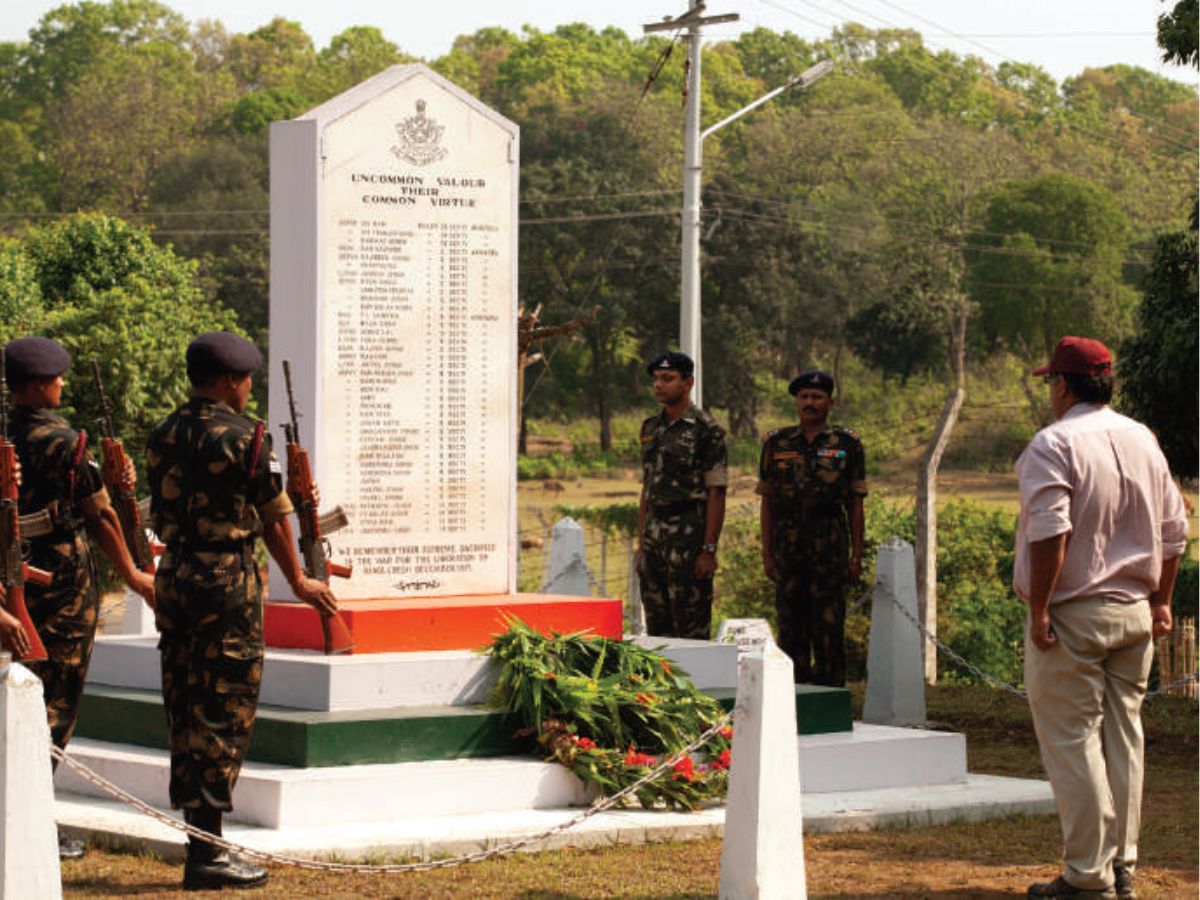
New Delhi: For many in India, 1971 became a story that seemed to end neatly. A just war, a decisive victory, a surrender on a winter afternoon, and the belief that history had declared its verdict. In Bangladesh, the story never carried that sense of completion. The war was a climax inside a much longer and more painful narrative. It paused a tragedy that had begun years earlier and that never truly ended. Behind the images we remember lay a society that had already been worn down by neglect, contempt and the steady erosion of trust.
The fault lines that tore East Pakistan apart did not appear suddenly in 1971. They grew through years of humiliation and distance, in which a region that sustained the economy was treated as inferior in culture and identity. Language became the earliest battleground. When Urdu was imposed, it was not merely an administrative act. It was a message that Bengali identity could be overruled and made subordinate to a political imagination centred elsewhere. Political marginalisation followed. Economic extraction deepened resentment. By the time the 1970 elections delivered an unambiguous democratic mandate to East Pakistan, the idea of a shared nation already stood hollow.
What came next was not only a military crackdown. It was a collapse of trust at the most intimate levels of society. Violence entered homes before it entered history. Local militias and collaborators joined hands with the Army. Old grudges resurfaced and were recast as ideological loyalty. Neighbours turned on neighbours. Women bore the weight of a brutality that societies still struggle to acknowledge openly, even after half a century. Much of the killing took place at close quarters and survives in whispers rather than public testimony. The war became personal long before it became geopolitical. For many families in Bangladesh, liberation arrived over the wreckage of memory rather than as a clean moment of release. The scars remained in silences, in absences, and in the reluctance to speak of what had happened, except in fragments that never quite formed a single story.
I grew up with the war at a different kind of proximity. Commanded by my father, 18 Rajput at Agartala was a part of 311 Brigade, and was the spearhead of 57 Division’s (4 Corps) thrust toward Dacca. For India, the campaign became a story of clarity, discipline and strategic brilliance, studied in staff colleges and retold with pride. Years later, when I worked with Lieutenant General Adi Meherji Sethna, who had been Brigadier General Staff (BGS) at Eastern Command during the war, I saw how even within our own military system, memory had begun to fragment into competing interpretations. The operational achievement remained uncontested, yet the lived experience had many layers, shaped by distance, personality and time. Victory had fixed the event in one frame. Those who had lived through it carried another.
Over time, the war moved from lived reality into symbolic space. Sacrifice slipped into the background. A morally complex campaign was softened into patriotic nostalgia. In Bangladesh, politics changed rapidly after independence. Those who had collaborated were not always permanently marginalised. Power shifted. Narratives were recast. Among many who had fought, particularly within sections of the officer corps, there was a quiet resentment that the Awami League had appropriated a broader and more diverse freedom struggle and folded it wholly into its own political story. The war was remembered selectively, sometimes to consolidate authority and sometimes to suppress dissent. Public commemoration survived in ritual and ceremony. Private memory fractured. A younger generation grew up at a distance from the emotional weight of 1971, encountering it as textbook and posture rather than as inherited truth.
Some of us sensed the depth of that erasure long before it became visible in public discourse. It was one of the reasons Lieutenant General Rakesh Loomba and I travelled to Dhaka, to understand whether the narrative of 1971 could be reopened in a manner that did not rely on triumph or grievance, but on acknowledgement. General Vijay Kumar Singh, then Minister of State for External Affairs, understood the importance of that effort. What we encountered instead was absence. The memory of the war had receded so deeply into silence that even recognition felt cautious and incomplete. As Indians, we felt that distance acutely.
As a historian, I also knew that Bangladesh needed to construct an identity that did not rest on a permanent relationship of gratitude toward India. The decision to step away from that narrative allowed space for national consolidation. It also created a vacuum that another power recognised and entered. China understood that opportunity long before most others did and began to inhabit the spaces where silence had replaced memory.
India, meanwhile, assumed that the moral clarity of 1971 had stabilised the relationship. But gratitude does not pass unchanged across generations. Memory does not travel automatically through time. In many ways, India closed the chapter while Bangladesh continued to live inside it. The violence of 1971 did not disappear. It remained just beneath the surface, shaped by demography, economic pressure, ideological contest and unresolved trauma. Each time the country has faced internal strain, older impulses have returned. Crowds gather. Minorities are targeted first. Not because history demands revenge, but because societies under stress retreat into the simplest and most dangerous forms of identity mobilisation, repeating patterns that were never fully confronted.
This cannot be viewed as an isolated Bangladeshi crisis. The Northeast of India has always been part of the same arc of geography, migration and memory. Assam, Tripura, North Bengal and Manipur have lived with the aftershocks of displacement, cultural anxiety and demographic churn for decades. Identities here have been shaped by the same movements of people, by the same fears of erasure and by the same uneasy histories that unfolded across the river. The emotional climate of these regions is inseparable from what happens in Bangladesh. Our own politics in recent years has hardened identities further and has introduced new insecurities into a landscape that was already fragile. What plays out in our public life is closely watched from across the frontier and it shapes how Indian intent is read. For many in Bangladesh, it reinforces the perception of India as an overbearing presence rather than a stabilising neighbour.
That perception matters. It influences which forces gain legitimacy within Bangladesh and which narratives acquire moral weight. It amplifies the loudest and most ideological voices on both sides. The turbulence in the Northeast does not exist in isolation. It both influences and is influenced by events in Bangladesh. The two spaces are tied by rivers, history and anxieties that return whenever the region becomes uncertain about its future. It is also one of the longest land borders in the world, longer than India’s frontiers with either Pakistan or China, yet far more permeable in sentiment and experience because terrain does not keep lives apart in the same way. Geography here does not divide. It connects. Memory moves across this landscape with a force stronger than policy, and often with consequences that are visible only in retrospect.
The present moment is not a rupture. It is continuity resurfacing. It is the unfinished business of a past that was never fully spoken aloud. The violence and anxiety of 1971 did not vanish with surrender. They were absorbed into politics, into migration, into institutional rhythms, and into the silences of families. They settled into the emotional landscape that stretches from the delta to the hills of the Northeast, shaping instinct, fear and expectation long after the maps changed. What we are seeing today is not the beginning of a new crisis. It is the return of an old one in a different shape.
This region cannot be read only in terms of borders on a map. It must be understood as a single historical field in which memory, identity and power move across communities rather than stop at fences. Bangladesh and India do not merely face each other across a line. They inhabit the same arc of consequence. Instability on one side unsettles the other, and the political signals from our own border states travel back across the river with equal force, altering perceptions, reinforcing suspicions and shaping outcomes in ways that are rarely acknowledged openly.
That is why Bangladesh cannot be engaged as a short-term problem to be managed. It must be understood with strategic foresight, with an awareness of how decisions taken today will echo across generations and across the fragile ecology of the region. The cost of misreading this landscape has always been paid not only in policy failure, but in human lives. The lesson of 1971 is not triumph. It is the danger of believing that history closes its own chapters. The war did not end the story of East Bengal. It paused it. The pause is moving again. What matters now is whether we choose to watch it unfold from the distance of memory, or whether we find the maturity to read its consequences before they arrive at our door.
If there is a lesson for India in this turbulence, it lies in resisting haste, reading the drift of events with care, and recognising that in this region, every decision echoes much farther than it first appears.
Shiv Kunal Verma is the author of various books including the Long Road to Siachen, Northeast Trilogy, Assam Rifles, 1962: The War That Wasn’t and 1965: A Western Sunrise.




