
New Delhi: When a country announces a powerful new missile, it is not enough to show a dramatic video. Serious militaries and serious analysts look for data—radar tracks, flight paths, speed and altitude, guidance behaviour and proof that the missile did what the government claims it did. This evidence usually comes in the form of telemetry and tracking footage.
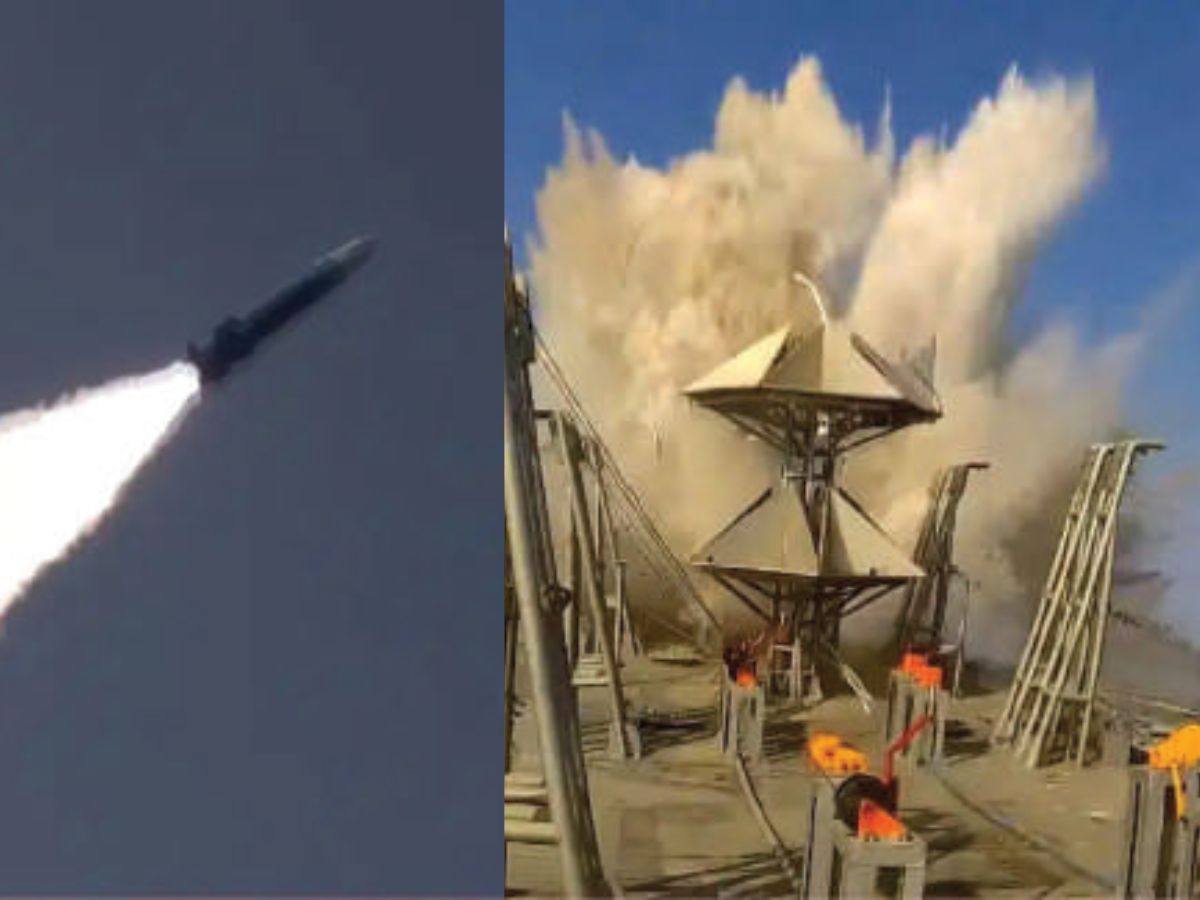
In Pakistan’s recent showcase of its anti-ship ballistic missile (ASBM), that kind of evidence was almost completely missing. Instead of technical information, the Pakistan Navy offered a stylish, tightly edited launch video and a distant impact plume at sea. The visuals were designed to impress, but they did not answer the basic technical question: did the missile actually perform as a true ASBM? That is why the core judgement is simple—a missile without telemetry is a missile without proof. Pakistan offered spectacle, not science.
WHAT SERIOUS MISSILE TESTS NORMALLY SHOW
When India tests an advanced missile, its Defence Research & Development Organisation often shares radar-tracking footage, graphs showing altitude and range and sometimes animations of the flight path based on real data. China’s state media regularly shows trajectory diagrams and tracking clips for its long-range missiles. The United States, through agencies like the Missile Defense Agency and the US Navy, publishes radar screens, infrared tracking views and time-stamped sequences that follow the missile from launch to impact. Even Iran, which is usually secretive, still releases partial tracking images and trajectory visuals for its headline tests.
These countries do not always reveal everything. They protect sensitive details. But they release enough to prove that the missile flew as described. Telemetry and tracking videos act like the “lab report” behind the big headline. They show that the test was not just a public-relations stunt, but a measured event with documented performance.
WHAT PAK CHOSE TO SHOW INSTEAD
In Pakistan’s ASBM video, that “lab report” is missing. The official footage does not contain radar tracks, on-screen altitude or speed figures, flight-path overlays, seeker visuals, or any form of mid-course or terminal tracking. There is no segment where viewers can see the missile’s path plotted over time and space. There is no evidence of how high it flew, how fast it travelled, or what manoeuvres it performed.
Instead, the video is built around tight shots of the missile launching from the ship, a plume rising into the sky, and then a distant splash or explosion on the sea surface. The editing is cinematic. The sequence feels more like a promotional clip than a technical record. The choice is clear—focus on style, avoid data. The absence of telemetry and tracking is not a small detail. It is the missing core of the story.
WHY TELEMETRY MATTERS SO MUCH
Telemetry is the stream of data that a missile sends back to engineers during flight. It includes information such as speed, altitude, angle, guidance mode, and what the seeker is locking on to. It allows designers to confirm whether the weapon followed its intended profile and whether each stage of flight worked correctly. Without telemetry, an outside observer cannot know if the missile behaved like a true anti-ship ballistic weapon or simply flew along a simple ballistic arc toward fixed coordinates.
For an ASBM, this distinction is critical. A real ASBM must be able to locate and hit moving ships over long distances. It needs to adjust its flight based on updated target positions and then home in accurately during the final phase, often in a cluttered and defended environment. None of this can be confirmed from a short, edited video of a launch and a splash.
SPECIAL BURDEN OF PROOF FOR ASBM
An anti-ship ballistic missile is not just another rocket. To be credible, it must do several complex things at once. It has to find a ship at sea, which is constantly moving. It has to keep track of that ship as it changes speed and direction. It must receive updated targeting data during its flight, often from distant sensors like satellites, aircraft, or long-range radars. In the endgame, its seeker has to distinguish the real ship from decoys, chaff, jamming and other defences.
None of these advanced functions are visible in Pakistan’s ASBM video. There is no moving ship, no evidence of mid-course updates, no indication that the missile’s seeker locked onto anything dynamic. The impact, as shown, could just as easily be the result of firing at a fixed GPS point where a barge or dummy target was anchored.
Without telemetry and tracking, it is impossible to say whether this was a clever, guided strike against a simulated ship or simply a controlled shot at a static location.
SPECTACLE OVER SCIENCE
The way the test was filmed suggests the priorities behind it. The camera angles are clean and dramatic. The launch looks powerful. The explosion at sea is satisfying to watch. These are the ingredients of a good social-media clip, a video that will be shared widely with patriotic captions and big claims of “historic success”.
But this approach favours spectacle over science. A government confident in its technology usually wants to prove performance, not just show fire and smoke. It wants foreign militaries to quietly note the new capability and adjust their planning. That requires data. By avoiding telemetry and tracking in its public material, Pakistan has chosen an information style that seeks applause rather than technical respect.
HOW OTHER NAVIES LIKELY TO SEE IT
Professional navies and defence analysts will not be convinced by visuals alone. They will note the lack of telemetry, the absence of tracking, and the failure to demonstrate key ASBM behaviours. They will treat the test as an early step at best, not as proof of a mature, integrated anti-ship ballistic system.
This matters for Pakistan’s credibility. If it continually presents highly edited videos without backing data while making very bold claims, its announcements risk being discounted over time. In any future crisis, adversaries are likely to believe what they can measure, not what they see in stylised clips.
SPECTACLE, BUT NOT YET PROOF
In the end, Pakistan’s ASBM showcase offered a powerful image but a weak evidentiary record. The missile looked impressive on camera, but the missing telemetry left a hole at the centre of the story. Without flight data, tracking visuals, and seeker confirmation, the world is being asked to accept big claims on the basis of small proof.
In modern missile testing, visuals can excite the public. But it is the numbers—the telemetry, the tracking, the flight profile—that convince professionals. A missile without telemetry remains a missile without proof.
-
Commander Rahul Verma (Retd), formerly of Indian Navy, is an Emerging Technology and Prioritisation Scout for a leading Indian MNC.




