LONDON:A defining feature of Trump 2.0 is a pattern of firmly setting out on one course, only to change direction, sometimes more than once. The distinguished Financial Times columnist, Robert Armstrong, coined the phrase “Trump Always Chickens Out,” for this behaviour, or TACO. Other commentators prefer the term “flip-flop”. Nowhere are these words more appropriate than in Trump’s attitude to Russia and the war in Ukraine. During his 2024 campaign, Donald Trump repeatedly insisted that he would end the RussiaUkraine war within 24 hours of inauguration.
This was a classic Trump boast, which few if any took seriously. It was therefore not surprising that the pledge quickly softened in January this year when Trump’s special envoy to Ukraine, Lt Gen Keith Kellogg, announced that the Administration now aimed for a “solid and sustainable” agreement within 100 days instead. The following month, Trump initiated a surprise phone call with Vladimir Putin, aiming to restart direct US-Russia negotiations, drawing criticism for bypassing Kyiv and European allies.
Then in July, Trump changed his mind and reversed a pause on military aid following a major Russian drone and missile assault on Ukraine. He threatened 100% tariffs and secondary sanctions on countries trading with Russia if a ceasefire wasn’t agreed within 50 days. Around the same period, he publicly stated that he was “angry” with Putin and threatened secondary oil tariffs if Russia didn’t halt its aggression. Just days later, however, Trump changed his mind again and dialled back, urging European allies to take a lead in supporting Ukraine and scaling back direct US military involvement.
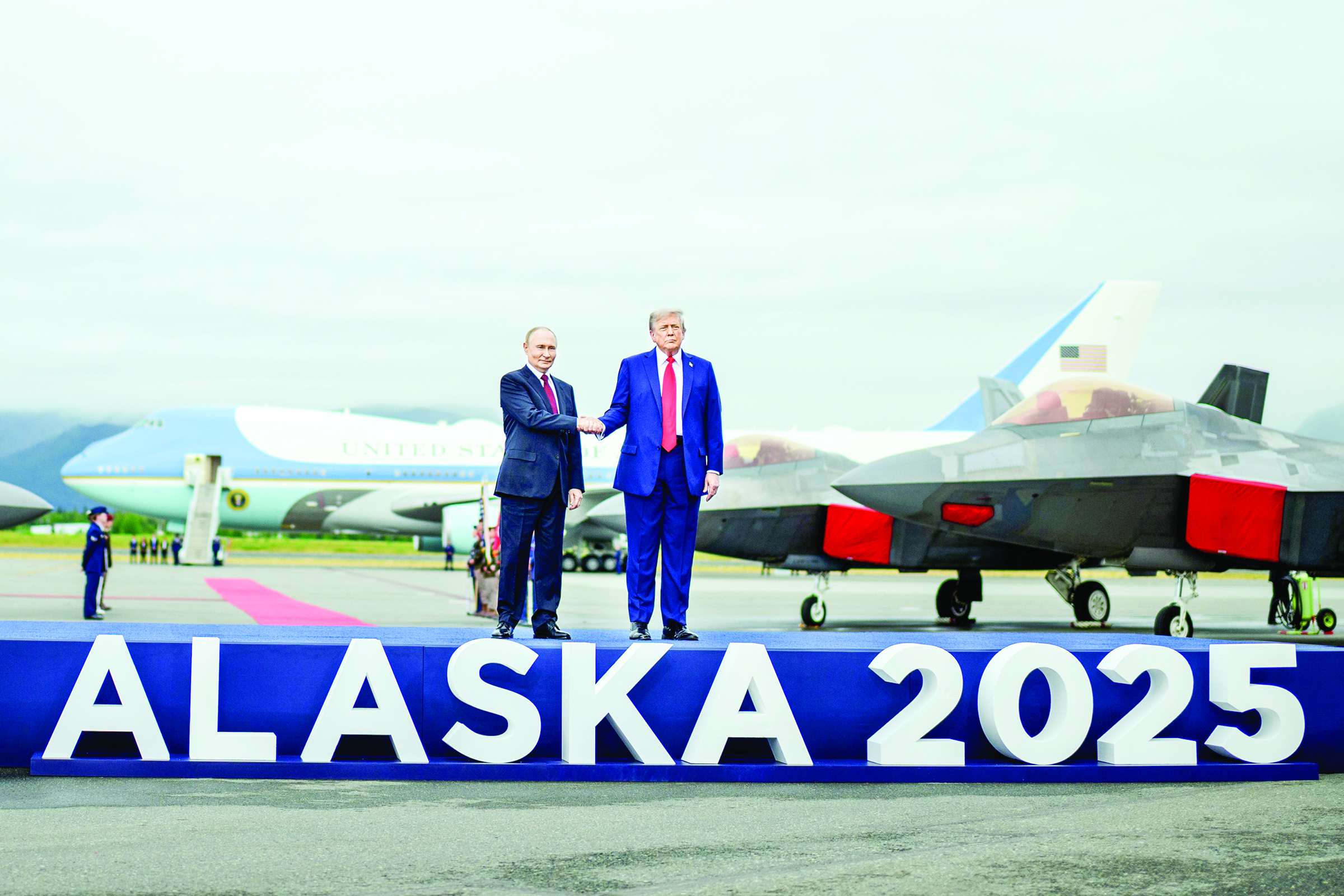
At the summit in Alaska early this month, Donald Trump again flip-flopped and reversed earlier demands for a ceasefire, opting instead for a rapid peace deal, even if this meant territorial concessions by Ukraine. For his part, by agreeing to the summit with Trump, Putin cleverly avoided any punishing new energy sanctions, while receiving an unusually warm red-carpet welcome. Analysts widely characterised the summit as a public relations triumph for the Russian leader, restoring his international stature and obtaining significant concessions from Trump.
As so often happens with the Donald, the Alaskan summit was high on symbolism and optics and low on actual results. It reinforced Russia’s diplomatic position and left peace efforts in limbo. On 8 August Donald Trump plainly stated that any peace deal would involve “swapping of territories”, which was puzzling. Since Ukraine no longer holds any Russian territory, it would mean offering Kyivcontrolled land in return for the territory that Moscow currently occupies, which makes little sense.
Trump, however, clearly finds the land-swap proposal reasonable, while Ukraine’s President Zelenskyy has understandably rejected it, saying that “Ukrainians will not gift their land to the occupier.”
The optics from the Alaskan summit revealed that Donald Trump still harbours a deep admiration for the Russian leader’s authoritarian grip on power, something he would love to emulate in the United States. Putin, a former KGB officer brings a spy’s talent for deception and manipulation, not to mention an instinct for flattering Trump and echoing even his most outlandish convictions.
There remains in the West a firm belief that the Alaskan summit was simply a ploy on Putin’s part. Vlad may have felt some pressure from the secondary sanctions being placed on the Kremlin’s trade partners, including India, and decided that Alaska was the time to blindside Trump with an offer, with little intention of following it through. In recent weeks, Putin has repeated his maximalist claims that “all of Ukraine belongs to Russia” and as the massive missile and drone attacks on Ukraine continue, the message from the Kremlin is that Putin is not a man eager for peace.
Nowhere is this more evident than in the Kremlin’s tactics on the issue of security guarantees, demanded by Ukraine as a way of ending the war. Kyiv has repeatedly insisted that any end to the war must come with strong, legally binding security guarantees to prevent future aggression from Russia. These guarantees are crucial for Ukraine to agree to any ceasefire or peace deal. Zelenskyy accepts that NATO membership is unlikely in the short term, but will accept “NATO type” guarantees of protection from the West.
This includes Western “boots on the ground”, which European countries are working towards, together with possible US air support. On Thursday, Russian Foreign Minister Sergei Lavrov claimed that any attempt to solve issues of security without Moscow were “a road to nowhere”, saying at a press conference “We cannot agree with the fact that now it is proposed to resolve questions of security issues without the Russian Federation”.
Later, Lavrov upped the ante by claiming that China also needed a say in the matter, once again moving the goal posts and forcing the West to recalculate its negotiating strategy and tactics. Lavrov said that Ukraine’s security guarantees “should be provided on an equal basis with the participation of countries like China, the United States, the UK and France. Zelenskyy rejected Lavrov’s proposals, claiming they were simply stalling tactics, which they clearly are.
The Alaska summit didn’t change the fundamentals of Russia’s war against Ukraine. Russia’s goals remain maximalist and eliminationist. One of Putin’s great skills is appearing to be measured and constructive, when in fact he’s being insincere, intransigent or plain threatening. This was illustrated by his innocuous sounding remark at the post-summit press conference, that in order to achieve a long-term settlement in Ukraine “we need to eliminate all the primary root causes of the conflict.” Decoded, this is a clear reference to Putin’s historical thesis that Ukraine is an invented country that has been used for centuries by Russia’s enemies as a base from which to attack Moscow, a view the Russian leader retains today.
Putin called, apparently reasonably for Trump, to “consider all the legitimate concerns of Russia and reinstate a just balance of security in Europe and in the world on the whole.” But to Putin, that “just balance” means a withdrawal of most NATO forces from countries along Russia’s border. His goals in Ukraine have always been ideological, and there is simply no grand bargain that will satisfy him, shy of Ukraine’s total capitulation – which will not happen.
Now in its fourth year, there is little sign of Russia’s war on Ukraine ending soon. Russian forces currently control a fifth of Ukraine, and show no sign of backing down in their slow push westwards. Much of the front line has become entrenched and heavily fortified, resembling WW1-style attritional warfare, which makes quick advances extremely costly and slow.
Moscow appears to be settling in for a long conflict, using Russia’s larger population and industrial base to grind down Ukraine’s resources and willpower. To end the conflict, Vladimir Putin demands recognition of annexed territories and “neutrality” from a demilitarised Ukraine.
In turn, Ukraine demands full territorial restoration including Crimea. It’s no wonder that the leaders of Britain, France and Germany have all said they are sceptical that Vladimir Putin wants to end the war. Me a nwh i l e, Donald Trump, repeatedly changing his mind on the way ahead, insists that he wants to end the “bloodbath” of the war and be remembered as a “peacemaker president”, no doubt having in mind his dream of being awarded the Nobel Peace Prize.
During the Alaskan summit he seemed to be unaware that the war in Ukraine is part of a broader geopolitical struggle between Russia and the West. An end to the war, currently extremely unlikely, will be seen as a win or loss, not just for Ukraine, but for broader global alliances.
John Dobson is a former British diplomat, who also worked in UK Prime Minister John Major’s office between 1995 and 1998. He is currently a visiting fellow at the University of Plymouth.
