The Andaman and Nicobar Command, India’s only operational tri-service command, is uniquely placed to monitor the critical waterways of the Bay of Bengal and adjoining seas. Within this island chain, the bases at Car Nicobar and Great Nicobar are of extraordinary importance.
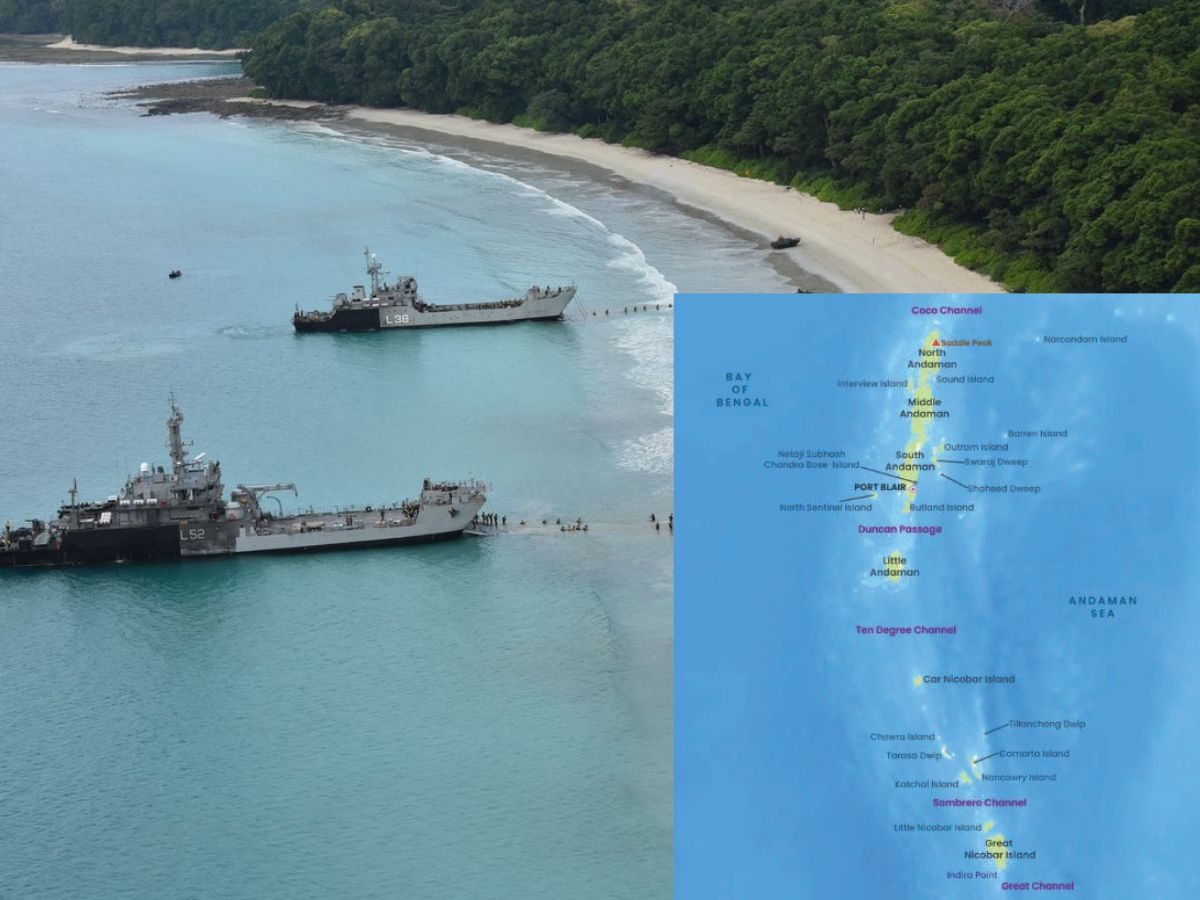
Andaman and Nicobar arc: India’s strategic anchor in the Indian Ocean Region and Indo-Pacific (Image: File/ X)
New Delhi: The Indo-Pacific has emerged as the defining strategic arena of the 21st century. Stretching from the eastern coast of Africa to the Pacific islands, this vast expanse is home to the world’s most dynamic economies, critical sea lanes, and intensifying geopolitical contestation. India’s geography confers both opportunity and responsibility. With a coastline of over 11,000 kilometres and island territories that overlook vital shipping routes, India sits at the heart of the Indian Ocean. Nearly 95% of India’s trade by volume including crude oil, coal, electronics, and agricultural products moves by sea, traversing these waters.
The broader global context only heightens the stakes. The global balance of power is shifting eastwards, and the extended Indian and Pacific Ocean space already accounts for around 60% of global GDP. Three of the world’s five largest economies are in Asia, and their growth has generated an insatiable appetite for energy. Lacking self-sufficiency, these economies depend heavily on imports from Russia, West Asia, and Africa, with Indian Ocean sea lanes carrying most of this cargo. Over 80% of world trade by volume moves by sea, much of it through these interconnected oceanic corridors. At the same time, more than 95% of international data traffic, the lifeblood of today’s digital economy, travels through undersea cables laid across this expanse. Any disruption of these arteries, whether energy routes or digital networks, would endanger global security and prosperity.
India’s vision of a free, open, and inclusive Indo-Pacific where sovereignty is respected and coercion has no place has been welcomed by partners and smaller nations alike. Initiatives such as the launch of the Forum for India Pacific Islands Cooperation (FIPIC) in 2014 have deepened India’s engagement with Pacific Island states. India has built strong strategic linkages with ASEAN countries, joined hands with likeminded powers in the Quad, and taken concrete steps to expand its presence across Asia’s maritime theatre. Nowhere is this more evident than in the Andaman and Nicobar Islands, which serve as the fulcrum of India’s eastern seaboard strategy.
The Andaman and Nicobar Command, India’s only operational tri-service command, is uniquely placed to monitor the critical waterways of the Bay of Bengal and adjoining seas. Within this island chain, the bases at Car Nicobar and Great Nicobar are of extraordinary importance. Car Nicobar hosts an Indian Air Force facility that provides air dominance over the Bay of Bengal and sustained surveillance of shipping activity. The base also supports joint exercises such as Malabar, enhancing interoperability and reinforcing India’s Act East policy. Its location, just under a thousand kilometres from the Malacca Strait, adds to its strategic value.
Even more consequential is INS Baaz, India’s southernmost naval air station at Campbell Bay in Great Nicobar. Upgraded and integrated into broader development plans, it lies barely 100 kilometres from the Malacca Strait. This is among the world’s most vital maritime chokepoints, handling around 60% of China’s trade and nearly 90% of Japan, South Korea and some ASEAN nations’ oil imports. For India, it is an indispensable artery for energy and commerce. The ability to monitor, secure, and, if necessary, influence access to this strait confers immense strategic leverage. INS Baaz supports maritime reconnaissance, anti-submarine warfare, and surveillance operations, and is being expanded under the Modi government’s Rs 72,000-crore Great Nicobar project, which also envisages a trans-shipment port and an international airport. This integration of security and economic infrastructure strengthens both India’s logistics capacity and its strategic posture.
Control and influence over the approaches to the Malacca Strait guarantee the safety of India’s own sea lines of communication and protect its growing digital and energy requirements. With Car Nicobar and INS Baaz acting as forward outposts, India possesses the capability to track submarine movements, deter hostile actions, and work with partners to ensure a free and open maritime commons. When integrated with India’s wider Security and Growth for All in the Region (SAGAR) doctrine, these capabilities reinforce India’s role as a credible net stakeholder and provider of stability across the Indian Ocean space.
This expansion of infrastructure and capability is emblematic of Prime Minister Modi’s broader emphasis on self-reliance in critical sectors. Security is no longer viewed as a narrow military function but as a comprehensive national project encompassing infrastructure, industry, technology, and human capital. The Nicobar bases are therefore not isolated military installations; they are part of a holistic effort to ensure India has the means to shape, rather than merely react to, developments across the Indian Ocean Region and the wider Indo-Pacific. Prime Minister Modi’s proactive policies, from the launch of FIPIC to the strengthening of facilities in Car Nicobar and Great Nicobar reflect India’s determination to shape the regional balance in favour of openness, security, growth, and freedom of navigation.
During his recent visit to the island chain, Union Home Minister Amit Shah also reinforced India’s security commitment by chairing a high-level Parliamentary Consultative Committee meeting focused squarely on national security, disaster management, cybercrime, and strategic infrastructure. In emphasising a coordinated, multi-domain strategy to counter emerging threats and boost cyber resilience, the visit signalled that India’s security calculus in the eastern maritime approaches encompasses both hard defence and governance systems.
India’s investments in Car Nicobar and Great Nicobar spanning military infrastructure, logistics hubs, and connectivity projects are ultimately about securing the arteries of energy, commerce, and data that sustain modern life. These initiatives ensure that it is no longer a peripheral player but a central actor with the capacity to guarantee security, project strength, and uphold the principle of a free and open wider maritime commons.
Anil K. Antony is National Secretary and National Spokesperson of the Bharatiya Janata Party.
