Indian Army Chief Gen Upendra Dwivedi’s Bhutan visit strengthens Indo-Bhutan defence ties through cultural, strategic, and military collaboration.
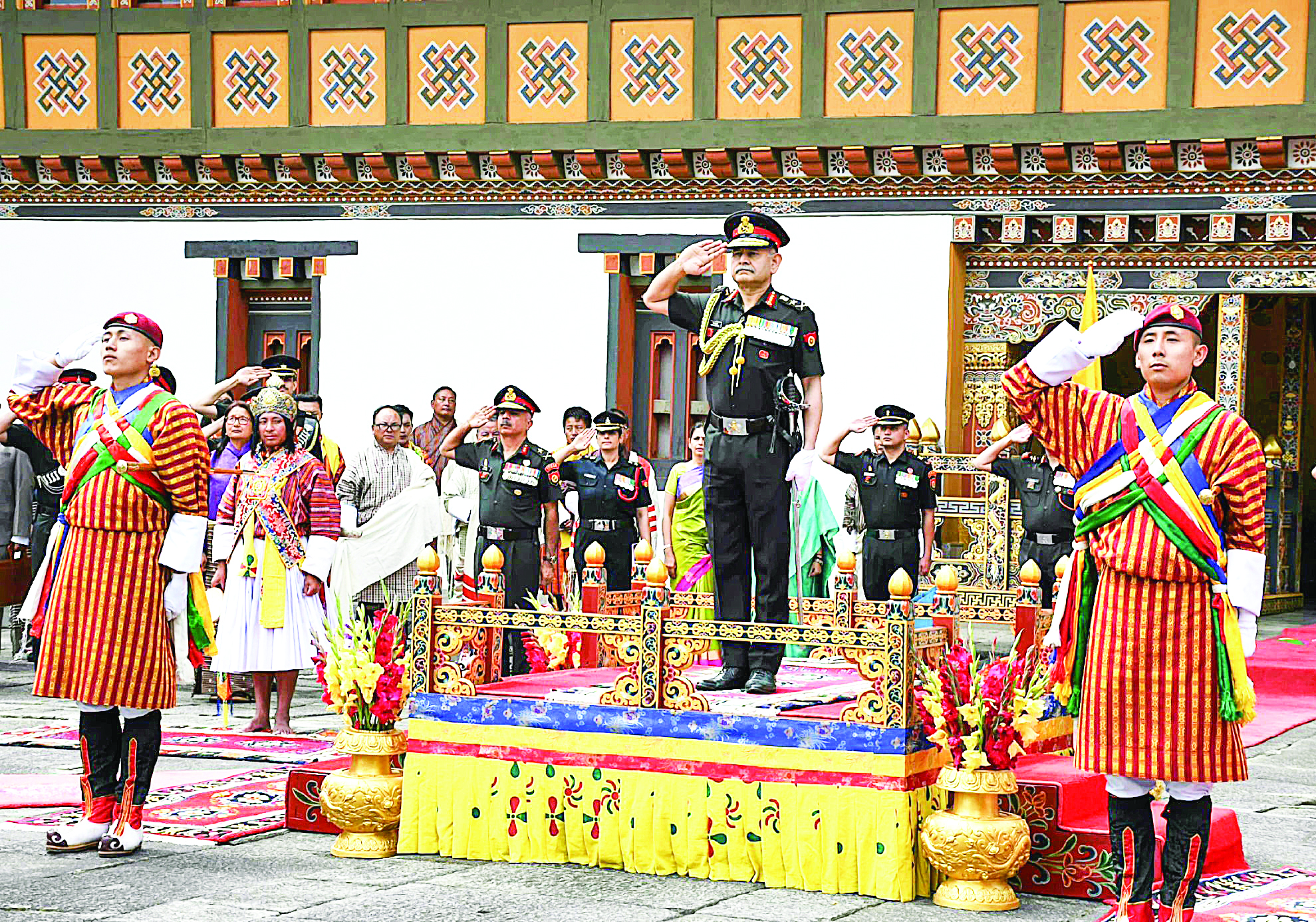
NEW DELHI: Indian Army Chief General Upendra Dwivedi recently undertook a four-day official visit to the Kingdom of Bhutan from 30 June to 3 July 2025, further deepening the historic ties between the two nations. The visit reaffirmed India’s enduring commitment to Bhutan as a close and trusted partner, particularly in the backdrop of regional challenges posed by China’s growing assertiveness. India and Bhutan share a profound and enduring bond rooted in their common Buddhist heritage. Originating in India and introduced to Bhutan in the 8th century, Buddhism has since become an integral part of Bhutanese identity and culture.
This shared spiritual foundation continues to foster mutual respect, deepen understanding, and strengthen the close bilateral relationship between the two nations. The Indian Army Chief holds a distinguished honorary appointment as Colonel of the Regiment of the Ladakh Scouts, which has a deep cultural and spiritual connection with Buddhism.
His association with this regiment reflects not only India’s strategic commitment to its Himalayan neighbours but also an institutional respect for Buddhism as a guiding philosophy in the region. During his visit, the Indian Army Chief called on His Majesty King Jigme Khesar Namgyel Wangchuck (K5) and His Majesty the Fourth King, Jigme Singye Wangchuck (K4). Discussions centred around shared security concerns and the long-term capability development of the Royal Bhutan Army (RBA). The Army Chief also held in-depth deliberations with Lt Gen Batoo Tshering, Chief Operations Officer (COO), RBA, on evolving threats, joint training, and modernisation imperatives.
A key highlight of the visit was the Indian Army Chief’s interaction at the Gyalsung Academy at Tashichhoeling, Samtse—an ambitious national service programme envisioned by His Majesty K5 to prepare the youth of Bhutan for future responsibilities. General Dwivedi appreciated the academy’s transformative efforts and assured India’s willingness to extend continued support. At HAA, the COAS visited the Indian Military Training Team (IMTRAT), the oldest and one of the most important overseas training missions of the Indian Army. IMTRAT has played a pivotal role in mentoring the RBA for decades, symbolising India’s “Neighbourhood First” approach in action. While appreciating IMTRAT’s legacy, the COAS’s visit also served as a timely opportunity to propose recalibrating this long-standing cooperation, in line with contemporary strategic realities. In light of the current geopolitical environment, a set of forward-looking recommendations to further consolidate Indo-Bhutan military cooperation could be:
• Greater Cultural Integration: IMTRAT’s presence in Bhutan could be further harmonised with local traditions. Officers may be encouraged to adopt Bhutanese ceremonial attire during formal occasions, as was historically practised. A review of IMTRAT’s nomenclature could also be considered to reflect Bhutan’s primacy and partnership in this enduring military relationship.
• Structured Joint Training and Capacity Building: It is proposed that training activities between the Indian Army and RBA wings be conducted at designated Foreign Training Nodes, with joint planning and resource sharing. This would foster interoperability, modernisation, and mutual learning.
• Enhanced UN Peacekeeping Collaboration: With Bhutan’s successful deployment of a 140-member RBA contingent in the UN Mission in the Central African Republic, new avenues for collaboration in peacekeeping training are recommended. These include exchange of Subject Matter Experts from India’s Centre for UN Peacekeeping (CUNPK), joint training modules, and sharing of online UN training content.
• Training in Next-Generation Weapon Systems and Emerging Domains: To meet the operational demands of the future, the Indian Army could assist in training RBA personnel in niche areas such as unmanned aerial systems (UAS), counter-UAS technologies, cyber operations, and information technology.
• Permanent Regimental Affiliations: It is proposed that Indian Army regiments such as the Assam Regiment, Bihar Regiment, Gorkha Rifles, and Kumaon Regiment be affiliated with respective RBA wings. This will institutionalise long-term cooperation and facilitate leadership development and capability enhancement.
• Engaging the Next Generation of Bhutanese Youth: Recognising the aspirations of Gen-Z, the Indian Army may consider sponsoring Bhutanese civil students for higher education in premier Army-run institutions such as the Army Institute of Technology and Army Law College. This will serve as a bridge between civil society and defence partnerships, fostering goodwill and future collaboration.
These recommendations reflect India’s sincere desire to deepen military cooperation in a manner that respects Bhutanese sovereignty, culture, and national priorities. They are intended to stimulate mutual growth, shared learning, and capacity enhancement, anchored in the unique relationship that the two countries share. The military association between India and Bhutan, first initiated during the reign of His Majesty King Jigme Dorji Wangchuck, has evolved into a strategic partnership founded on trust, respect, and shared interests.
The COAS’s visit reaffirms this legacy and offers a clear blueprint for the future. As India and Bhutan navigate an increasingly complex regional and global security landscape, such high-level engagements mark a firm step towards building resilient and future-ready defence ties. The visit of General Upendra Dwivedi not only celebrated the past but also laid the foundation for a renewed and forwardleaning Indo-Bhutan partnership—one that is poised to scale new heights of cooperation, capability, and camaraderie in the years ahead.
Lt Gen Baggavalli Somashekar Raju, PVSM, UYSM, AVSM, YSM, is a retired General Officer of the Indian Army. The General Officer has been the Commandant of the Indian Military Training Team in Bhutan. He has served as the General Officer Commanding-in-Chief, South Western Command and Vice Chief of Army Staff
