The killing of so called student leaders Hadi or Sikdar may be the tipping point, but the larger question is who benefits from their deaths.
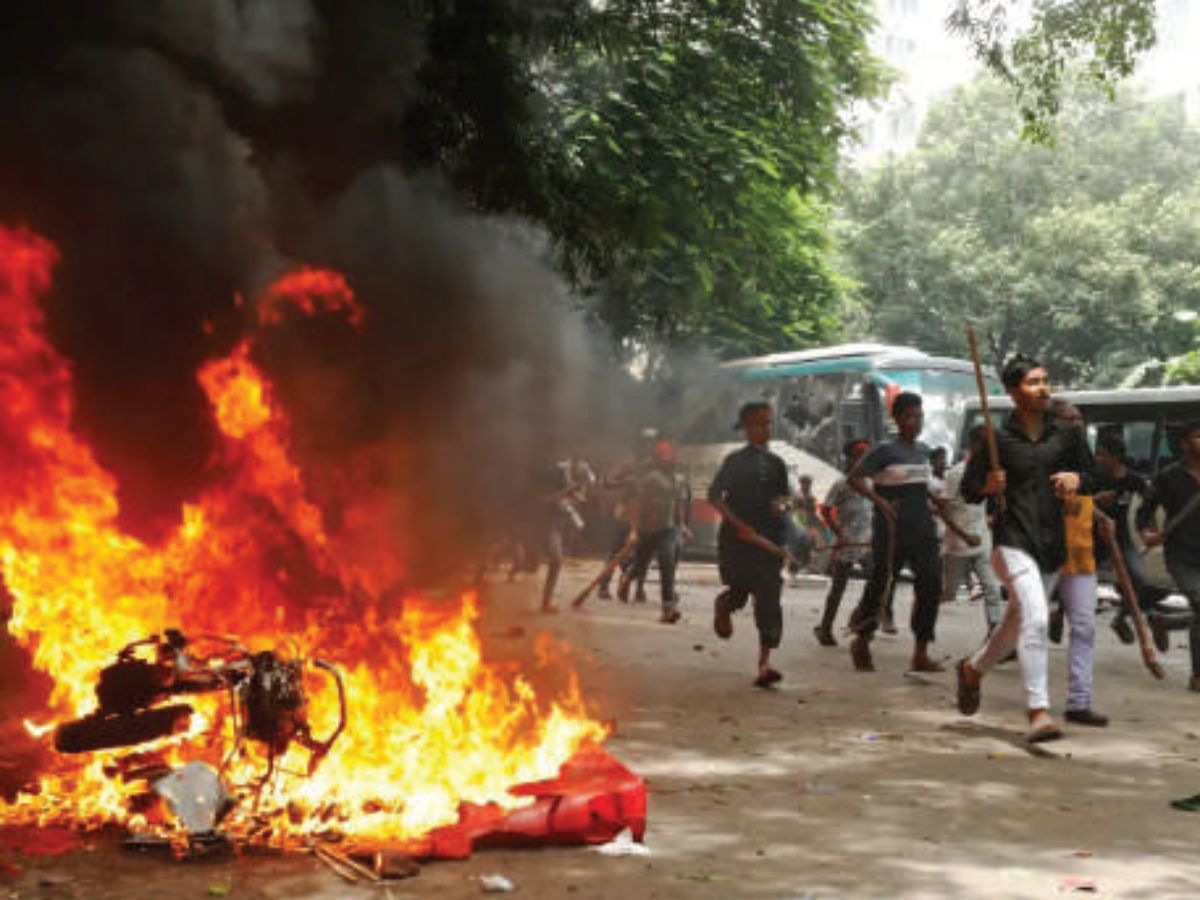
Bangladesh: A Raging Inferno in India’s Neighbourhood
New Delhi: Most geopolitical issues have historical faultlines. The partition of Bengal by the British in 1905 laid the initial basis of Bangladesh. Curzon announced the division of Bengal along religious lines, with East Bengal for Muslims and West Bengal for Hindus on 16 October 1905. It was again reunited in 1911 because Hindus opposed it as part of the British divide and rule policy. Muslims, led by Nawab Khwaja Sallimullah of Dhaka, supported the partition of Bengal. Post pouring in of refugees into India and the genocide unleashed by the Pakistan Army, the “Lightning War” in 1971 by the Indian armed forces, astute political and diplomatic will along with the Mukti Bahini carved out Bangladesh. The young nation state saw its first coup in 1975, when Ziaur Rahman took power through violence and bloodshed. During this violence, Sheikh Mujibur Rahman, also known as “Bangabandhu”, was killed. This changed the complexion of the sociopolitical landscape, with the Bangladesh Nationalist Party (BNP) getting into the overall power calculus. Historically, political change in Bangladesh has been synonymous with extreme violence. Disputes between India and Bangladesh include border demarcation, illegal migration, water sharing, and maritime boundaries. Border management incorporates securing the 4,096 km frontier through fencing, technology and increased patrols to curb smuggling, trafficking, and illegal migration in accordance with the 1974 and 2015 Land Boundary Agreements. 3,232 km has been covered with fence. A length of 865 km of the India-Bangladesh border is yet to be fenced, which includes a length of 174 km of a non-feasible gap. Under the 2015 Land Boundary Agreement, 162 enclaves were swapped. Bangladesh received 111 Indian enclaves (approx. 17,160 acres), while India received 51 Bangladeshi enclaves (approx. 7,110 acres). This came along with citizenship aspects of the populace residing in these enclaves as well. The agreement formally demarcated a previously un-demarcated 6.1 km stretch of the border in West Bengal, Tripura, and Assam. In India, this was implemented through the 100th Amendment to the Constitution.
Through the years, Al-Qaeda Indian Subcontinent (AQIS) stepped up its efforts to increase radicalisation in Bangladesh through the spread of propaganda materials, compelling the young population to conduct lone-wolf attacks and bring in “Sharia”. Since August 2024, post a seemingly externally engineered ouster of Sheikh Hasina, several high-profile radicals and terrorists have either escaped or been released from prison, including the chief of the Al-Qaeda-linked Ansarullah Bangla Team (ABT). Hizb-ut-Tahrir (HuT), the group facing a formal ban, a pro-Caliphate group has emerged from the shadows. The Harkat-ul-Jihad-al-Islami (HuJI-B), which was dormant for a decade, has also resurfaced, penetrating larger organizations like Hefazat-e-Islam (HeI). This landscape has been further complicated by the Jamaat-e-Islami (JEI) getting into the political slugfest. JEI emerged from the Jamaat-e-Islami of Pakistan in 1979. The party was banned along with all other religion-based parties in 1972. The ban was lifted in 1976, and its leaders were allowed to participate in political activities after 1979. It actively participated in the pro-democratic mass uprising against the government of Hussain Muhammad Ershad in 1990. Post the general election in 2001, the party joined the coalition government led by BNP. In August 2013, Bangladesh Supreme Court cancelled the registration of the party. In early August 2024, the party was yet again banned by the Awami League government. However, after the fall of the AL government, the decision was reversed by the newly installed Yunus led Interim government. In June 2025, the ban on the party was officially lifted, and its registration was reinstated by the Supreme Court. Islami Chhatra Shibir, the student wing of JEI has been active since 1977 and its predecessor Islami Chhatra Sangha has always been controversial with its activities along with the Pakistan Army during the liberation war of 1971. JEI is likely to emerge as an important player in the impending political struggle of Bangladesh in 2026.
Bangladesh showed a lot of promise with a burgeoning economy, microfinance prowess, garment production and relatively good governance in the Indian sub-continent before 2024 but has now been eclipsed by the rise of radicalism. This assumes a far greater relevance with a young demographics and a large anti-India sentiment, propagated by right wing Islamist thought, besides external forces. As the interim government is poised to give way to a democratically elected government for perceived legitimacy, internal power struggles will be the norm and new players like Tarique Rahman are jumping back into the arena from a long exile abroad. The run up to the elections will also give impetus to incidents of minority subjugation and fringe elements will paddle an anti-India rhetoric. This could be a way to either postpone the electoral process or even a subtle bait for India to intervene, thus opening another front. The killing of so called student leaders Hadi or Sikdar may be the tipping point, but the larger question is to understand as to who benefits from their deaths. This is the junction point wherein the narrative of Islamist consolidation as an antidote to disorder could also take shape.
It must be geographically understood that Bangladesh, besides being enveloped on three sides by India, has taken shape not based on geography, but purpose. It still depends on India for most of its power, energy and food security, besides financial and technical assistance in cutting edge projects. While this is liable to shift, the sheer logistics of the same has the wherewithal to bleed its fragile economy. It was Indian intervention which put an end to a gory genocide, unleashed by Pakistan in 1971. While the rhetoric from across the fence can be loud, the rebuttal must be calibrated and well thought with India’s economic progress and containment as the central thought, without getting embroiled into a security situation, which would suit Pakistan and some external entities. The timely elections in February 2026 may change the political mosaic but the social fabric will require a lot of effort now. The elections need to incorporate Awami League for fairness and a balanced political mandate. Either way, deradicalisation is a tedious and difficult process and Bangladesh may have to temper down several aspects to balance tomorrow’s peace and progress with its ideological shift. At the present juncture, India’s grammar of deterrence and strategic autonomy should be prudent enough to face this raging inferno in the neighbourhood.
Anurag Awasthi is a former Colonel and currently CEO of Escape Velocity Mediaworks. He is a policy expert and a columnist who writes extensively on critical technologies, security and geopolitics. Views are personal.
