
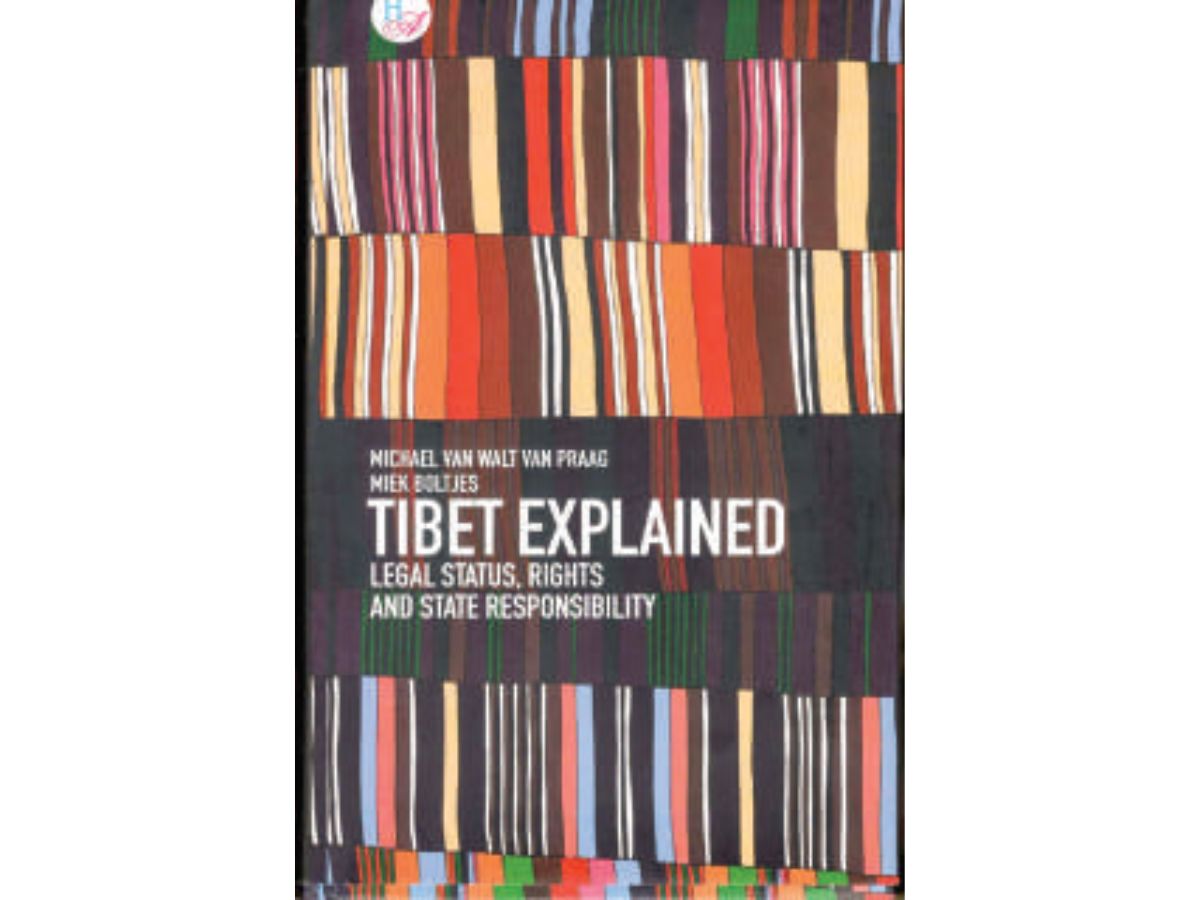
New Delhi: A book comes up as a logical and convincing answer to the Chinese about their colonial occupation of Tibet, East Turkistan and South Mongolia. Since China has acquired new economic, military and diplomatic muscles it has started imposing these claims and narratives on the world community about one of its most touchy core issues viz. its colonial occupation of Tibet, East Turkistan and South Mongolia. China has not only declared every issue related to these countries as its ‘internal matter’ which no government or institution can even discuss openly. It also wants everyone to refer to the Tibetans, Uyghurs and Mongols as ‘ethnic minorities’ of PRC and frowns upon any attempt to term any of them as a ‘country’. This Chinese aggression has now reached the levels that it has started dictating world governments and institutions to refer to Tibet as ‘Xizang’—a clear attempt to wipe out even the idea of ‘Tibet’ from international community’s mindscape.
In this context an interesting and a forceful book, which is based on almost ten years of research by two dedicated and committed researchers has come as a great relief to those who want to see history and related facts free from the Chinese coloured narratives. This research includes analysis and engagement with Chinese, Mongolian, Tibetan and Manchu historians, experts and non-Chinese historical sources. This book, titled Tibet Explained: Legal status, rights and state responsibility, published by Har-Anand of New Delhi and written jointly by Michael Van Walt Van Praag and Miek Boltjes, is one of the most outstanding works of research on Tibet since it was occupied 74 years ago in 1951. Both of these authors are internationally acknowledged specialists in interstate conflict and international law.
This book, divided into five sections and spread over thirteen chapters, offers meticulously researched and minutely discussed historical facts which challenge and expose every single false narrative of Chinese communist propaganda machine that is focused at claiming ownership of Tibet.
The three chapters of Part-1 deal with PRC’s claim to Tibet, especially China’s narrative that ‘Tibet has always been a part of China’. According to the authors China’s claims over Tibet have serious impact on India’s sovereignty as China claims India’s Arunachal Pradesh and parts of Ladakh purely on the basis of claiming Tibet as a part of China. Chapter three stands out as it logically and graphically exposes present day China’s real historic and legal status vis-à-vis Tibet or other colonies. Through a graphic chart the authors have visually exposed the hollowness of Chinese claims by discussing the historic time line of all dynasties which ruled over China for 1,222 years from 690 AD till 1912 when the modern ‘Republic of China’ was declared and came into existence. In this chapter the authors have exposed present day PRC government’s claims over Tibet, East Turkistan and South Mongolia with clinical precision. It underlines the expansive footprint of the Mongol and Manchu empires who ruled many other countries and region in addition to China. “This makes very clear why the PRC insists on superimposing the label ‘China’ on the Mongol and Manchu empires, as it is only these empires that exercised authority in large regions of Inner Asia, not only the Chinese Ming Empire.”
The authors point out that the present day communist Chinese rulers are laying their claims over Tibet, ‘Xinjiang’ and South Mongolia simply on the logic that since the Mongols and the Manchus ruled over China while the above mentioned regions were also under their influence; hence they belong to China of today.
The book’s focus in Part 2 is on assessment of PRC’s historical claim to Tibet. In five chapters of this section the authors analyse the historic relations of Tibet with the Mongol, Ming and Ching Empires. The authors also discuss modern Tibet between 1912 and 1951 when Tibet functioned as a free and independent country.
In Part 3 the authors have analyzed and demolished the idea that China’s military action against Tibet and the forced signing of the ‘17-Point Agreement’ Dalai Lama’s delegation bestows China’s sovereignty over Tibet. Two chapters on the question of Tibet’s right of self-determination in Part 4 of this book present Michael’s skills as a seasoned jurist. This section argues and proves that since Tibetans qualify to be ‘a people’ hence they have a right to the full exercise of self-determination under the prevailing international laws.
All Chinese governments since occupation of Tibet in 1951 have been resisting similar international demands by claiming that Tibet is an ‘integral part of China’.
The main highlight of this book is its Part 5, which deals with the international community’s policies and approach towards Tibet. Here the authors have reminded the international governments about their obligations under the international law which include asking them ‘not to recognize the PRC’s unlawful seizure and annexation of Tibet’; and to desist from rendering any aid or assistance to PRC government which helps it to maintain its unlawful occupation of Tibet.
But the most significant operative part of this chapter and the book is a list of nine policy recommendations by the authors to world governments, institutions and media to stop using terminology or actions which end up promoting China’s false narratives on Tibet and other Chinese colonies. These points include: desisting from stating that ‘Tibet is a part of PRC’; refrain from stating that they oppose the idea of independence for Tibet; treat China-Tibet conflict as an international matter and not an ‘internal matter of China’; endorse Tibetan people’s right to self-determination; never use terms like ‘national minorities’ for Tibet, Uyghurs and Mongols because it reduces their identity to some minor Chinese ethnic groups whereas they have been independent ‘nations’ in recent history; and reject and contest PRC’s assertion that Tibet is a ‘core interest’ of China.
This book is a mine of authentic information on history of China and its major colonies namely Tibet, East Turkistan and South Mongolia which is going to prove invaluable to all researchers, China experts, diplomats, media persons and activists.




