
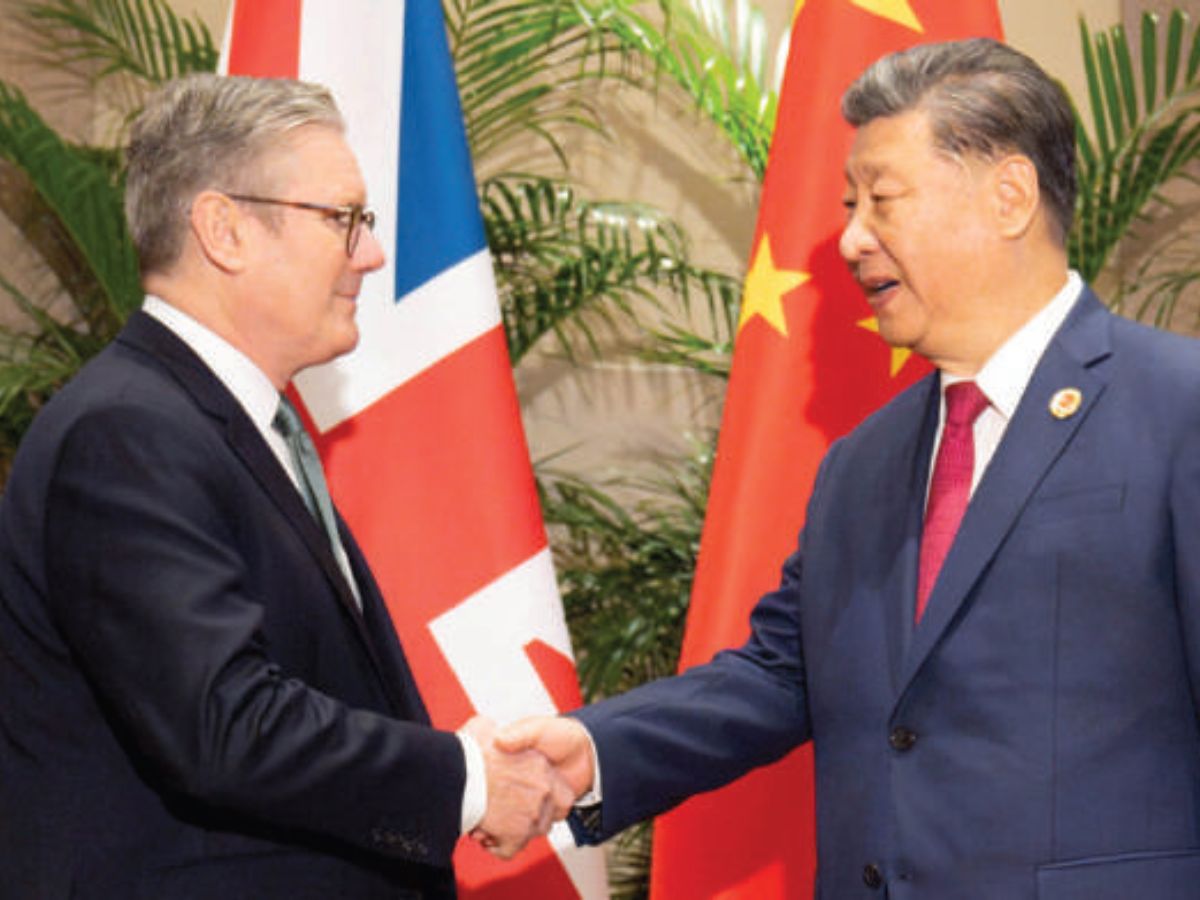
London: China presents a complex and contradictory challenge for the United Kingdom – a true diplomatic and strategic conundrum. As the world’s second-largest economy and a rising global power, China is both a vital economic partner and a formidable geopolitical rival. Navigating this relationship demands from the UK a careful balance between economic pragmatism and national security. This challenge came to a head last month as charges of espionage on behalf of China were dropped against two UK citizens.
In March 2023, Christopher Cash, aged 30, and Christopher Berry, 34, were charged under Section 1 of the Official Secrets Act, of “obtaining, collecting, or communicating information between January 2022 and February 2023, which might be useful to an enemy”, i.e., China. The Act is more than 100 years old and is used rarely – and not all that successfully – to try and catch enemy agents. Both men strongly denied any wrongdoing and the arrests were kept quiet until later that year.
Cash, who studied China and Globalisation at King’s College London before moving into the media world, was described as a former parliamentary researcher, linked to senior lawmakers in the right-wing Conservative Party. Berry, a friend of Cash, had been working in teaching roles around China since around 2015. He was reportedly intercepted returning to Britain with encrypted communications apps used exclusively by Chinese intelligence operatives.
Christopher Cash and Christopher Berry attracted attention because the case against them involved allegations of espionage for China linked to the UK parliament. Cash has been identified as an advisor to the China Research Group, a UK parliamentary group made up of Conservative MPs in Westminster. Its stated purpose is to promote fresh thinking among lawmakers about how Britain should respond to the rise of China – economically, industrially and diplomatically.
Essentially, the CRG sees China both as a challenge and as a country that must be cautiously engaged with. Because of this, the CRG tends to adopt a more scrutinising, sometimes hawkish stance on issues such as trade, industrial policy, state subsidies, national security, technology, foreign policy, human rights and foreign-influence operations. Inside information on the CRG’s policies and activities would therefore be extremely helpful to Beijing.
The case against Case and Berry hinged on the interpretation of the 1911 Official Secrets Act, which required the recipient state, in this case China, be considered an “enemy” or threat at the time of the alleged exchange. The collapse has drawn criticism of the British Government’s perceived reluctance to label China a security threat, the result of it’s balancing act between national security, economic ties to China, and global diplomacy. This is the crux of Britain’s China conundrum.
On one hand, China is an essential trading partner. UK businesses benefit from Chinese investment, and sectors like education and manufacturing are closely tied to Chinese markets. Chinese students make up a large proportion of international enrolments at British universities, contributing £2.3 billion a year in tuition fees without which many of Britain’s universities would go bust, while companies across the UK rely on Chinese supply chains. Yet this economic interdependence is counterbalanced by growing concerns over national security and human rights. Issues such as the erosion of freedoms in Hong Kong, alleged abuses in Xinjiang, and aggressive posturing towards Taiwan have drawn strong criticism from British politicians and the public.
The UK government has also become increasingly wary of Chinese influence in critical infrastructure, as seen in the reversal of its decision to allow Huawei access to the 5G network. Moreover, in a post-Brexit world, the UK is seeking to redefine its global role. Aligning more closely with allies like the US, Australia, and Japan through initiatives such as AUKUS, the UK is increasingly positioning itself within the Indo-Pacific region, a move partly driven by the need to counterbalance China’s growing influence. Internally, British politics reflects this divide: some push for a more assertive stance on China, while others urge continued engagement to protect economic interests. This tension underscores the broader dilemma – how to engage with a country that is simultaneously a partner, competitor, and strategic threat.
There is little doubt among lawmakers in Britain that China represents a strategic threat. For example, back in 2022 Britain’s security service, MI5, issued a rare public interference alert warning about a UK-based solicitor, Christine Lee, alleging that she was working on behalf of the Chinese Communist Party in funnelling large donations to UK politicians to influence policy in favour of Beijing. MI5’s Director General Ken McCallum has repeatedly warned that Chinese espionage is the most game-changing threat to UK national security, pointing to the fact that more than 20,000 people in the UK have been targeted online by Chinese operatives for recruitment or influence campaigns in the past few years. UK universities have been flagged for unknowingly collaborating with Chinese institutions linked to the military, and a number of reports issued by MI5 have highlighted many joint research programmes that potentially benefit Chinese defence projects, where students or researchers affiliated with the People’s Liberation Army gain access to sensitive technologies.
Perhaps the most memorable alleged breach of national security occurred in 2016 when a Chinese consortium called Elegant Jubilee purchased for about £2.4 billion a 49 percent stake in Global Switch, a data centre company which some claim is used by the UK government. While there is no publicly verified evidence that any government information was compromised, many believe that extremely sensitive data was transferred between departments using Global Switch which might have enabled Beijing to steal a goldmine of secret information. It has also been reported that China hacked the UK Foreign Office through an outdated computer system.
Another burning issue between London and Beijing involves the application by the Chinese government for a new “super-embassy” in London. The new one will be considerably larger than the current embassy, with numerous offices, residential quarters, as well as visa and cultural services. Beijing purchased the ancient site of the Royal Mint close to the Tower of London for £255 million in 2018, and has been trying to obtain planning consent for the construction of the huge new embassy building ever since. A final decision by the Government was due to be taken last week, but it has now been delayed yet again until December. Because of its location, close to key communication infrastructure, such as fibre-optic cables, data centres and telecommunication exchanges, there’s concern that as the Embassy will have a number of underground rooms and tunnels, these could give access to spy on, or even tap these lines. Suspicion was fuelled by the “greying out” of the lower floors on the architectural plans supporting the planning submission. The application was initially turned down by the local planning authority, but it has now risen to government and even Prime Ministerial level. Some critics insist that allowing such a large embassy will give China a symbolic and practical boost, possibly normalising a more aggressive posture; others say that turning down the project could cause diplomatic and trade friction with Beijing.
In some ways, the “super-embassy” is a cameo of the current debate about China in Britain. Some push for a more assertive stance on China safeguarding national security, while others urge continued engagement to protect economic interests. This tension underscores the broader dilemma and conundrum – how to engage with a country that is simultaneously a partner, competitor, and strategic threat. The challenge lies in maintaining constructive dialogue and economic ties, without compromising national security or fundamental values. Striking this balance will be one of Britain’s most testing foreign policy tasks in the coming decade.
-
John Dobson is a former British diplomat, who also worked in UK Prime Minister John Major’s office between 1995 and 1998. He is currently a visiting fellow at the University of Plymouth.




