
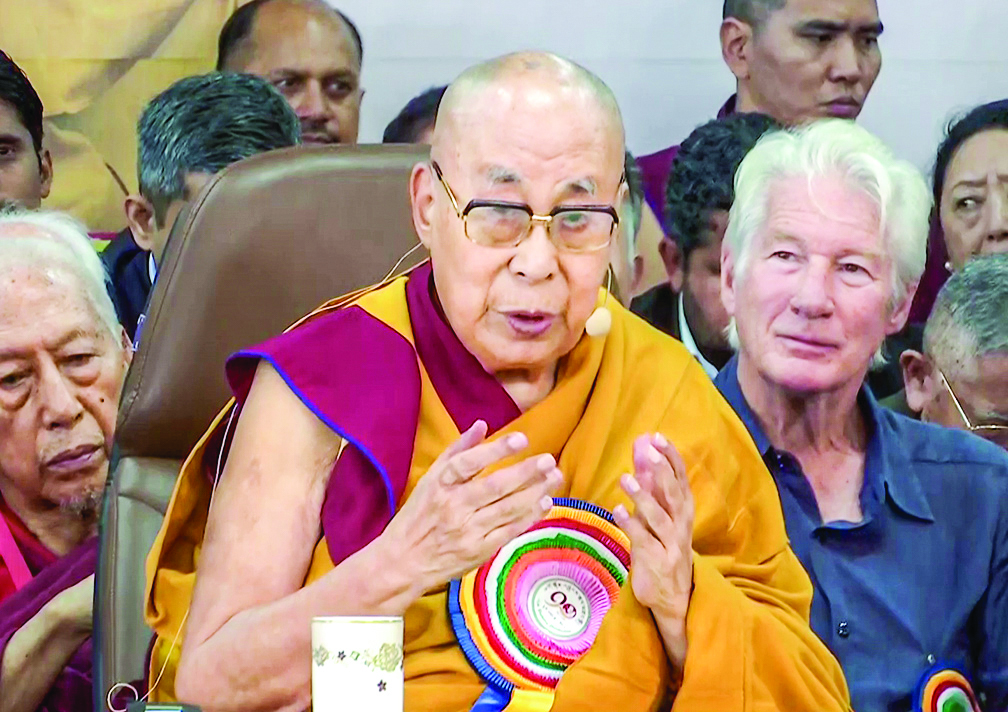
NEW DELHI: In Buddhism, specifically, in the Tibetan Buddhist community, it is un-Buddhist of or a negative conceptual thought (Namtok) to speak of the demise of a Lama even before his passing. In this regard, to speak of the reincarnation of the 14th Dalai Lama is an “unholy” deed for many Tibetans who believe the topic is uncalled for, and perceive others who speak of it as unnecessarily meandering on a sacred Buddhist practice that’s personal and exclusive. Yet the reincarnation of the 14th Dalai Lama has become a geopolitical coil, waiting to be manipulated by nation-states.
The Chinese party-state, in particular, is many steps ahead in its preparation, measures to control, selection process of the next Dalai Lama and build a pro-Beijing international narrative around the issue of the 14th Dalai Lama’s reincarnation. In April, China invited more than 20 monks and religious affairs officials from Buddhist countries including Nepal, Mongolia, Cambodia, Vietnam, Thailand and Sri Lanka to monasteries, research institutes, universities and exhibitions in Lhasa and Beijing. The purpose of inviting this delegation was apparently to strengthen these Buddhist delegates’ understanding of the concept of incarnation, a topic most potentially more familiar to these Buddhists than the self-proclaimed atheist Chinese-party state itself, who had on multiple occasions called the reincarnation of the 13th Dalai Lama, Tenzin Gyatso by various disparaging terms including “wolf in a sheep clothing”, “separatist.”
Since the 18th Party Congress, the China Buddhist Association, under the guidance of the United Front Work Department (UFWD), convened three World Buddhist Forums in October 2015, April 2018, and October 2024 respectively in Jiangsu, Fujian and Zhejiang province of China. The sixth World Buddhist Forum held from October 15-17, 2024 claimed to have 800 participants from 72 countries. At the inaugural ceremony, Wang Huning, Politburo Standing Committee member and Chairman of the Chinese People’s Political Consultative Conference (CPPCC), iterated the Chinese government’s support for the China Buddhist Association’s engagement in global religious and cultural exchanges, essentially implying the UFWD’s non-coercive and coveted project of building China’s soft power diplomacy, globally and Buddhism as one of the means to it. Wang Junzheng, the Tibet Autonomous Region (TAR) Party Secretary made a visit to Nepal, Sri Lanka and Singapore in November 2023 while in the same month, his colleague, Yan Jinhai, Chairman of TAR People’s Government made similar trips to Thailand, Myanmar and Maldives. The following year from September 22-28, 2024, Wang Junzheng visited Mongolia and South Korea. These rare international visits by officials of China-occupied Tibet, are potentially aimed at building up foundations of support for China’s selection and recognition of the reincarnation of the 14th Dalai Lama in the future.
In addition to these external diplomatic manoeuvres, China, in recent decades, has been laying the groundwork internally for the process of selecting and recognizing a successor to the 14th Dalai Lama, including passing regulations and measures, holding secret meetings of key religious affair officials, building profile of the China-appointed Panchen Lama and increased the role of the UFWD in Tibet, especially in its oversight of the Tibetan monastic institutions, including monks and nuns.
One of the earliest and more elaborate legal measures that China passed and implemented with regard to reincarnations in general and of the 14th Dalai Lama in particular is Order No.5. China’s Bureau of the State Administration of Religious Affairs adopted the ‘Measures for the Administration of the Reincarnation of the Living Buddhas in Tibetan Buddhism’ or Order No. 5 which laid out the hierarchy of approval procedures required for the official recognition of a reincarnated lama/tulku. The process (bottom up) begins with an application by the Monastic Management Committee of the concerned monastery where the reincarnated lama/tulku belongs to, followed by review and approval of the Religious Affairs Department of the local county’s People’s Government, and then by the provincial or TAR People’s Government.
Furthermore, Article 9 of Order No.5 requires additional layers of approval of the reincarnation depending on their influence level as indicated in “Figure 1” with this article. The article stipulates that the reincarnation of a “particularly significant influence” among followers must require approval of the State Council of the People’s Republic of China. This is evident that by “particularly significant influence”, Order No.5 implicitly refers to the 14th Dalai Lama given his vast religious, cultural and political influence both within Tibet and internationally, indicating China’s preparation for the 14th Dalai Lama’s reincarnation since 2007.
According to Tibetologist Robert Barnett, in January 2021, the Chinese-party state convened a secret meeting of 25 Chinese government officials and formed a Committee, committed for the selection of the 14th Dalai Lama’s reincarnation. The Chinese-government is also making greater efforts to raise the profile of Gyaltsen Norbu. On June 6, the top echelons of the CCP including Xi Jinping, Wang Huning, Cai Qi, member of the Standing Committee of the Political Bureau of the CCP Central Committee and Director of the General Office of the CCP Central Committee, Li Ganjie, member of the Political Bureau of the CCP Central Committee and Minister of the United Front Work Department, met Gyaltsen Norbu, the China-appointed Panchen Lama in Zhongnanhai in Beijing. Xi Jinping urged him to contribute more significantly to promoting ethnic unity, religious harmony, and the stability in Tibet. From the meetings of the CCP leaders with Gyaltsen Norbu, it is evident that the China-appointed Panchen Lama, who had since 1996, has not been able to gain and garner the spiritual legitimacy among the Tibetan public. The CCP authorities have been orchestrating yearly visits for him to Tibet, more so, since 2017 onwards, and strategically highlights his activities in the media. The increasing visibility and public exposure of Gyaltsen Norbu, over the last several years, implies China’s long-term religious and political plan to gain legitimacy for their recognition of reincarnations and religious practices. However, there is a caveat here, though, in that, despite being appointed as the reincarnation of the 10th Panchen Lama, Choekyi Gyaltsen, the Chinese party-state appears to maintain a degree of mistrust toward Gyaltsen Norbu. This is evident from his meetings with the same officials of the CCP during which he has been repeatedly urged to further strengthen his political convictions and to remain ideologically aligned with the CCP Central Committee with Xi Jinping at the core.
Similarly, officials of the United Front Work Department (UFWD, brainchild of Mao Zedong, and now heavily used by Xi Jinping as a “magic wand”, regularly inspect monastic institutions and appear to be confronting a dilemma of both appeasement and indoctrination with “socialism with Chinese characteristics” among the monastic community. On the one hand, during the inspections, officials tell the monks and nuns to carry forward the tradition of practising Buddhism, while on the other hand, tell them to abandon core spiritual beliefs such as rebirth and afterlife. This ambiguity also stems from the fact that monastic institutions historically have held a strong un-imposed legitimacy among the broader Tibetan population, and also, monks and nuns have been at the forefront of resistance against the CCP in the major uprisings in 1959, 1987-88 and 2008. Out of the 155 Tibetans self-immolated against China’s rule, a significant number of them were monks and nuns. The Chinese party-state, therefore, gauges the monastic community with dual potential as an “agent” of state-objectives, and a strong force to be reckoned with for mobilization and resistance. In this regard, the effort to Sinicize Tibetan Buddhism, impose increased surveillance and inspections in monasteries across Tibet have intensified over the years.
While China’s State Council has already been given the responsibility to select and approve the succession of the 14th Dalai Lama and therefore, putting efforts to build a pro-Beijing narrative internationally, should the 14th Dalai Lama pass away in exile, it could potentially attract massive social and political unrest for the CCP, particularly by the Tibetans in occupied Tibet. Politically, the angst and vengeance from within (possibly may lead to physical resistance as well) against the CCP will exponentially increase, the legitimacy building project China has been pursuing through different colonial mechanisms will grow thin and begin to fracture. Socially, a repeat scenario similar to 1959, where many Tibetans reportedly jumped into rivers, or took their lives after learning that the CCP had forced their leader into exile, as documented in documentary films and oral histories, could most likely occur again. This time, however, the reason of their frustration and desperation would be that the CCP caused their Lama and leader to pass away in exile, far away from their homeland.




