Notwithstanding the thaw in India-China relations, it will be naïve to overlook the fact that the contention at the LAC will persist and China will keep bolstering Pakistan’s military preparedness against India.
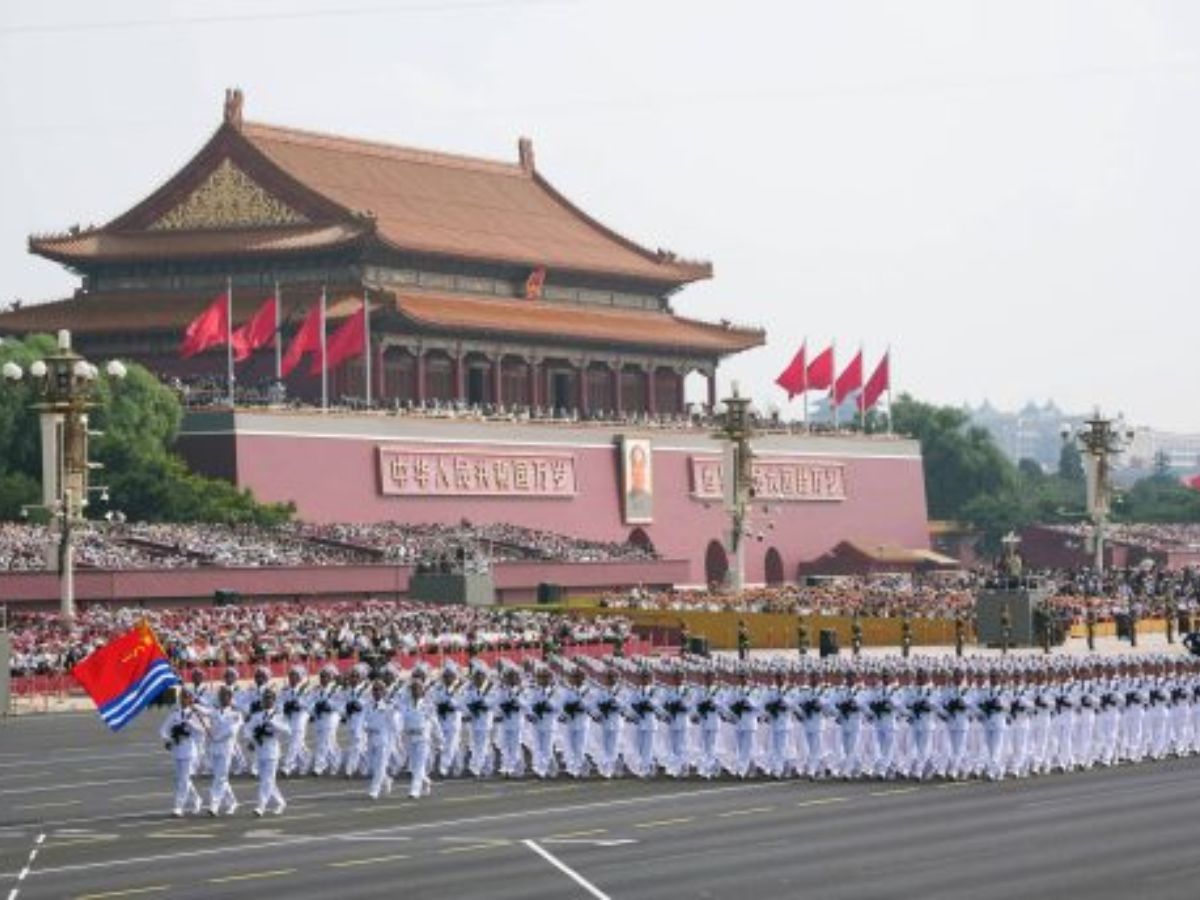
New Delhi: Mao Zedong’s quote, “Political power grows out of the barrel of a gun” was reverberating on September 3, 2025, at Tiananmen Square. Hypersonic missiles rolled past jubilant crowds, drones whirred overhead, and thousands of goose-stepping soldiers marched with clockwork precision. Xi Jinping, dressed in a military tunic, proclaimed: “The Chinese nation is a great nation that is not afraid of violence.” It was both optics and warning, aimed at domestic and international audiences.
For India, the military juggernaut’s display merits deep examination and immediate attention.
THE OPTICS AND MESSAGING
China’s military parades are not mere rituals of pride; they are occasions of strategic communication. Mao’s 1949 proclamation that “the Chinese people have stood up” was once about revolution. Xi’s 2025 vision focuses on rejuvenation as part of China’s aspiration to achieve superpower status by 2049. Notably, the guest list included 27 heads of state/government: Vladimir Putin, Kim Jong Un, and Iran’s President stood shoulder to shoulder with Xi, signalling a coalition of states, or in Uncle Sam’s parlance, the Axis of Turbulence, contesting Western primacy.
The absence of Western and some Asian leaders, including Prime Minister Narendra Modi, highlighted the divided geopolitical stage. Even across the Atlantic, the spectacle drew attention. Donald Trump, with his ever-restless fingers on his cell phone, posted on Truth Social: “Please give my warmest regards to Vladimir Putin and Kim Jong Un, as you conspire against the United States of America.” His sarcasm only underscored how the parade played out in America’s consciousness.
The timing of the spectacle was deliberate, coinciding with the largest SCO meeting held since its inception. It comes as Xi’s 2027 deadline approaches for the PLA to be ready for Taiwan contingencies. At home, the purging of senior Rocket Force officers and CMC has raised doubts about internal stability; the parade sought to reassure domestic audiences that discipline has not dulled capability. Abroad, the message was deterrence and power projection: China will not be caught unprepared for the wars of tomorrow.
KILL CHAIN PHILOSOPHY DISPLAY
Beyond the choreography, four themes stood out.
First, the PLA’s embrace of multi-domain operations, linking land, sea, air, cyber, and space into one battlespace. The parade witnessed significant participation of contingents of the PLA’s Space Force, Cyber Force, Information Support Force, and Logistics Support Force. Electronic warfare vehicles and AI-enabled command platforms were showcased to demonstrate how China aims to paralyse enemy networks and sustain its own decision-making in conflict.
Second, the prominence of drones and counter-drone systems underlined lessons Beijing has drawn from Ukraine. The FH-97 stealth combat drone, paired with directed-energy weapons and microwave defences, suggested that China foresees swarming, autonomous warfare where machine speed could outpace human reaction.
Third, the parade displayed ground-based air-defence and antiballistic missile systems such as the HQ-20, HQ-19, and HQ-29 that form part of a “multi-layer air and missile defence network.”
Fourth, China’s nuclear “nuclear triad”—including the JL-3 SLBM, the DF-16 ICBM and the new DF-5C with more than 20,000 km range.
IMPLICATIONS FOR INDIA
For India, the takeaway is glaring. The asymmetry in capability is widening. Beijing’s advances, inter alia, in drones, hypersonic technology, electronic and cyber warfare, space technology, and influence operations outpace India’s incremental modernisation.
Yet the answer is not to replicate China’s arsenal system for system. The Indian Armed Forces’ “Ran Samvad” seminar held in Mhow highlighted that future wars will be multi-domain, hybrid, and prosecuted across the spectrum of conflict with compressed operation cycles up the escalation ladder. It stressed that India must prepare not only through platforms but through agility, integration, and innovation. One key message was the need for a whole-of-nation approach: India’s thriving digital economy, start-ups, and universities should become active partners in defence preparedness. Instead of waiting for long procurement cycles, adaptive technologies—particularly in drones, counter-drone systems, and battlefield surveillance—must be tested and iterated with soldier feedback. The seminar also underscored civil-military fusion: harnessing India’s coding talent, AI expertise, and private industry to strengthen the armed forces from within.
Another emphasis at Mhow was jointness. India’s services must operate as a seamless future-ready joint force, integrating cyber, space, electronic and cognitive warfare alongside traditional land, sea, and air power. “Ran Samvad” also recognised the need to build enduring partnerships with like-minded countries for building diplomatic clout and external balancing. The added but unstated need is to sharpen credible nuclear deterrence, strengthened by sea-based assets, for assured massive second strike capability.
Above all, there must be an accelerated push for theaterisation while heeding the core competencies of each Service. Reservations towards the creation of theatre commands must be addressed through professional dialogue with a strong nudge from the National Command Authority.
CONCLUSION
China’s Victory Day parade was a spectacle designed to project confidence, unity, and technological maturity. Xi recently warned adversaries that those who challenge China will “have their heads bashed against the Great Wall of steel forged by 1.4 billion people.” Notwithstanding a thaw in India-China relations, it will be naïve to overlook the fact that the contention at the LAC will persist and China will keep bolstering Pakistan’s military preparedness against India.
By consolidating the rich operational experience of its armed forces, embracing joint reforms and nurturing strategic partnerships, New Delhi can ensure that Beijing’s theatre of strength does not dictate the script of Asia’s future. The choice before India is clear: to be a cautious spectator, or to become a decisive shaper of the emerging order. Therefore, for India, the challenge is not to be intimidated by this rhetoric, but to ensure that its own deterrence and war-fighting capabilities are credible to safeguard its legitimate national interests.
The author is the Director General of the United Service Institution (USI) of India, established in 1870. He can be reached at balka5459@gmail.com
