
The rice shoots slept in the mud. The farmer, seeking rapid growth, pulled them upward, one by one. “I have taught them to grow,” he said. At sunrise, the meadow lay barren and pale. To lift the stem is not to rise, roots must embrace the earth below. (Zen Parable)
In Dhaka’s acrid haze—the lingering residue of torched newsrooms like Prothom Alo and The Daily Star—the world stumbles over its own shock. Smoke still stings foreign eyes, yet global powers had long celebrated this turmoil as democracy’s triumphant dawn. They missed the threads unraveling beneath their gaze: not liberation, but collapse. What emerged after Sharif Osman Hadi’s assassination was no democratic dawn, but a Frankenstein state stitched from mob fury, Islamist revanchism, and geopolitical puppetry—a warning etched in blood across South Asia that reverberates through every corner of our fractured world.
The catastrophe did not ignite with Hadi’s death on December 18, 2025. It began months earlier when student protests against discriminatory civil service quotas erupted into a leaderless uprising. Western observers, intoxicated by the “Gen Z revolution” narrative, projected liberal ideals onto a movement devoid of democratic scaffolding. They ignored Hasina’s warnings of foreign-backed regime change—not as dictatorship paranoia, but as prescience. When the military abandoned her on August 5, 2024, exchanging bullets for ballots, the world cheered conscience. In truth, generals orchestrated a surgical coup: sacrificing Hasina to install Muhammad Yunus while retaining absolute control through shadowy intelligence networks and strategic resource allocation. The West embraced this charade, mistaking military-manipulated “transparency” for progress, blinded by relief at avoiding another Myanmar-style pariah state.
Yunus’ interim government had no mandate beyond army benediction—a fatal vulnerability exploited from day one. Within weeks, it mirrored Iraq’s catastrophic post-2003 debaathification purges: banning the Awami League and its student wing decapitated state machinery overnight. Police stations stood empty as officers vanished into detention centers; within four months, 637 documented mob lynchings surged—a 1,250% spike—as law evaporated entirely. Communities, abandoned by a hollowed-out state, turned to vigilantism with terrifying efficiency. This was not chaos but design: the military needed social fragmentation to justify permanent intervention, creating what scholars now term “structured anarchy.”
Into this void flooded anti-India propaganda masterminded by Jamaat-e-Islami and Pakistan’s deep state, which had spent decades cultivating networks within Bangladesh’s religious schools. They recast the revolution as a “Second Independence”—rejecting 1971’s secular liberation war as Indian subservience—and weaponized social media with sophisticated disinformation campaigns originating from servers in Karachi and beyond.
International complicity deepened the wound catastrophically. The IMF fast-tracked $4.7 billion in emergency aid despite GDP plummeting to 3.7% and foreign reserves halving within six months. Garment factories—employing 4 million women, mostly from Hindu communities—collapsed entirely, yet World Bank reports praised “macroeconomic stability” while ignoring the humanitarian freefall. Human rights abuses were systematically reframed as “transient transitional friction,” exposing democracy’s brutal bargain: geopolitical convenience consistently trumps moral clarity. Meanwhile, attacks on minorities escalated with chilling precision. 2,442 documented assaults targeted Hindus, Buddhists, and Christians—temple desecrations using ritualistic symbols, forced conversions under threat of death, systematic seizure of ancestral lands—all framed as purging Indian proxies through carefully staged social media videos that went viral globally before being debunked.
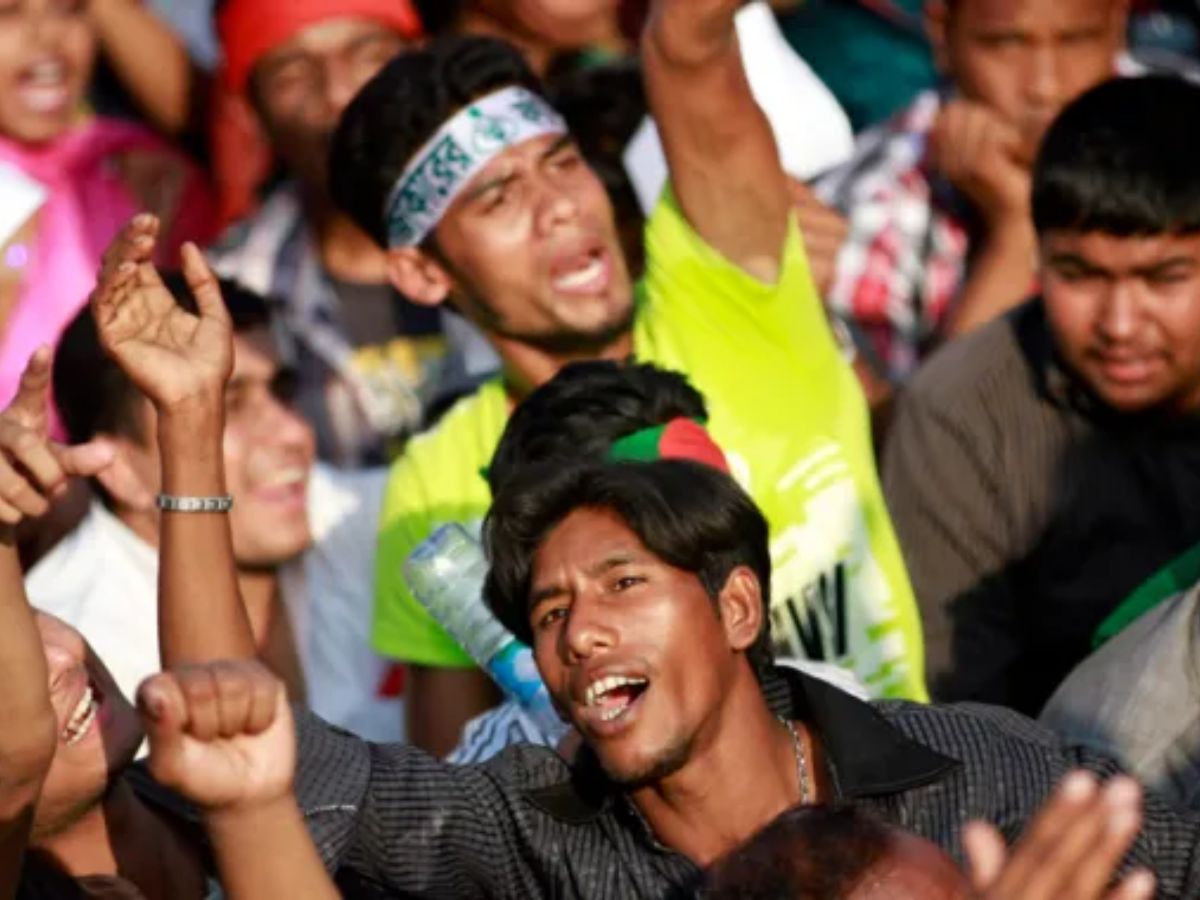
Hadi’s murder became the regime’s crucible. His assassination was instantly recast by radical elements as an “Indian conspiracy,” a narrative that ignited mobs to assault Chattogram’s Indian Assistant High Commission and set ablaze the offices of media outlets deemed insufficiently aligned with their cause. This was not protest; it was orthodoxy enforced through spectacle violence, fueled by a narrative branding secular institutions as “agents of India”. The symbolism of destroying newspaper archives was a deliberate attempt to erase the chronicles of Bangladesh’s pluralistic history.
As the February 12, 2026, election approaches, the hijacking of the revolution is nearing completion. The interim Election Commission’s decision to compress the campaign into a mere 40 days is a political death sentence for the fragmented student movements, which lack organizational depth. Conversely, it is a strategic gift to well-organized Islamist parties like Jamaat-e-Islami, whose intact grassroots networks are now poised to capitalize on the chaos. What began as a demand for quota reform now risks birthing a state where the democratic process is used as camouflage for a fundamentally illiberal agenda.
The tragedy lies in how easily revolutionaries surrender their ideals. Student leaders who toppled Hasina watched helplessly as their movement birthed monsters they’d once opposed. The military’s genius was letting mobs do its dirty work while posing as moderates—a blueprint now studied from Myanmar to Mali by autocrats learning to weaponize “leaderless resistance.” International actors compound the sin: celebrating “stability” while enabling ethnic cleansing-lite through aid and silence. When Yunus’ commission fast-tracks constitutional changes enshrining Islam’s primacy and stripping citizenship rights from 1.3 million stateless Rohingya refugees, Washington looks away—preferring a compliant theocracy to Chinese influence. This isn’t oversight; it’s moral abdication disguised as realpolitik.
Consider the deeper rot: Western democracy promotion programs measure success through electoral rituals while ignoring whether societies can sustain pluralism. They fund voter education but neglect local governance, leaving voids where warlords and militants thrive. When the U.S. State Department calls Bangladesh “a partner in resilience” amid rising persecution, it validates tyranny through semantic sleight-of-hand. True democracy requires nurturing institutions before toppling dictators—not assuming ballots alone can conjure civic culture from ashes. Meanwhile, China exploits this vacuum with infrastructure deals that trade debt for strategic ports, while India struggles between principled noninterference and desperate containment of jihadi spillover into Assam.
Most damning is how Bangladesh exposes democracy promotion’s fatal vanity across the Global South. From Tunisia to Thailand, movements collapse when external actors prioritize quick wins over sustainable foundations. This failure was purchased at a high price. Between 2020 and 2024, international donors poured nearly $70 million into democracy and governance programs in Bangladesh. Yet, these funds largely flowed to elite NGOs producing glossy policy papers in Dhaka, neglecting the gritty, grassroots interfaith coalitions needed to counter Islamist narratives. When the military banned the Awami League in October 2025, there was no civic buffer to prevent the slide into anarchy—only a vacuum.
The path forward demands painful honesty rarely seen in diplomatic circles. Sanctions must target military assets—not just officials—but this requires unprecedented intelligence sharing that nations like Pakistan won’t permit. Aid should flow only through UN channels with human rights monitors embedded in police precincts and courts, though even this faces sovereignty objections from ASEAN states watching Vietnam’s similar descent.
Crucially, the West must abandon its Manichean worldview: seeing every uprising as either “pro-democracy” or “authoritarian.” Bangladesh’s tragedy stems from refusing nuance—viewing Hasina solely as a dictator while ignoring how her removal empowered forces that would burn the nation to erase her legacy.
As Dhaka’s smoke clears, two futures loom with terrifying clarity. One path leads to February 12: elections skewed by military advantage and Islamist mobilization, cementing a hybrid state where mobs enforce religious conformity under democratic veneer while generals control telecommunications and currency reserves. The other requires acknowledging that democracy cannot be airlifted—it must grow from soil tilled by locals, not foreign consultants. For now, the guns are silent but the killing continues: through economic strangulation in garment districts, cultural erasure of Hindu festivals, and whispered terror in university corridors where students once debated Plato.
The fire consuming Dhaka’s newspapers isn’t random vandalism. It’s the deliberate torching of truth itself—the final act in a revolution hijacked not by villains, but by our collective willingness to believe comforting lies. Until we confront this complicity—admitting that promoting “democracy” without building civic infrastructure is cultural imperialism—we will keep lighting funeral pyres for democratic dreams worldwide. As the ashes settle over Bangladesh, they form letters only we can read: a warning written in smoke and blood for every nation where idealism meets institutional fragility.
Brijesh Singh is a senior IPS officer and an author (@ brijeshbsingh on X). His latest book on ancient India, “The Cloud Chariot” (Penguin) is out on stands. Views are personal.




