Militaries worldwide draw on their own history, mythology and geography when naming units and campaigns. What matters is not whether a name has mythological or cultural roots, but whether it is coupled with discriminatory treatment of personnel.
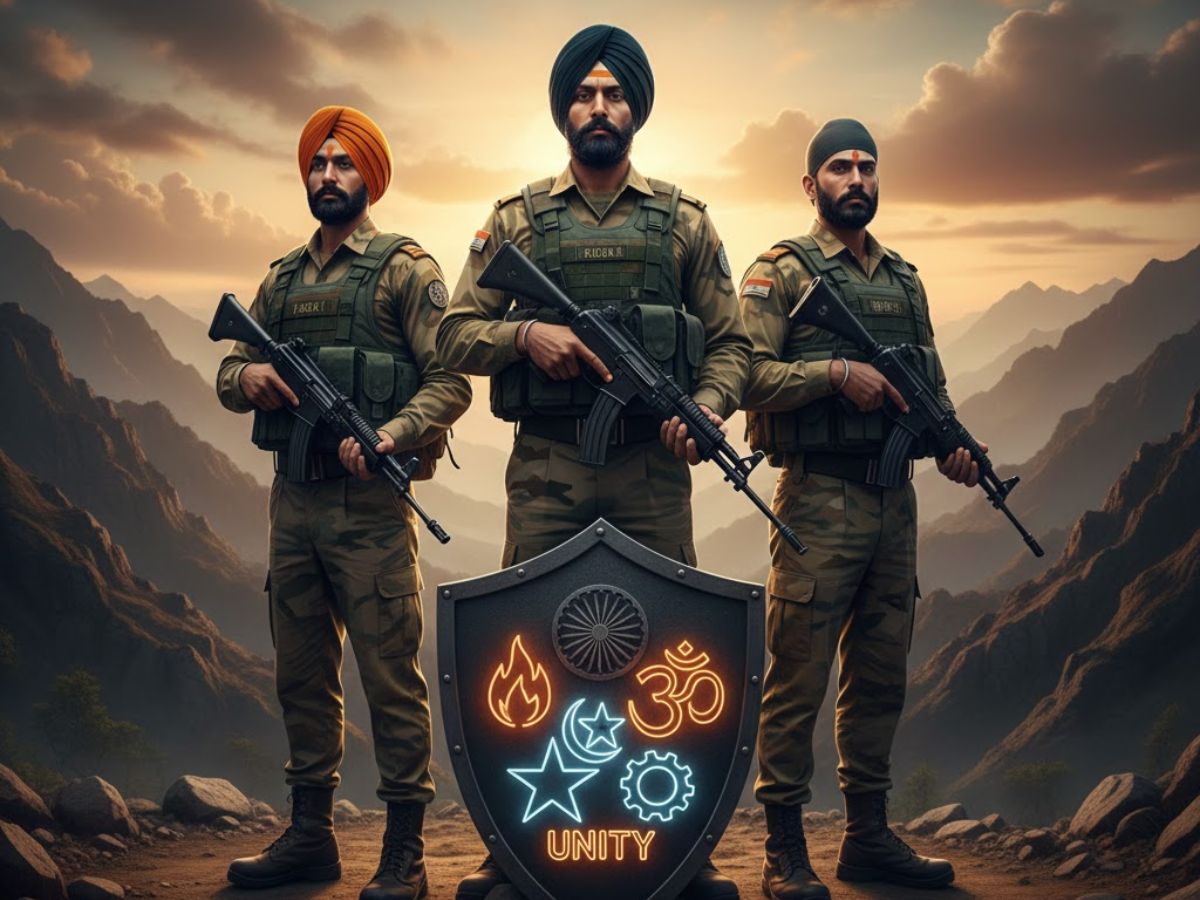
Discipline, Faith and Unity: Why the Indian Military is Secular
New Delhi: A malicious perception is being created that India’s armed forces are drifting towards majoritarian religious dominance and that the handling of Lieutenant Samuel Kamalesan’s case exposes a basic institutional fault line. A closer reading of the law, military practice and judicial reasoning suggests otherwise. The facts do not sustain the charge of systematic communal bias; rather, the criticism rests on selective readings of evidence and a misunderstanding of how secularism operates within a disciplined, multi-faith force.
DISCIPLINE, RELIGIOUS FREEDOM AND THE ARMED FORCES
Constitutionally, military personnel do not stand in the same position as civilians. The Constitution permits Parliament to restrict certain fundamental rights of members of the armed forces, police and intelligence agencies in the interests of discipline, public order and national security. Courts have repeatedly upheld this distinction, recognising that a combat organisation requires limits on personal autonomy which would be impermissible in civilian life. This has direct consequences for religious expression. Soldiers and officers retain their faith, but the manner of its outward practice is subject to service regulations and operational needs. Commanders are empowered to curb individual assertions of conscience if these threaten unit cohesion, disrupt routines, or conflict with long-standing regimental traditions that serve a unifying function. Judicial decisions have consistently affirmed that, in a fighting force, unity of command and shared purpose take precedence over maximum accommodation of personal preference. Seen in this light, Lt Kamalesan’s dismissal does not reveal a new “fault line”; it reflects the application of familiar principles. His repeated refusal to obey a lawful order to be present during his troops’ religious parade—even after a compromise allowing him to remain outside the inner sanctum—was treated by the Delhi High Court and the Supreme Court as an issue of discipline, not theology. Acting under Section 19 of the Army Act, 1950 and Rule 14 of the Army Rules, 1954, the authorities and the courts held that his conduct fell within Section 41, which deals with disobedience to a superior officer, and found that such defiance undermined essential military ethos. The Court viewed him as placing his personal interpretation of religion above the demands of command, rendering him unfit to lead. This legal and institutional framework does not permit the Army to impose a particular religion, nor to discriminate in postings and duties on grounds of faith. It does, however, require that officers accept the longstanding maxims that “the religion of the men is the religion of the officer” in the limited sense that they share in the collective religious life of their troops as part of regimental cohesion.
MULTI-FAITH REGIMENTAL PRACTICE VERSUS ‘MAJORITY RELIGION’
Critics argue that the Army increasingly reflects the “majority religion” in its visible symbols and rituals, thereby marginalising minorities. This overlooks the distinctive evolution of religious practice within the regimental system. Units maintain mandirs, gurdwaras, churches and sarvdharma sthals designed not as spaces of proselytisation, but as focal points of shared identity and morale. Personnel of one faith routinely attend or support the observances of another as an act of solidarity. In many infantry and armoured regiments, officers and troops participate together in thanksgiving services, ardas, aarti and special prayers for the unit’s safety and success. The aim is to create a shared sacred space for the regiment as a fighting body. That such spaces often contain Hindu elements reflects demography and history, but these coexist with Sikh, Christian, Muslim and Buddhist practices, as well as separate arrangements for individual worship.
The concept of “Sarv Dharm Sambhav” is built into this architecture. Sarva Dharma Sthals typically accommodate a cross, a mihrab or prayer space, a place for the Guru Granth Sahib, and Hindu symbols within a single precinct. The Jammu and Kashmir Light Infantry’s early adoption of the mandir-masjid-gurdwara (and later gompa) complex in 1948, later generalised across the Army, is emblematic of this institutionalised multi-faith design. Similarly, the Ladakh Scouts’ war cry, “Ki Ki So So Lhargyalo”, rooted in local Buddhist tradition yet used as a unifying regimental call, illustrates how the Army draws on regional religious culture to strengthen cohesion among troops who are themselves religiously diverse. These are not signs of a majoritarian takeover, but examples of how Indian units have historically used religious and cultural symbols to bind very different communities into a single professional force.
VISIBLE RELIGIOSITY, CIVIL-MILITARY OPTICS AND INSTITUTIONAL BIAS
Another line of criticism focuses on senior officers’ presence at Hindu ceremonies and on the Army’s role in high-profile religious events such as the Ram Mandir ceremony or the Kumbh Mela. These appearances are presented as proof of institutional tilt towards one faith. Here it is important to distinguish optics from policy. The Army has a long-standing constitutional role in Aid to Civil Authority. When civil administrations request assistance for large gatherings—religious or otherwise—the armed forces may provide engineering support, crowd management, communications, medical aid and disaster-response contingents. This has occurred for events associated with different religions, including the Haj pilgrimage and major Christian festivals, as well as secular state occasions. Uniformed presence in such contexts reflects the deployment of specialised capabilities, not endorsement of a particular theology. To read logistical or security support as evidence of partisan religious alignment is to ignore the continuity of this practice across governments and across communities. The crucial test is whether such support is dispensed in a discriminatory manner. There is no credible public evidence that the Army selectively withholds assistance from non-Hindu events when legitimately requested.
‘INDIGENISATION’ OF SYMBOLS AND THE POLITICS OF NAMING
Critics further claim that naming operations, exercises and initiatives after Hindu civilisational references marks a “new normal” of majoritarian politics. This conflates indigenisation with communalisation. Militaries worldwide draw on their own history, mythology and geography when naming units and campaigns. What matters is not whether a name has mythological or cultural roots, but whether it is coupled with discriminatory treatment of personnel. In India, replacing colonial-era nomenclature with indigenous references is part of a broader decolonisation agenda. Ships, ranks, ceremonies and formations have been renamed to reflect Indian history, sometimes drawing on epics or deities, sometimes on geography or abstract concepts. These coexist with older traditions and do not, in themselves, alter recruitment standards, promotion prospects or disciplinary norms for minorities. To describe this process as “purging” foreign norms in favour of an “imagined authenticity” is to mistake a quest for institutional self-confidence for sectarian capture.
SOLDIERS AS ‘SOCIAL WARRIORS’ AND WELFARE SCHEMES
Concerns have also been raised about directions asking soldiers on leave to spread awareness of government welfare schemes, described as turning them into “social warriors” for the ruling party. Yet welfare schemes such as housing, health insurance and pension reforms are, in law, religion-neutral state programmes. The armed forces have a long history of supporting national initiatives—from vaccination drives to infrastructure projects in remote regions—without this being treated as partisan work. The line would be crossed if soldiers were instructed to seek votes for a party or to propagate explicit political slogans. Encouraging awareness of state schemes, in itself, occupies a grey zone that warrants careful monitoring, but it is not automatically equivalent to converting the Army into a political instrument.
INDIAN SECULARISM AND INSTITUTIONAL SAFEGUARDS
The deeper conceptual issue is the model of secularism at stake. India has largely practised a version rooted in ‘sarva dharma sambhava’: equal respect and engagement with all religions, rather than strict separation. The state builds and regulates religious endowments, supports pilgrimages and participates in multi-faith ceremonies while being constitutionally barred from discrimination or coercion. The Army’s religious life reflects this approach: multi-faith worship spaces, celebrations of multiple festivals, and expectations that personnel will stand with each other’s rituals as a mark of comradeship. Against this background, the charge of structural majoritarianism requires evidence of systematic patterns: bias in recruitment, training, promotion, postings, discipline or access to justice linked to religious identity. Publicly available material does not show such a pattern. Minority officers and soldiers continue to hold sensitive and prestigious appointments. Courts and tribunals have, in several cases, granted relief to minority personnel where procedures were flawed or rights infringed. The failure of Lt Kamalesan’s petition, grounded in repeated disobedience of lawful orders, sits within this broader record rather than overturning it.
None of this justifies complacency. A polarised political environment, louder civilisational rhetoric and attempts by external actors to appropriate the armed forces for partisan narratives all pose genuine risks. These must be managed through internal safeguards, professional education and robust civilian oversight. But those safeguards will be better served by evidence-based critique than by sweeping claims that the Army has already succumbed to majoritarian domination. A narrower and more precise conclusion therefore suggests itself. Lt Kamalesan’s case reflects the Indian Army’s long-standing balance between individual conscience and collective discipline in a multi-faith force. The real task is to ensure that this distinctive model of ‘sarva dharma sambhava’ remains genuinely even-handed under changing political pressures. That requires vigilance, constitutional seriousness and honest debate—not the presumption that the institution has already crossed an irreversible line.
The author is Additional Director General of the Centre for Land Warfare Studies (CLAWS).
